
Fight or Flight (Diary of a Wimpy Kid #21)
Greg Heffley’s notes on the school’s bullies get away from him, and his usual way out of trouble starts to look like the trouble.
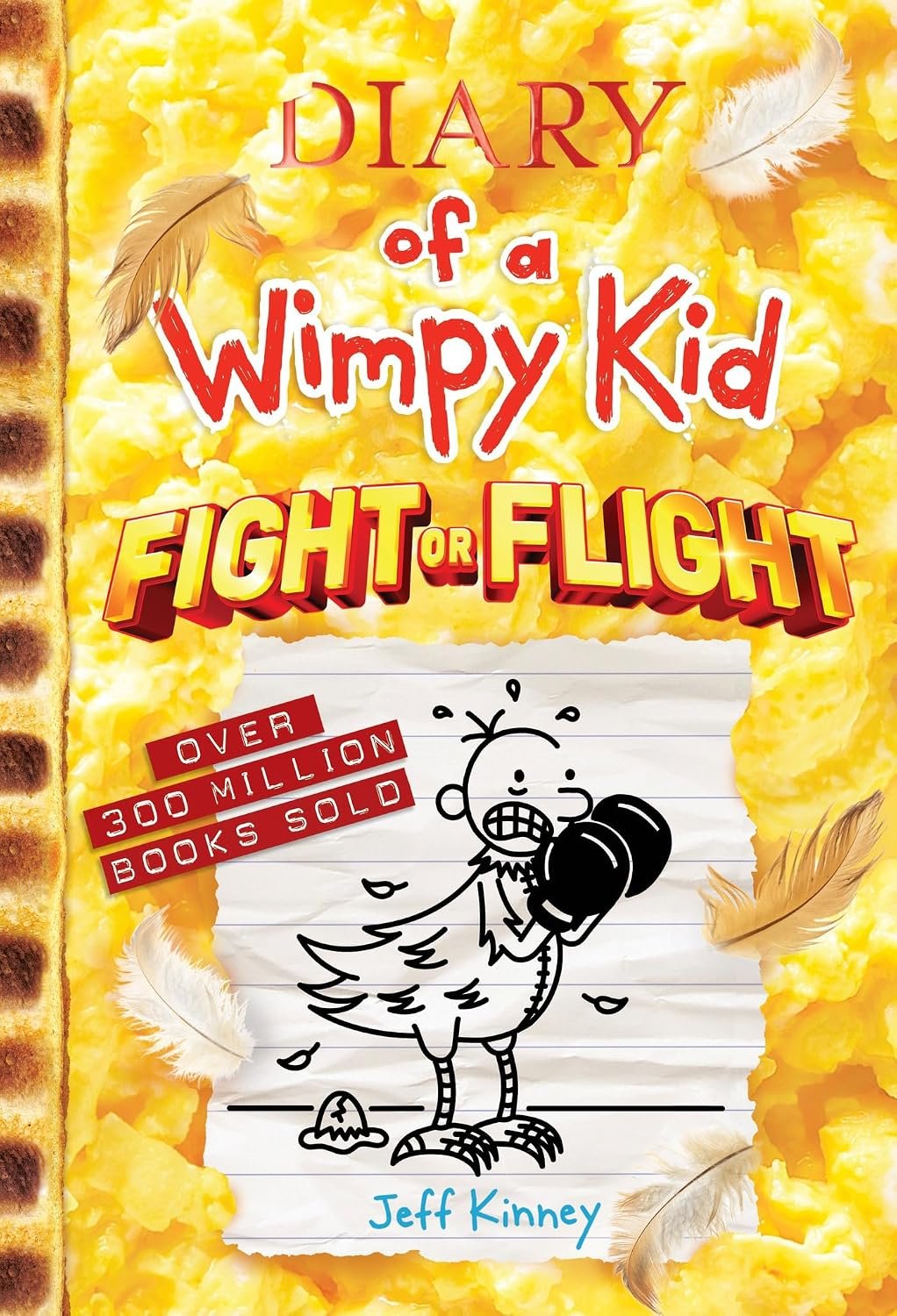
Greg on notebook paper, gloves on, with the title Fight or Flight over a yellow field.
Greg Heffley has spent twenty books explaining, mostly to himself, how a person gets through middle school without becoming the story everyone tells at lunch. Jeff Kinney’s Fight or Flight is the twenty-first diary, and the publisher’s premise puts that expertise under pressure. Greg has been keeping notes on the school’s biggest bullies, and on the small strategies he thinks will keep him out of their way. The binder goes to the wrong hands. After that, the question on the jacket is no longer theoretical. Does he step toward the trouble, or does he try to get out of the room?
The twenty-first diary
A binder, and the trouble it was meant to prevent
The useful fact in the Abrams description is not the boxing language. It is the binder. Greg, who has always treated survival as a private system, has written that system down. Penguin’s edition page calls it a three-ring binder of notes on the biggest bullies, with strategies for outsmarting them. That is a very Greg object. He does not imagine himself winning a fair fight. He imagines a plan that lets him avoid one.
A diary is already a place where a boy writes the version of the day he can stand. A separate binder of bully notes is something else. It is fieldwork. Kinney has built the series on the gap between Greg’s confidence in his own reading of a room and the room’s actual reading of Greg. A file of strategies makes that gap visible. If the notes are smart, they are also evidence. If they are not smart, they are evidence of a different kind.
The publisher does not say who finds the binder, or what the notes actually contain. That is the right amount of premise for a book that has not reached its October 20, 2026 publication date. What the listing does say is that Greg’s world starts to unravel, and that he is in a race before the truth comes out. The title’s other half, flight, is the option he has preferred for years. Fight is the option the plot is daring him to consider.
Readers who know the series will recognize the shape. Greg gets an idea that feels like control. The idea leaves his hands. The rest of the book, if it follows the pattern, will be the cost of having been clever on paper. This feature is not going to guess the cost. The binder is enough to say what kind of story Kinney is promising.
Rowley, the corner, and a friendship that has never been simple
Rowley Jefferson takes karate, so Greg believes he has someone in his corner. Rowley has been that someone since the first diary. He is also the friend Greg underestimates. Karate does not rewrite that history. It gives Greg a new way to misread it.
The humor in a Wimpy Kid book usually lives in that misreading. Greg wants a bodyguard. Rowley, across the series, wants a friend who will show up without keeping score. A karate class is a concrete thing a parent can sign a child up for, and a concrete thing Greg can turn into a strategy. The unexpected twist promised on the jacket is unspecified. It does not need to be named here. The interesting pressure is already visible: Greg’s plan depends on a friend whose loyalty he has never been careful with.
Kinney has also written the Awesome Friendly books from Rowley’s side of the same halls. That matters for this volume even if a reader never opens them. Rowley is not only Greg’s illustration of niceness. He is a character with his own record of the friendship. A book in which Greg needs Rowley’s training is a book about the imbalance the series has been drawing for years, stick figures and all.
None of this requires a blow-by-blow of the school bully. The bully is a function in the premise: the person the notes were about, and the person who must not learn who wrote them. The relationship that can actually change the temperature of the book is the one between the boy with the binder and the boy in the karate class.
What the diary form still does on book twenty-one
Fight or Flight is a hardcover of 224 pages from Amulet Books, an imprint of Abrams, with the ISBN 9781419782701. The publisher lists about 350 black-and-white illustrations and an age range of 8 to 12. Kinney writes and draws the series. The pages are still built as a kid’s journal: lined-paper energy, a caption that undercuts the sentence above it, a face that says the thing Greg will not.
That form is why the series could go this far without becoming a different kind of book. Greg does not grow into a narrator who understands himself. He remains a middle-school boy writing tonight’s version of today. The cartoons are not decoration. They are the second opinion. A reader can watch Greg declare a plan and see, in the drawing, the plan already failing. For a story about notes on bullies, that double voice is the natural instrument.
Fight or Flight is numbered 21, after Partypooper. A new reader does not need the earlier diaries to follow a boy, a binder, and a friend who takes karate. A reader who has them will recognize Greg still taking notes on a building he has never really mastered.
A series that started as a website, and a book that is still ahead of its date
Kinney was born on February 19, 1971, in Fort Washington, Maryland. He studied at the University of Maryland and has said the idea of Greg arrived in 1998, years before a publisher saw it. In 2004 the story ran on Funbrain as a daily online diary. Abrams signed a print deal in 2006, and the first book appeared in 2007. He also created the children’s site Poptropica. With his wife he owns An Unlikely Story, a bookstore in Plainville, Massachusetts.
That timeline is the useful context for a twenty-first volume. The diary was a cartoonist’s project before it was a fixture. Kinney spent years on the voice. The print series kept the voice narrow on purpose. Greg’s family, his brother Rodrick, his friend Rowley, and the ordinary humiliations of school stayed large enough to hold a new premise every year. A binder of bully notes fits that room. It does not ask the world of the books to change. It asks Greg’s usual habit, writing things down, to become the problem.
The publication date on the Abrams and Penguin pages is October 20, 2026. This feature is written before that date, from the publisher descriptions and the series record, not from a reading of the finished book. Nothing here describes a chapter, a winner, or an ending. The premise is enough to say who the book is for: a reader between about 8 and 12 who already likes Greg, or a reader ready to meet him in a story about a plan that escapes.
Fight or Flight belongs on that shelf as book 21, in the same illustrated hand.
More Journal stories are on the Journal, and other book articles are collected in Book Reviews.
About the book.
Amulet Books, an Abrams imprint, lists Fight or Flight as Diary of a Wimpy Kid book 21, a 224-page hardcover with about 350 black-and-white drawings, ISBN 9781419782701, for ages 8 to 12. The stated publication date is October 20, 2026. The premise on the publisher page is Greg’s binder of notes on the school’s bullies, and what happens when those notes leave his hands.
A short note
I like that the trouble starts in a binder. Greg has always believed a private system will keep middle school from getting its hands on him, and Fight or Flight makes that belief into an object someone else can open. The part I would hand someone first is the picture of Rowley in his corner, karate and all, while Greg is still trying to turn a friend into a plan. This is a diary about a boy who would rather outsmart a fight than have one. I have not read the October book, and I am not going to pretend the last page has already happened. What stays with me is the premise itself: the notes were supposed to keep him safe, and the notes are now the risk.
This is a sponsored MarketAnyBook book feature. It is a promotional editorial based on supplied materials and verified public information, not a full-book review. Book links may be sponsored or affiliate links.
Found a book worth opening?
Books worth discovering. Authors worth knowing.
Return to the Journal →