
The American Way of Killing
Gladwell argues the United States does not have a crime problem so much as a violence problem it has chosen.
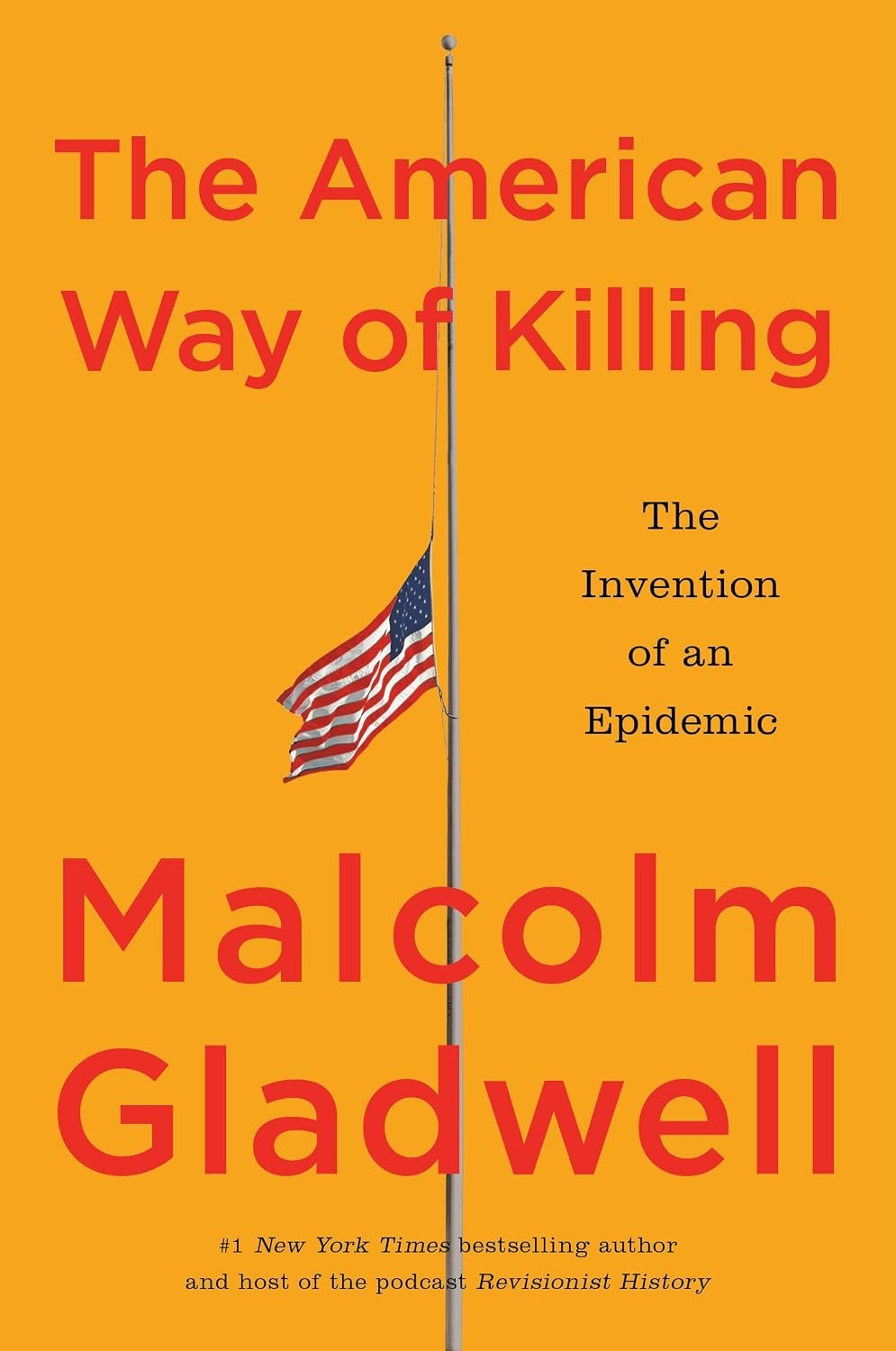
Malcolm Gladwell’s book on American violence and the gun argument.
The American Way of Killing: The Invention of an Epidemic is Malcolm Gladwell’s book about lethal violence in the United States. Little, Brown published the 288-page hardcover on September 29, 2026. The argument, as reported from the book, is that the country does not have a crime problem so much as a violence problem, and that Americans misunderstand their history with guns. The book is divided into three parts: dishonest conversations about guns, misdiagnoses of the violence problem, and the moral absurdities that follow.
A violence problem, not a crime problem
The claim the book is willing to make
Gladwell’s reported thesis is blunt. Americans, he argues, have convinced themselves they are over-policed when the opposite is true, and they have misunderstood the nature of lethal violence. The subtitle, The Invention of an Epidemic, treats the current pattern as something made, not something the country simply suffers. A review of the book says he builds that case from a North Carolina shooting range, a 1739 slave rebellion, and a modern German prison. Those three scenes are the method: a present place, an old revolt, a comparison overseas.
The three-part structure matters more than any one anecdote. First, the way the gun conversation lies to itself. Second, the wrong diagnosis. Third, the moral results of that wrong diagnosis. A reader can enter at the claim without needing Gladwell’s earlier books. The Tipping Point and Revisionist History are context for the voice, not prerequisites for the argument.
This feature does not grade the argument. It has not audited the sources. What is verified is the claim, the three parts, the 288 pages, and the September 29 date. That is enough to know the book is an argument, not a memoir and not a policy manual with a single bill attached.
How the stories are being used
Gladwell’s usual move is a story that arrives before the theory. The reported range, rebellion, and prison fit that move. A shooting range is a legal place where the tool is ordinary. A 1739 rebellion is a historical scene in which violence had a political meaning the later gun debate often flattens. A German prison is a comparison, the thing American arguments rarely sit with for long. The book, on this account, wants those three rooms in one argument.
The review describes Gladwell as angry and not hiding it. That is a tonal fact, not a quotation from a chapter. It tells a reader what kind of nonfiction this is. It is not a cool explainer that pretends the author has no stake. It is a book with a verdict in the subtitle. Epidemic is a word that already chooses a side. Invention says the epidemic was built.
Little, Brown is the publisher. The ISBN on the listing is 9780316603783. Those are object facts. They do not prove a chart. A reader who wants the numbers has to open the book. This feature will not invent them.
Who it is for
The book is for a reader who wants the American gun argument retold as a history of violence rather than as a fight about statutes. It will annoy a reader who wants a neutral briefing. The reported stance is not neutral. Gladwell says the country has misnamed the problem.
Eleven books in, the voice is familiar: a scene, a counter-scene, a claim that the obvious story is wrong. The American Way of Killing uses that voice on a subject that does not forgive a cute reversal. The title is the warning. Killing is the noun. Way of is the accusation that the killing has a style.
I have not read the three parts. The verified offer is the claim, the structure, and the scenes the reviews name. That is the part worth opening, and it is also the limit of what this feature can say.
More Journal stories are on the Journal, and other book articles are collected in Book Reviews.
About the book.
Little, Brown published The American Way of Killing on September 29, 2026, a 288-page hardcover. Gladwell argues the United States has a violence problem rather than a crime problem, in three parts: gun talk, misdiagnosis, and the moral results.
A short note
I like that the subtitle says the epidemic was invented. The part worth opening is the rename: not crime, violence, and a book split into the bad conversation, the wrong diagnosis, and what follows. Gladwell fits the book because the method is already a scene set against the official story. I have not read the range or the prison chapter. The claim is the part I would hand someone first.
This MarketAnyBook feature is based on the publisher listing and verified public information. It is not a full-book review. Book links may be affiliate links.
Found a book worth opening?
Books worth discovering. Authors worth knowing.
Return to the Journal →