
Dys-What: That’s a funny name
A child and his mother use humor and a shared book to open a conversation about living with dysautonomia.
Books worth discovering. Authors worth knowing.
Dys-What: That’s a funny name by Spencer Pollack and Nikki Pollack introduces dysautonomia through a child’s perspective on daily life. The book’s published description emphasizes humor and the difficulty of repeatedly explaining an experience that other people may not see. This feature focuses on the book’s stated purpose and possible uses in conversation, rather than offering medical guidance or a full-text review.
An editorial introduction to the book, its premise and the story surrounding it.
Beginning with a question
The title starts with uncertainty about a word. That is a recognizable place for a child reader to begin: encountering an unfamiliar name before understanding what it means to someone else. The conversational phrasing makes room for curiosity rather than demanding prior knowledge.
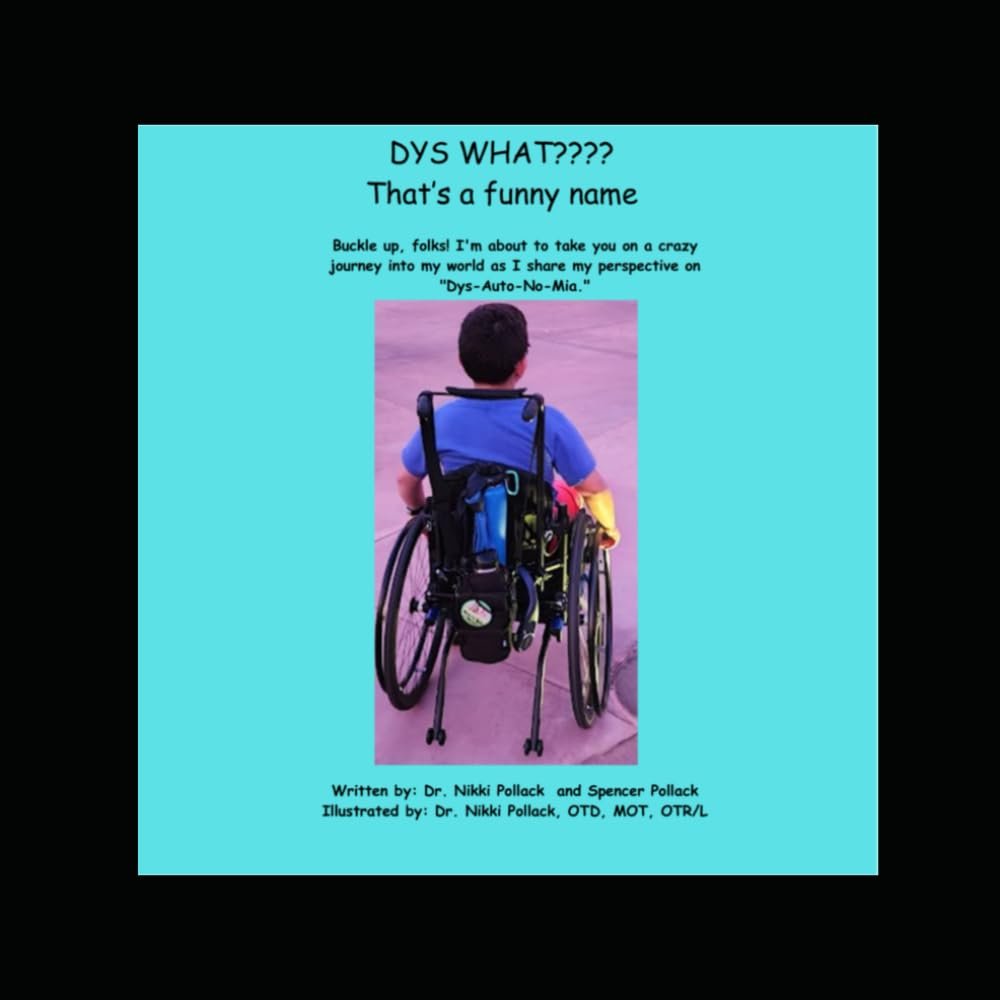
The cover develops that approach by breaking the condition’s name into spoken parts. This is an observation about the book’s presentation, not a clinical definition. Its immediate invitation is to listen to a person describe his world, rather than to memorize terminology before meeting him.
A book as a way to explain
The publisher-style description identifies a practical reason for the project: it gives the child a way to share what he experiences without having to explain it from the beginning every time. It also names teachers, parents, and friends as people who may benefit from hearing that perspective.
That purpose distinguishes the book from a comprehensive reference guide. A personal account can give readers a starting point for understanding one person while leaving room for others to describe different experiences. The feature does not claim that every child with the same diagnostic label will recognize every detail.
Humor and being taken seriously
The description expressly identifies a humorous approach. Humor can be one way a speaker chooses to make a difficult subject approachable, but its presence should not be mistaken for a request to dismiss the subject. A reader can respond to the tone while still listening carefully to what is being communicated.
For shared reading, an adult might ask which part of the narrator’s explanation stood out, or what the reader would want a friend to understand about an experience of their own. These are optional conversation prompts inspired by the book’s purpose. They are not exercises claimed to appear in its pages.
The cover puts a person at the center
The supplied artwork uses a turquoise panel with a central photograph of a child using a wheelchair, viewed from behind. The title and explanatory text sit above the photograph, with creator credits below. Its presentation directs attention to an individual’s account rather than to a diagram or a list of symptoms.
A visible mobility aid does not explain everything about the person using it. The feature therefore does not infer severity, prognosis, or a complete medical history from the image. What the cover does establish is the book’s personal framing and its invitation to encounter that perspective through reading.
Reading together without making assumptions
A family or classroom conversation could ask what it means to listen when someone describes something unfamiliar. Another useful question is whether the reader has ever found it easier to explain an idea through a picture or written words than by speaking on the spot. These questions keep the focus on communication and respect.
Children should not have to share private information to take part in that conversation. A reader may simply notice a new perspective or think of a kinder question to ask. The book’s stated aim provides an opening; the needs and preferences of the people reading together can shape what follows.
Choosing whether to explore further
This title may interest families and educators seeking a short, illustrated introduction to an individual child’s experience with dysautonomia. The available description supports that orientation, but does not establish a precise reading level, clinical effectiveness, or suitability for every classroom. An interior sample can help with vocabulary, layout, and tone.
More introductions to children’s books and nonfiction can be found in the MarketAnyBook Journal. Here, the central idea is a useful one for a book to explore: making space for someone to explain their own experience, in their own chosen form, before assuming that an unfamiliar word tells the whole story.
About the book.
The selected English paperback is credited to Spencer Pollack and Nikki Pollack, ISBN 9798878235501. It is described as a children’s book about personal experience with dysautonomia. The cover credits Nikki Pollack with the illustrations as well as a shared writing credit.
This article is presented as a MarketAnyBook Book Feature based on supplied materials and verified public information. It is not presented as a full-book review.
Found a book worth opening?
Books worth discovering. Authors worth knowing.
Return to the Journal →