
Forbidden Child
A young spy finds a baby her society forbids, turning obedience into a choice she can no longer make without question.
Books worth discovering. Authors worth knowing.
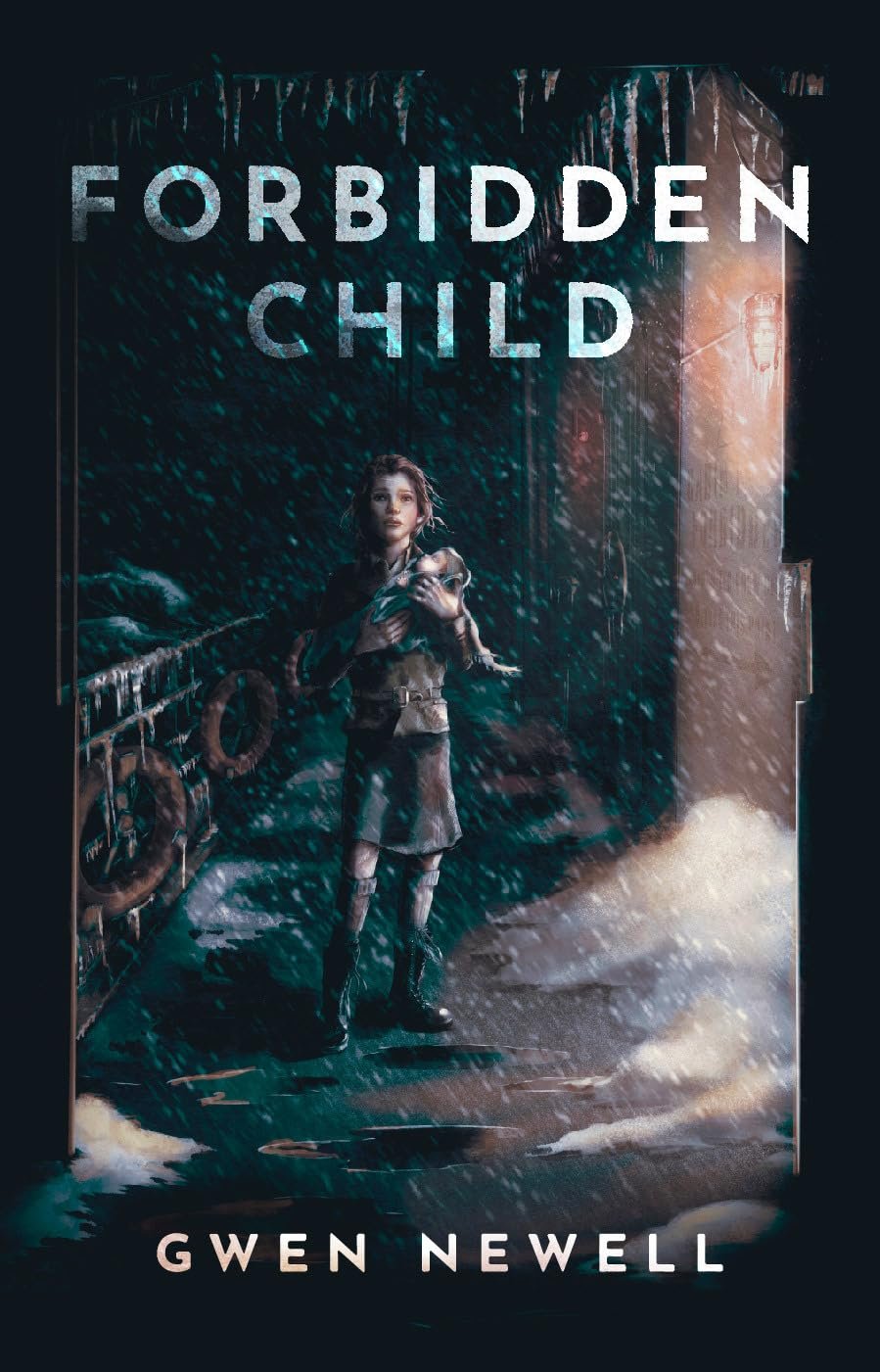
Gwen Newell’s Forbidden Child centers on Piper Pascal, a girl raised to serve the authority governing the only world she knows. When she discovers a child born without permission, the rules that have defined her life come into conflict with the vulnerable person in front of her.
An editorial introduction to the book, its premise and the story surrounding it.
Piper Pascal knows what she is supposed to do when someone breaks a rule. Reporting disobedience is part of her role, and pleasing the Godmother is part of how she understands her place in the world. Then the supposed offense has a face: a baby who cannot survive without help.
In the publisher’s account of Forbidden Child, Piper has lived aboard the Escape, a vast cruise ship, since a catastrophic flood. She has no memory of an earlier world. The Godmother governs the ship and exercises control over everyday life, including who is permitted to be born.
A world with nowhere easy to step outside
The shipboard setting gives the premise a particular kind of pressure. In a city, a dissenter might imagine another neighborhood or a road out. A vessel carrying an entire society creates a more enclosed question: what does it mean to resist an authority when that authority appears inseparable from the place that keeps everyone alive?
This feature does not assume details of the ship’s layout or the mechanics of escape beyond the published setup. The broad situation is already enough to establish the dilemma. Shelter and control occupy the same physical space, and a person who questions one may feel she is endangering the other.
That makes the setting relevant to more than suspense. It asks how people learn to regard a system as inevitable. If Piper cannot remember anything before life aboard the Escape, she has little personal experience against which to compare what she has been taught.
The enforcer who has to reconsider
Piper is not introduced as a detached observer of the regime. The synopsis places her inside its surveillance apparatus from childhood. The author identifies her as thirteen, making her both young enough to have been shaped by adult authority and old enough to act on its behalf.
That combination gives the story a difficult moral starting point. Recognizing a wrong can mean recognizing one’s own participation in it. The question is therefore larger than whether Piper dislikes a particular order. It concerns whether she can reconsider the judgments she has helped enforce.
For readers of dystopian fiction, this is a useful distinction. A protagonist who begins in open opposition has one kind of task. A protagonist whose loyalty is challenged by experience has another: she must learn to doubt a framework that has previously told her who she is.
EDITORIAL NOTECompassion becomes dangerous when it asks a person to question the rules she once helped uphold.
A baby turns policy into responsibility
The baby is the premise’s decisive encounter. Population control can be described in the abstract, but caring for a child makes the consequence immediate. Piper cannot treat the discovery only as a theoretical disagreement while the baby depends on what she does next.
The published description states that protecting the child would put her at risk of pursuit, arrest and death. Those are the announced stakes, not a summary of how events ultimately unfold. They establish why the decision carries weight before the reader knows the route the story will take.
A dependent child also changes what courage might look like. Protecting someone is not necessarily the same as making a dramatic declaration. It can involve patience, attention and the repeated willingness to put another person’s needs into an already dangerous calculation. The premise invites that broader understanding without requiring the ending to be revealed.
Loyalty, care and the language of authority
The title given to the ruler is striking: Godmother. It evokes a personal, protective relationship even as the synopsis describes an oppressive system. The gap between a caring title and controlling conduct gives readers a way to think about the difference between claimed responsibility and actual care.
Piper’s attachment to that authority makes her conflict more personal than a simple disagreement with an unfamiliar official. To question the Godmother is also to question the source of approval she has trusted. The premise consequently links political control with the emotional need to belong.
Newell presents the book as an adventure for younger readers, while catalogues also place it in young-adult dystopian fiction. Readers choosing it can expect a setup involving surveillance, threats and a child’s vulnerability. Its central question is accessible across those categories: what should someone do when a command contradicts the responsibility she feels toward another person?
This sponsored feature introduces the novel using the author’s and publisher’s public materials. It does not claim a full-book review or disclose how Piper’s choice is resolved.
About the book.
Forbidden Child is Gwen Newell’s debut dystopian novel, published in 2023. Piper Pascal lives aboard the Escape under the Godmother’s control. Finding an unauthorized baby forces her to choose between reporting a violation and protecting a life.
This article is a sponsored MarketAnyBook Book Feature based on supplied materials and verified public information. It is not presented as a full-book review.
Found a book worth opening?
Books worth discovering. Authors worth knowing.
Return to the Journal →