
Mediumship Foundations
A concise introduction to the beliefs, vocabulary and practices associated with contemporary mediumship.
Books worth discovering. Authors worth knowing.
Noelle Deane offers newcomers a short orientation to mediumship as she understands it, drawing on her own experience and years of study.
A nonfiction feature about a spiritual practice, careful self-reflection and the distinction between personal belief and verified scientific evidence.
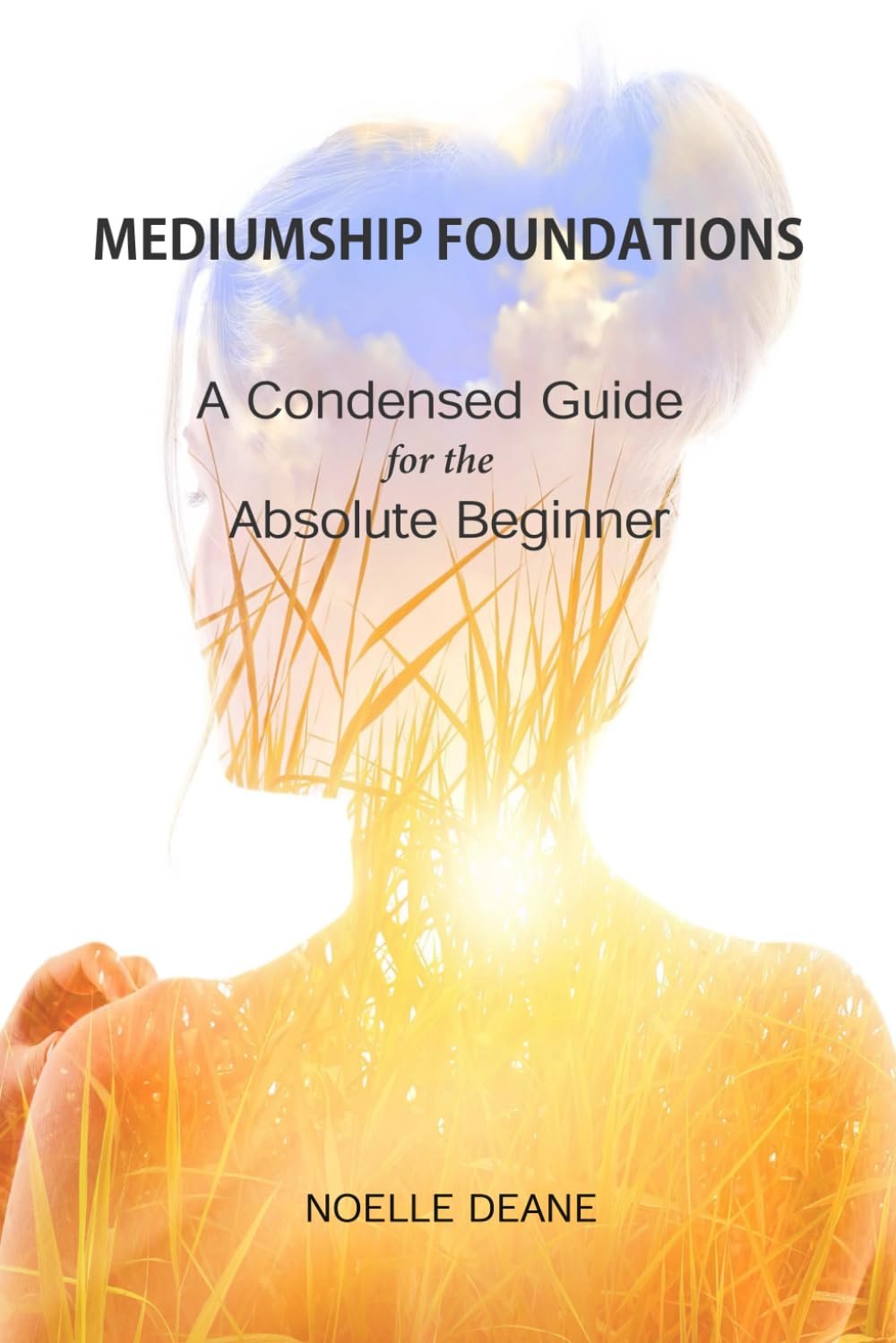
Mediumship Foundations: A Condensed Guide for the Absolute Beginner announces its priorities plainly. Noelle Deane has written a short orientation for people who are curious about mediumship but do not know how to begin exploring the subject. The public book description identifies the author’s personal experiences, reading, classes, podcasts and conversations as sources for the material, gathered over roughly twenty-eight years. At fifty-five pages, the guide is designed to introduce basic ideas rather than resolve every question the subject raises. Its scope matters because readers approaching spiritual literature can have very different expectations: some seek a practice within an existing belief system, while others want a critical examination of extraordinary claims.
Deane’s published introduction speaks to the first audience. She presents the material as her understanding and emphasizes that individuals may take different paths. That is an honest frame for a belief-centered book. A reader can engage with the vocabulary and reflective exercises associated with a spiritual tradition without assuming that the author’s metaphysical explanations have been independently demonstrated. This distinction allows the guide to be considered on its own terms while maintaining clarity about evidence.
Why the beginner focus matters
Specialized spiritual communities often develop terminology that feels opaque to newcomers. Someone exploring mediumship may encounter discussions of intuition, receptivity, spiritual connection and personal signs before understanding how practitioners use these words. A condensed guide can provide a common starting language. Its value is organizational: it helps a reader distinguish concepts and decide which questions deserve further investigation. The public description says each section could be expanded into a full chapter or even a separate book, emphasizing that brevity is an intentional design choice.
That design also has limitations. A short introduction cannot be treated as an exhaustive history of mediumship, a survey of scientific research or an authoritative guide to mental-health concerns. It can point toward resources and describe a practitioner’s experience. Readers should be attentive to the difference between a useful explanation of what someone believes and evidence that the belief corresponds to external reality. When a guide openly states that it is based on personal understanding, the most respectful reading preserves that distinction rather than either mocking the author or accepting every claim without examination.
Experience as a source of meaning
Deane emphasizes what she has learned through years of encounters with books, teachers and discussion groups. Such an account can help readers understand how a practitioner develops confidence within a tradition. Personal experiences may be emotionally compelling and meaningful to the person who has them. But sincerity and intensity are not the same as independent verification. A careful feature can acknowledge the former without claiming the latter. That is particularly important when a book discusses contact or communication that readers may interpret as supernatural.
The guide’s autobiographical foundation may also be a point of connection for readers who want a less institutional introduction. Rather than presenting one universal timetable, the public description tells beginners to be patient and to develop an approach appropriate to themselves. This emphasis on individual pacing has a broad practical appeal: learning a reflective practice can be less intimidating when uncertainty is treated as normal. It does not, however, establish that anyone following the steps will experience particular phenomena or develop extraordinary abilities.
The language of intuition and receptivity
The author’s description links mediumship with the development of intuition or receptivity. These words can carry many meanings. In ordinary life, intuition may refer to quick judgments shaped by experience; in spiritual traditions it may be used to describe a more expansive sense of perception. Readers benefit from noticing which meaning a writer intends in a given passage. Confusion can arise when a term that is familiar in everyday language is used to support claims that require a different standard of evidence.
A guide for absolute beginners can be useful precisely because it offers an opportunity to ask those questions early. What does the practitioner mean by a particular experience? How does she distinguish a strong impression from an interpretation formed afterward? Are readers encouraged to tolerate uncertainty? The public synopsis does not provide the exact exercise instructions, so this feature does not invent them. Its central point is that careful language is essential when exploring subjective experience, whatever a reader ultimately believes.
Patience and the risk of promised results
Deane’s public description discourages rushing and says each person has a unique timeline. This is a more cautious approach than books promising instant spiritual transformation. Patience can support thoughtful observation and discourage the pressure to report experiences simply because others appear to have them. Readers may find that useful even if they remain skeptical about the guide’s metaphysical framework. Reflective practices are easier to assess when one does not begin with the expectation that an unusual result must appear on demand.
The same caution needs to apply to claims about benefits. A spiritual practice may provide personal meaning, a sense of community or a structured occasion for contemplation. Those experiences should not be equated automatically with medical treatment, evidence of communication with the dead or a substitute for professional advice. The book’s public material does not justify promising healing, diagnoses or access to hidden factual information. A reader interested in any of those areas should evaluate them with appropriate evidence and independent expertise.
Resources as an invitation to keep learning
The author’s statement that more extensive resources exist is a useful acknowledgment of the guide’s limits. A fifty-five-page introduction can orient but not encompass a tradition with long and varied histories. Readers may want to investigate how different communities understand mediumship, which methods are described and where their interpretations disagree. A good approach is to combine curiosity with attention to sources, while remembering that independent scientific confirmation is a different kind of inquiry from learning the practices and language of a faith-based or spiritual community.
There is room for respectful disagreement here. Some readers may regard the material as part of a meaningful spiritual worldview. Others may be curious about the psychology of unusual experiences or the social role of ritual without endorsing supernatural claims. A beginner-friendly book can still be a useful object of study for either reader, provided it is not presented as a proof of things it does not substantiate. Deane’s emphasis on her own perspective gives that distinction a clear place to begin.
Who may benefit from this introduction
Mediumship Foundations is most directly aimed at adults who are new to mediumship and would like a concise practitioner-oriented introduction before deciding whether to explore further. Its short length may appeal to readers who feel overwhelmed by specialist books. It is less suitable for readers expecting a comprehensive empirical evaluation, academic history or step-by-step guarantee of paranormal results. Because the subject involves spiritual beliefs, readers should be free to set boundaries around the kinds of practices and claims they wish to engage with.
The defining promise of the book is modest in form even if the subject matter is expansive: a condensed personal map rather than a final answer. Deane offers a way to start asking questions and encourages patience with the process. Readers may value the guide as an entry into a spiritual community or examine it critically as an account of personal belief. Either way, its appropriate place is as a perspective on mediumship, not an independently verified account of supernatural communication.
About the book.
This 55-page beginner’s guide describes the author’s understanding of mediumship, informed by experiences, books, courses and discussions over approximately 28 years.
Independent MarketAnyBook editorial book feature based on public publisher, bookseller, and author information. This is not a claim of firsthand reading or a reproduction of the complete book. No plot scenes or quotations have been invented. The book link uses the owner-provided destination.
Found a book worth opening?
Books worth discovering. Authors worth knowing.
Return to the Journal →