
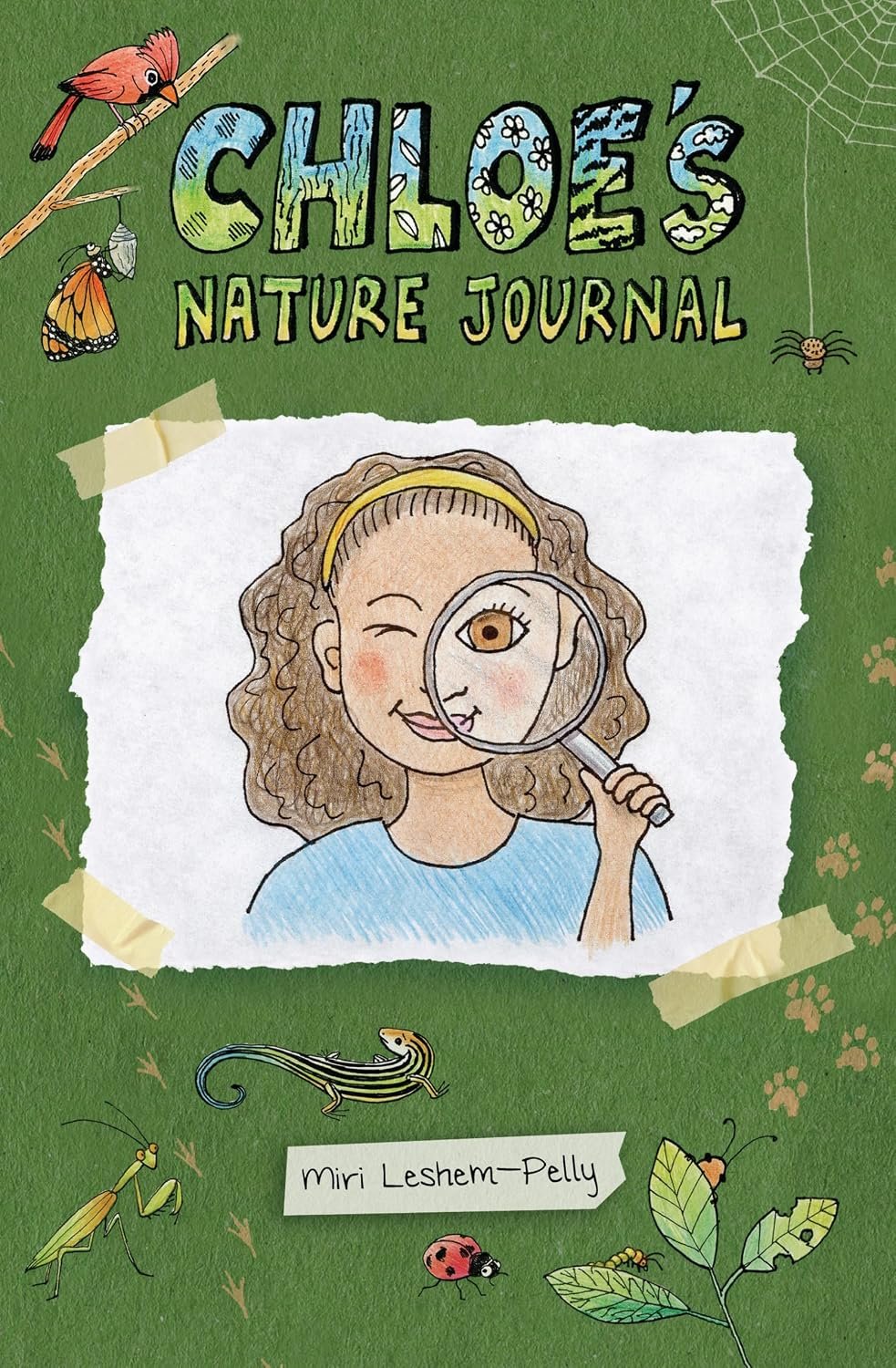
Chloe’s Nature Journal
A classroom nature-journal assignment helps a child discover that the smallest nearby creatures are worth noticing.
Books worth discovering. Authors worth knowing.
Chloe hopes to discover more wildlife than anyone else in class, but a first search around her yard appears disappointingly empty. A shift in attention changes the possibilities of the assignment.
A picture-book feature on observation, neighborhood ecology, patience and learning to look beyond spectacular wildlife.
The most surprising discovery in a backyard may be how much a child overlooked on the first visit. In Miri Leshem-Pelly’s Chloe’s Nature Journal, a teacher asks the class to record animals they find near home. Chloe wants to make the best discoveries, yet when she searches her yard, she initially cannot find anything worth drawing.
The author describes the picture book as an invitation to notice the small ecosystems just outside the door. That premise gives the narrative a productive shift: the challenge may not be the absence of wildlife but the expectations Chloe brings to looking. An ordinary yard becomes a setting for curiosity, attention and the delight of finding something overlooked.
Why a blank page can feel disappointing
A nature journal assignment sounds exciting until a child compares their surroundings with pictures of large, colorful animals. A backyard may seem bare beside a rainforest, an aquarium or a wildlife documentary. Chloe’s wish to find the most creatures in the class therefore creates a relatable difficulty. She may be looking for an impressive result before she has begun observing carefully.
The tension has a broader application to learning. When a child expects success to look spectacular, modest evidence may be dismissed too quickly. The book’s premise suggests that the first useful change is not a rare visitor arriving on command. It is paying attention to what is already present, including signs that require patience and a closer look.
Discovery begins with observation
Nature journaling combines noticing with recording. A drawing need not be artistically polished to preserve a question: what shape did a leaf have, where did a creature move, or how did one patch of soil differ from another? This practice invites a child to make a second observation rather than simply declare that something exists.
The book’s advertised educational value lies in that repeatable approach. Young readers can move from the page to a balcony, schoolyard, planter or park. The most important action is careful looking. A small patch of ground may contain insects, tracks, webs or plants that attract animals, though this feature does not claim which exact creatures Chloe meets in the story.
From competition to curiosity
The author’s synopsis notes Chloe’s ambition to discover more than her classmates. That wish gives the story immediate energy, but it may also narrow her attention. A child focused on winning can overlook the pleasure of an unexpected question. Nature does not arrange itself around a classroom ranking. It rewards neither the loudest observer nor the quickest declaration.
Such an arc can help adults discuss competition without scolding children for wanting to excel. Curiosity and achievement need not be enemies, but they often require different tempos. Observing a beetle’s movement for several minutes may teach more than collecting a long list of animal names in a hurry. The book provides an accessible fictional situation in which that distinction can matter.
Local ecology at a child’s scale
The author explicitly emphasizes small ecosystems near home. That is a valuable perspective because nature education is sometimes presented as travel to extraordinary places. Many families cannot visit distant reserves, and they do not need to do so in order to begin practicing observation. Neighborhood nature is shaped by weather, season, soil, plants and human activity.
A children’s book cannot catalogue every ecological relationship, but it can establish the habit of looking for them. Why might one plant attract more insects than another? What changes after rain? Which places offer shelter? Such questions turn a familiar yard into a place that keeps changing. They can also invite parents to learn alongside children instead of presenting themselves as experts with all the answers.
Drawing as a way to think
Chloe’s task involves a journal, so illustration and observation belong together. Drawing encourages a reader to slow down. A child making a sketch may notice the number of legs, the pattern of a wing or the uneven shape of a leaf. The picture can then preserve a detail that might otherwise be lost between seeing and describing.
Accuracy does not need to become a burden. An imperfect drawing can still record the excitement of a find or the beginning of a new question. Adults might consider making their own sketches without correcting a child’s picture into a standardized model. The aim of a nature journal is not to produce professional art; it is to build a relationship between attention and memory.
The book as an invitation outside
The story offers an easy extension beyond reading. A family can begin a notebook, revisit one spot over a week or list observations from a window. The activity need not involve collecting living creatures or disturbing nests. Looking from a respectful distance and leaving the environment intact are useful habits to pair with curiosity from the beginning.
There is also room to discuss uncertainty. A child may see something without knowing its name. Rather than guess, they can describe it, draw it and later compare it with a trustworthy field guide. This teaches an important lesson about scientific thinking: a question honestly left open is more valuable than a confident but unsupported identification.
A picture book with an educational backbone
Chloe’s Nature Journal is presented by its creator as a children’s book published by Creston Books. Its hook is small and approachable: an assignment, a frustrated child and a changed way of seeing. That scale may make it more directly useful for everyday reading than a book relying on spectacular wildlife images alone.
At the same time, its narrative is still a story, not a field manual. Readers hoping for species identification charts or a structured science curriculum should look for companion resources. The strength of the premise is motivational. It can make the act of noticing feel worth attempting before the reader has acquired specialized knowledge.
Who could enjoy Chloe’s Nature Journal?
Children who like observing animals, drawing or keeping notebooks may be drawn to Chloe’s situation. It can also suit readers who assume that nothing interesting lives nearby, because that is exactly the starting difficulty the synopsis identifies. Families and teachers looking for a low-cost activity to accompany a story will find a clear reason to explore this title.
For readers who need an exact age recommendation, reading level or classroom implementation plan, an authorized preview is the safest next step. The Journal recommends the book for its specific invitation to patient attention and local discovery, not a fabricated judgment of its every illustration or page turn. It reminds us that discovery can begin at home.
A note on the creator
Miri Leshem-Pelly is an author and illustrator of children’s books. Her official website identifies Chloe’s Nature Journal as a Creston Books title and describes its nature-journaling premise. Her larger catalogue also emphasizes imaginative visual storytelling and the natural world, which situates this book without requiring invented details of her personal life.
About the book.
Chloe must keep a nature journal of animals around home. Initially unable to find subjects to draw, she is encouraged toward the small ecosystems that exist close to her door.
Independent MarketAnyBook book feature based on public bibliographic, publisher and author information. It does not claim firsthand reading, reproduce an unpublished manuscript or invent quotations. The book link uses the owner-provided destination.
Found a book worth opening?
Books worth discovering. Authors worth knowing.
Return to the Journal →