
Melded
A reluctant spy and a former acolyte become one body and mind while a warlord hunts them.
Books worth discovering. Authors worth knowing.
What happens when the person you love can no longer be kept outside your own thoughts?
Dark queer fantasy with espionage, sacred power, body horror, and a romance tested by forced union.
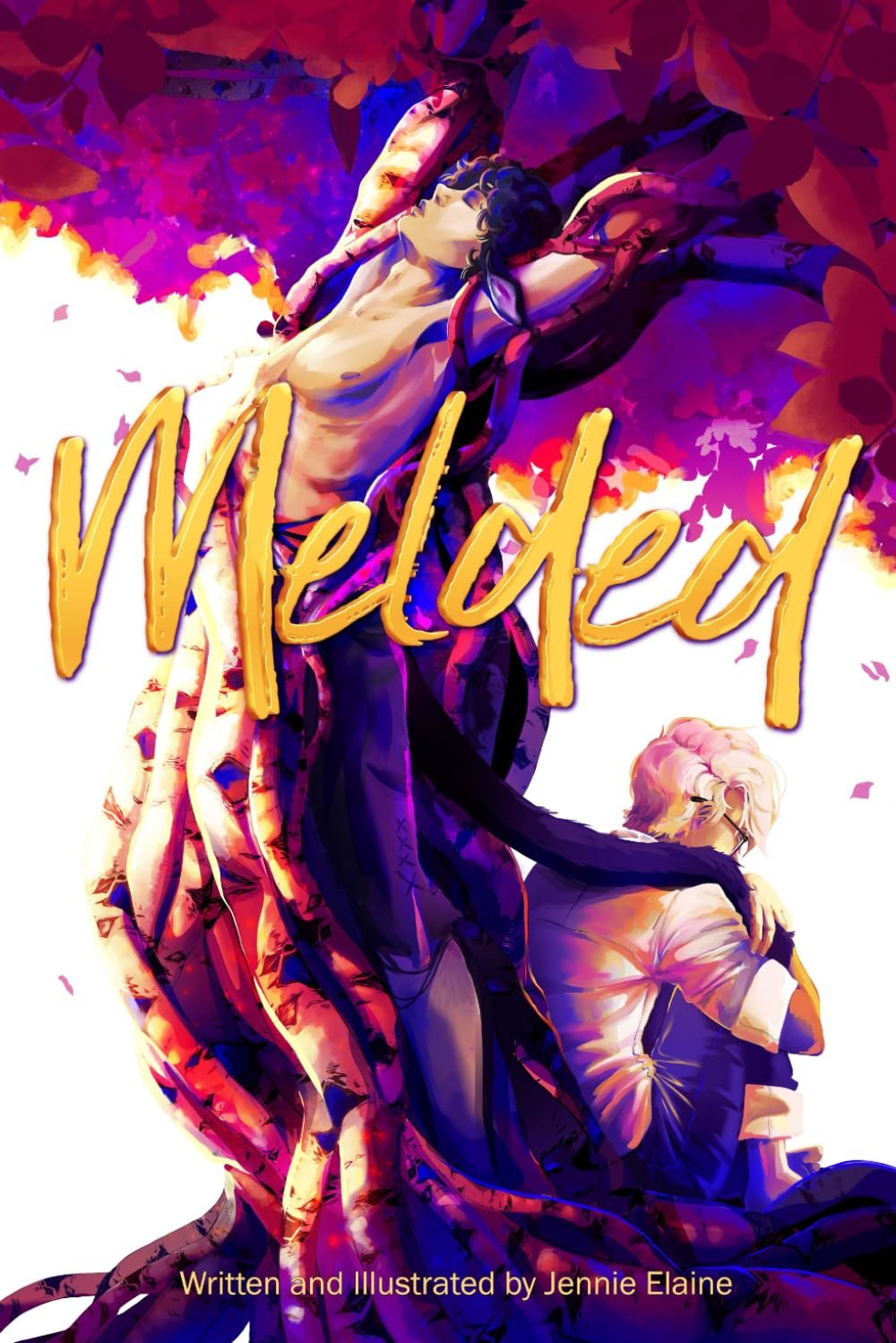
When two lives become one Jennie Elaine’s Melded uses a frighteningly literal supernatural device to explore questions of intimacy and identity. The publisher’s description introduces Simon Holiday, an unwilling spy assigned to translate temple texts, and Gen, a former acolyte trying to escape the power bound up with his past. Their attraction develops in a dangerous environment where personal secrets and political ambitions already threaten to overwhelm them. Then a force known as Haliz Fundir, a tree capable of joining bodies and minds, transforms their predicament into something more intimate than either planned. The two must endure a world hunting them while sharing the very boundaries that usually define separate people.
This is not simply a romance in which the characters are forced to travel together. Their bodies and thoughts have become entangled, according to the published synopsis. That creates a premise almost tailor-made for horror: the loss of interior privacy can be terrifying even between people who care deeply for each other. Yet the same situation also offers a striking metaphor for closeness. What does consent mean when there is no easy way to withdraw? How can trust grow when the other person might already know the fear behind a brave answer? Such questions emerge naturally from the confirmed story setup.
Simon’s compromised position Simon is not presented as an eager agent. The synopsis describes a reluctant spy whose choices appear shaped by previous coercion and a sense of guilt. His work translating sacred material places him near knowledge that powerful figures desire, even before his personal interest in Gen makes the assignment more precarious. Translation itself is a fascinating story device because it depends on interpretation: words can open a door to understanding, but a mistaken reading can mislead everyone involved. That is especially consequential when the subject is a temple’s concealed power.
A spy occupies a divided identity, speaking and acting for one purpose while concealing another. Romantic attraction makes that division increasingly difficult to maintain. Simon’s dilemmas are therefore not limited to external danger. His desire to make a genuine connection is in conflict with a role built on secrecy. Readers who enjoy morally pressured protagonists may find this more compelling than an uncomplicated hero whose only problem is defeating a villain. The synopsis leaves specific outcomes unresolved, which is appropriate for a spoiler-conscious feature.
Gen and the weight of a sacred past Gen carries a different burden. Public descriptions identify him as someone who once served the temple’s hidden power and now hopes to become a person separate from that legacy. The conflict between duty and self-definition makes him a strong counterpoint to Simon. One has accepted dangerous work he does not entirely want; the other wants to flee a role that continues to claim him. When their paths meet, the attraction is tangled with the possibility of becoming someone new.
The temple’s ceremonies and secrets are more than atmospheric decoration. They organize authority over knowledge and over bodies, particularly once the unusual properties of Haliz Fundir become central to the story. A power that fuses people can be described as miraculous or monstrous depending on who controls it and whether those involved can choose. That ethical ambiguity gives the fantasy setting a genuine horror dimension. The published summary indicates that Gen possesses a crucial secret, making his agency important to the conflict even while he is pursued by stronger forces.
The threat of Jorel and Haliz Fundir The antagonist Jorel is described as a warmonger who seizes the temple’s core and seeks control of its extraordinary power. He does not simply want to defeat an opponent; he wants to command a mechanism capable of erasing the boundary between individuals. In the wrong hands, the capacity to join minds suggests forms of coercion far more intimate than ordinary imprisonment. The story’s advertised stakes become simultaneously political and bodily. The temple’s sacred resource is no longer safe from instrumental use.
Gen and Simon’s decision to meld provides an immediate means of escape, according to the synopsis, but it also creates an enduring crisis. Their pursuers include Jorel’s followers, a dangerous scientist, and monstrous creatures. Readers of dark fantasy may be attracted by this mixture of religious lore, physical transformation, and pursuit. Yet the deeper imaginative pressure comes from an apparent solution that may create new dangers. Survival demands cooperation from two people who cannot simply retreat to their own private space when conflict arrives.
A romance that cannot avoid hard questions Melded is identified by its author in promotional material as a queer horror romantasy. That combination gives fair warning about the experience on offer. The relationship between Simon and Gen develops amid morally difficult decisions, bodily transformation, and external threats. A romance centered on shared consciousness can magnify ordinary intimacy. Secrets become harder to keep; misunderstandings may become less easy to sustain, but differences in values and fear can remain. Knowing someone’s thoughts does not automatically solve the problem of treating them with dignity.
The story seems especially interested in the distinction between being connected and being understood. Connection can be forced by magic. Understanding must still be chosen. As a conceptual reading of the premise, that distinction helps explain why the body-horror element has dramatic weight beyond its novelty. The public summary does not tell us exactly how the protagonists negotiate boundaries after the meld or how they resolve their relationship. Those discoveries belong to the book, and this feature deliberately avoids inventing them.
Monsters, science, and competing kinds of control The description adds an unsettling scientist and malformed monsters to Jorel’s extremist pursuit. That variety suggests multiple threats to the protagonists: political ambition, scientific exploitation, and creatures shaped by disturbing power. It also allows the novel to examine the difference between studying something and owning it. An institution may treat the tree as sacred, a ruler as a weapon, and a scientist as an experiment. Simon and Gen have to experience its effects inside their own lives, which gives them a stake none of those external claims can replace.
One of the great strengths of speculative horror as a form is the ability to make abstract anxieties physical. Loss of autonomy becomes a transformed body. A destructive ideology becomes a pursuer. Fear of being known too completely becomes an impossible lack of separation. Elaine’s published synopsis assembles these pressures around two people who are already falling in love. Whether each element is handled successfully is a question for a firsthand reader, not one this research-based feature can answer.
Where the book fits on a reading shelf Readers seeking conventional epic fantasy should be prepared for unusual body-horror ideas and a central queer relationship. Readers drawn to romance may want to know that the advertised atmosphere includes monsters, coercive power, and violent threats. Conversely, horror fans who enjoy character-driven emotional stakes may be interested in how the supernatural mechanics force Simon and Gen to depend on each other. The novel is marketed across genre boundaries rather than fitting a single simple label, and that is part of its identity.
Its public descriptions provide unusually clear character names, a named supernatural force, and the nature of the central crisis. This makes it possible to write a substantial preview without inventing additional scenes. The linked product page remains the best resource for checking a particular format, while the author and publisher descriptions supply the story’s fundamental facts. The book’s precise resolution, intimate exchanges, and action sequence are left for readers to encounter on their own.
A final recommendation Try Melded if your preferred fantasy combines a dangerous sacred power, an uncomfortable transformation, and a queer romance built under pressure. Simon and Gen’s involuntary union offers an unusual way to explore autonomy, trust, and the fear of being unable to hide. Jorel’s pursuit raises the stakes beyond their relationship and gives the speculative device a darker political purpose. This is better suited to readers comfortable with horror and bodily transformation than to anyone expecting light, uncomplicated romance. The publisher’s synopsis confirms the central premise; this feature leaves the full experience and ending for the novel itself.
About the book.
The published synopsis identifies Simon Holiday, Gen, the warlord Jorel, and the mind-merging tree Haliz Fundir as the central figures and force.
Independent MarketAnyBook editorial book feature. This article is an introduction grounded in public listings and is not a firsthand reading, rating, or guaranteed endorsement. Descriptions and interpretive commentary are distinguished; the separate Python publisher will resolve the public WordPress cover URL and media ID.
Found a book worth opening?
Books worth discovering. Authors worth knowing.
Return to the Journal →