
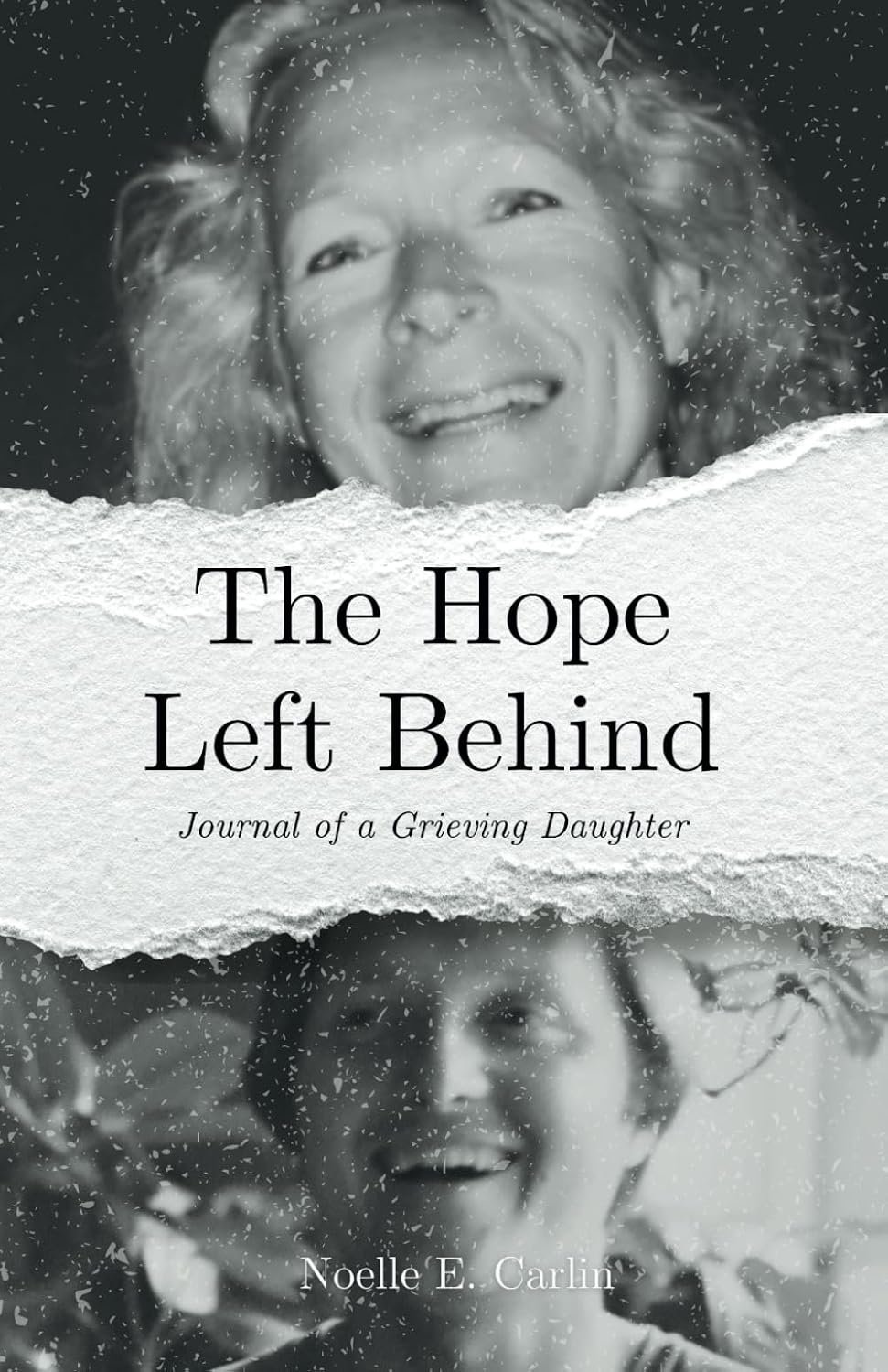
The Hope Left Behind
A memoir of losing both parents, told through candid journal reflections that leave room for humor and hope.
Books worth discovering. Authors worth knowing.
In a daughter’s journal, love and laughter can survive alongside the pain of losing both parents.
Personal journal, parental loss, memory and the coexistence of grief with humor.
A daughter’s record of two devastating losses The Hope Left Behind: Journal of a Grieving Daughter is Noelle E. Carlin’s personal account of living through the deaths of both her parents. That premise does not need embellishment to convey its stakes. Losing one parent can unsettle a person’s sense of identity and continuity; losing both changes the shape of the family history that seems available for new conversations. Carlin’s own description presents the book as candid, emotionally turbulent, and interested in the hope that can remain alongside profound sorrow. Instead of promising a neat resolution, the memoir offers a writer’s efforts to make sense of experiences that resist tidy explanation. Its form matters because a journal can preserve uncertainty as well as insight.
Why the journal form suits an unsettled experience Grief often refuses to progress according to a schedule. People may feel composed one morning and unprepared the next, or discover that an ordinary sound suddenly becomes attached to memory. A journal gives a writer permission to return to thoughts rather than declare them finished. Published descriptions of Carlin’s book emphasize entries, reflection, and personal honesty, suggesting an intimate approach rather than a detached survey of bereavement. The power of that framework lies in its limited perspective: it does not need to speak for everyone. It records how one daughter moves through loss. Readers may recognize parts of their own experience while noticing equally important differences.
Humor belongs in the conversation too One striking detail in Carlin’s presentation of the memoir is her insistence on humor. Laughter does not cancel grief, and in many families it is woven into the very memories that create the sharpest longing. A shared joke, an embarrassing family story, or a remembered habit can offer a momentary feeling of closeness. Such moments do not make a bereaved person less serious or less loving. Carlin frames humor as part of the truthful emotional landscape, not as a trick for transforming sadness into optimism. That refusal to demand a single mood is one reason a memoir of loss may feel more companionable than a prescriptive set of instructions.
What remains after a family changes The book’s title places the word ‘hope’ beside ‘left behind,’ and the pairing invites several possible questions. What survives when the people who knew earlier versions of us are gone? How do family rituals change when they can no longer be shared in the old way? Which memories become more precious, and which suddenly hurt? A daughter may be grieving people, roles, expectations, and imagined future conversations at once. These reflections are relevant to the memoir’s documented theme, although individual scenes should not be assumed unless the book itself confirms them. The broader value is its invitation to consider bereavement as a continuing relationship with memory.
The difference between testimony and instructions Readers sometimes turn to grief books hoping for a method that will make everything more manageable. This title deserves a different set of expectations. It is described as a memoir and journal, not a clinical program or therapeutic manual. A person’s testimony can offer recognition and language; it cannot establish universal stages of mourning or guarantee a particular outcome. Carlin’s account can be meaningful to people who share her situation, yet no two families and no two losses are identical. Holding that boundary is respectful both to the author and to readers who may be struggling with an experience too personal to fit anyone else’s timeline.
Remembering without polishing every memory Personal writing about parents can become difficult when love coexists with frustration, disagreement, or unfinished business. Many people inherit expectations that they should remember the dead only in idealized ways. Honest memoir opens a different possibility: memory can be affectionate while remaining complex. Carlin describes her work as raw and unfiltered, a signal that the book is interested in emotional truth rather than a public-relations portrait of perfect family life. It would be unfair to attribute particular conflicts or incidents without evidence. Still, the stated approach invites readers to value the texture of relationships rather than their simplification into a single lesson about gratitude.
A book for people beside the bereaved Carlin explicitly offers her story not only to those who have lost loved ones but also to people accompanying someone through grief. That second audience matters. Friends and relatives may feel pressure to say the right thing or to make sorrow disappear. Memoir can encourage the more modest and more useful practice of listening. Reading another person’s experience might help someone appreciate the unevenness of difficult days and resist imposing deadlines for feeling better. Yet the relationship between a book and a person in mourning is never automatic. Its contribution may simply be a phrase that helps start a conversation, or reassurance that silence can be shared respectfully.
Why no single ending will settle the subject The language of healing can suggest a finish line, but bereavement changes across anniversaries, celebrations, and ordinary routines. The Hope Left Behind signals a gradual discovery of possibility rather than an erasure of what happened. Hope might mean the willingness to make plans, to accept help, or to remember a parent without needing every recollection to have the same emotional force. Those examples are interpretive prompts, not claims about specific passages of the memoir. They help clarify why an honest grief narrative can be valuable even when it does not promise recovery in the way readers sometimes imagine that word.
The audience and the reading experience People looking for memoirs rooted in family relationships, intimate journal writing, and reflections on loss may find this title relevant. Readers who have recently experienced bereavement should decide whether an account of two parental deaths feels supportive at their present moment. There is no requirement to approach such material before one is ready. The published descriptions position the book as a source of connection and compassionate reflection. They do not warrant claims that every reader will find comfort or that the author offers professional counseling. The right expectation is encounter: one person’s account might illuminate feelings that are hard to describe, without prescribing what to feel next.
The hope of being understood What distinguishes Carlin’s project is its willingness to hold apparently opposite emotions together. Heartbreak and laughter, remembrance and forward movement, closeness and absence can inhabit the same pages. Memoir can make that coexistence visible in ways broader statements about resilience rarely manage. The Hope Left Behind asks for attention to a daughter’s lived experience and the possibility of human connection through storytelling. It is best approached without looking for a perfect theory of grief. The more grounded promise is that someone has chosen to record her passage through an altered life, offering others a chance to witness, reflect, and perhaps feel less alone in the questions that remain.
A closer reading question
Readers may also find value in considering how the memoir treats the act of writing itself. Turning feelings into sentences does not automatically resolve them, but it can create a record of what a day was like before memory begins rearranging it. A journal preserves contradiction: the same person can miss a parent fiercely and find something funny in a remembered expression. This is a reason to approach Carlin’s book as testimony rather than a book of slogans. Its observations belong to a particular life, and that specificity is what may allow others to recognize something authentic.
About the book.
A deeply personal memoir of losing both parents, reflecting on grief, memory, humor and hope.
Independent MarketAnyBook editorial book feature. Based on published descriptions and contextual analysis; not a firsthand full-book review, star rating or guarantee. The Python publisher resolves the WordPress cover and featured media ID.
Found a book worth opening?
Books worth discovering. Authors worth knowing.
Return to the Journal →