
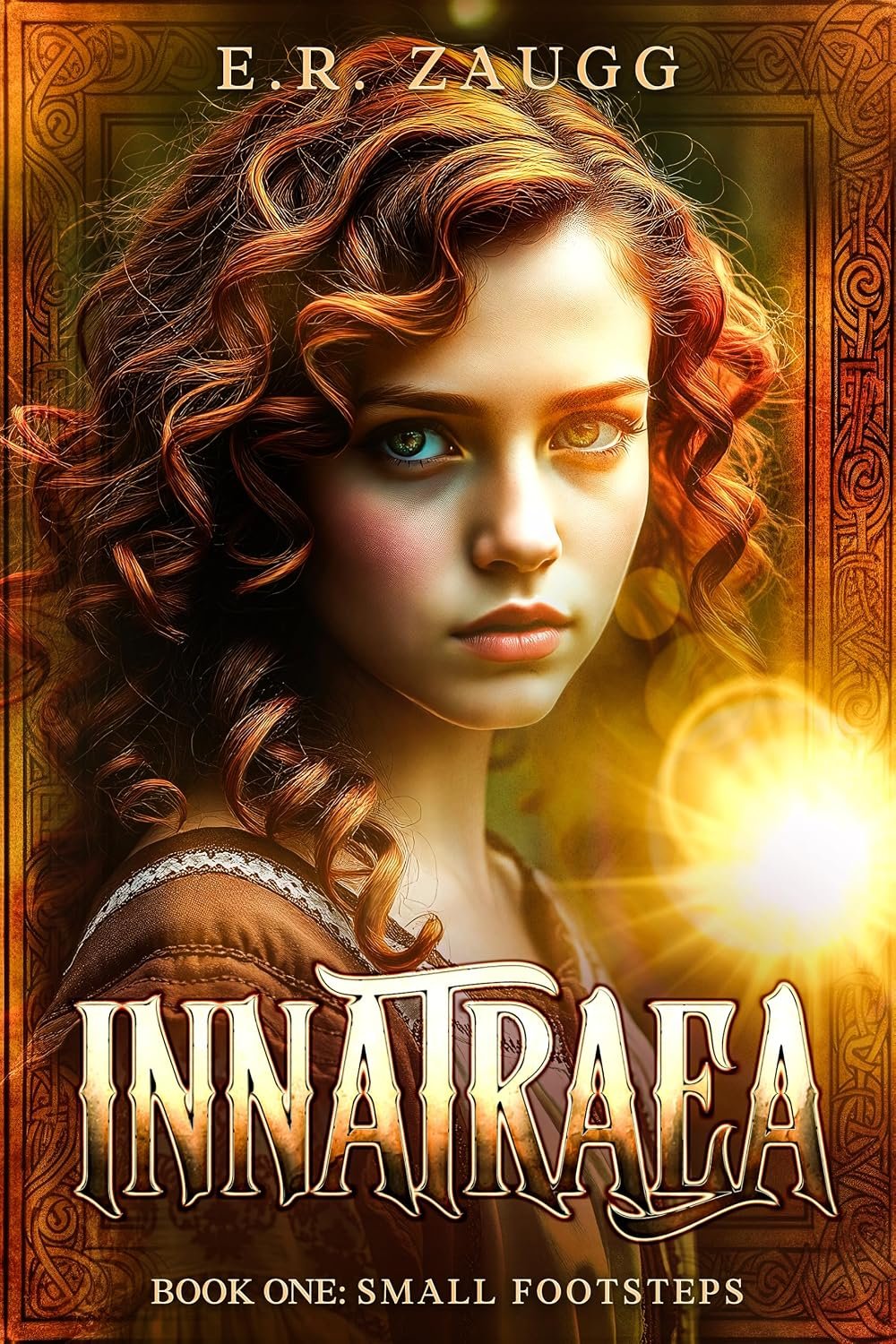
Innatraea Book One: Small Footsteps
Rosalie Sharone leaves Aliselle Falls to train among the Weavers, carrying immense magic and painful goodbyes.
Books worth discovering. Authors worth knowing.
Rosalie Sharone must leave those she loves and cross Innatraea toward an ancient order of powerful Weavers.
Aliselle Falls, Sceotan, the Weavers and a young woman’s dangerous initiation.
The moment Rosalie leaves home
In E.R. Zaugg’s *Innatraea Book One: Small Footsteps*, the extraordinary begins with a deeply recognizable decision: leaving the place that raised you. Rosalie Sharone grew up in Aliselle Falls, a quiet farm town where her formidable magical ability was kept away from unwelcome attention. Orphaned as a baby and cared for by an adoptive mother, she has spent years preparing for a future that will require her to travel far from those who know her best. The public synopsis describes her as unusually powerful, but it does not frame power as freedom from painful obligations. Her first real step involves saying goodbye.
Rosalie’s destination is Sceotan, an island kingdom associated with the Weavers, an ancient order of magic users. Becoming an initiate means entering an established structure of knowledge, rules and expectations. The journey therefore represents more than a simple search for a teacher. It moves Rosalie from informal belonging toward an institution that may recognize her gifts while placing its own demands on her identity. Readers drawn to apprenticeship stories may find that tension appealing: learning can enlarge a life, but can also challenge the relationships and assumptions that made earlier life feel safe.
Magic as promise and burden
The descriptions call Rosalie a prodigy whose raw power is vast and not yet fully understood. Such a character could become invulnerable if the only measure of strength were the ability to overpower others. Instead, the synopsis makes her capacity a source of danger. Weavers attract enemies, and Rosalie becomes a target before she has even reached her destination. Her talent changes the stakes of ordinary decisions: travel, trust and choosing an ally are not simple matters when strangers may value or fear the power she carries.
The author’s wider series introduction also emphasizes cultures and magical traditions across a large, interconnected world. This suggests that magic is not merely decoration layered over a familiar adventure. The way institutions understand power may matter as much as the power itself. Rosalie’s prospective role among the Weavers raises questions about who gets to define a gifted person and what obligations follow from recognition. These are interpretive angles grounded in the premise, not assertions about undisclosed scenes or the final design of the magical system.
The people left behind
Before entering that larger world, Rosalie must part from her adoptive mother, a first love and close friends. This detail keeps the personal scale of the narrative visible. The dream of becoming a Weaver might look unquestionably glorious from a distance, but its immediate cost is separation. In coming-of-age fantasy, leaving home often means seeking a self that cannot fully emerge while familiar roles remain fixed. Here the synopsis places that moment at the center rather than rushing past it toward a showcase of spells and battles.
There is an ethical dimension to such departures. A young person can be grateful to the family that protected them without agreeing to remain where they began. Likewise, love and loyalty need not be tests that require abandoning one’s vocation. Rosalie’s journey allows readers to consider these tensions without assuming how she eventually resolves them. The supporting cast is identified chiefly through their relationship to her; the available material does not supply their detailed personalities or future actions. What is supported is the emotional weight of the departure and the fact that ambition does not dissolve attachment.
An island order with high expectations
Sceotan is not simply a new location on a fantasy map. It is presented as the place where Rosalie’s preparation might become a new identity. The Weavers possess influence across Innatraea, suggesting a social and political position beyond that of solitary spellcasters. The synopsis establishes a stark risk: Rosalie’s gifts and intellect could lead to enormous power or destruction through forces surrounding her initiation. That creates a more pointed question than whether she will succeed at a series of magical exercises. What will joining the order demand, and who will decide whether her abilities are used well?
Stories of initiation often depend on a delicate balance between guidance and control. Teachers have knowledge that novices genuinely need, yet their authority can become dangerous if the institution mistakes ownership for mentorship. Those general possibilities are useful for reading *Small Footsteps* because the official premise emphasizes both the value and peril of Weavers’ influence. They should not be converted into unsupported accusations against any specific character. Readers can approach the order with curiosity and caution, allowing the narrative to establish its own alliances, conflicts and moral boundaries.
A large world introduced through one journey
The author describes Innatraea as a setting of diverse kingdoms, sentient mythical creatures and overlapping cultures. Rather than list every place at once, *Small Footsteps* begins with Rosalie’s individual movement from a farm town toward the island where she hopes to train. The choice can make large-scale worldbuilding more approachable. The reader encounters a world through what one character is seeking and what she is afraid of losing. A map may establish distance, but the character’s attachments give that distance emotional meaning.
Zaugg’s series introduction places women, vulnerable communities and questions of choice near the center of its fantasy imagination. Those are stated creative priorities, not evidence that every theme is fully resolved in this opening installment. The book’s public description calls it an introductory novella, and readers should expect the beginning of an expansive saga rather than a complete account of every realm. Its most tangible promise is the combination of high magical stakes with personal decisions about belonging, independence and loyalty. That is enough to distinguish its premise from a fantasy advertised only for spectacle.
For readers new to invented-world fantasy, the names and places in a series description can feel intimidating. This story offers a simple thread through that complexity: Rosalie wants to reach the community she has prepared to join, and the journey may imperil what she already loves. Remembering that motivation can keep the reader oriented as additional terminology and cultural histories appear. The synopsis establishes Aliselle Falls, Sceotan and the Weavers, but does not require advance mastery of the whole map. A strong entry point to a large saga often begins with one intelligible human choice.
Small footsteps and irreversible choices
The title is unusually modest for a story about potentially world-altering power. It reminds prospective readers that an adventure can be measured first by an ordinary departure, a goodbye or the courage to arrive somewhere unfamiliar. Rosalie’s gifts may be extraordinary, but her choices still unfold one step at a time. The synopsis leaves open whether the Weavers will provide the community she needs, whether enemies will close in and what becoming powerful ultimately means for her relationships.
For readers who like character-led fantasy, magical education and a larger world revealed through a personal journey, *Innatraea Book One: Small Footsteps* offers a clearly supported starting premise. This feature draws on the author’s series site and catalog descriptions rather than claiming independent knowledge of the complete text. The question worth taking into the opening pages is whether Rosalie can grow into the possibilities others see in her without losing the connections and choices that make her herself. The wider saga begins with that human-sized uncertainty.
About the book.
The opening Innatraea fantasy novella about Rosalie Sharone, the Weavers of Sceotan and a magical destiny.
Independent MarketAnyBook editorial book feature. Based on verified published descriptions and contextual analysis; not a firsthand reading, full-book review, rating or guarantee. WordPress cover and featured media are resolved by the publisher.
Found a book worth opening?
Books worth discovering. Authors worth knowing.
Return to the Journal →