
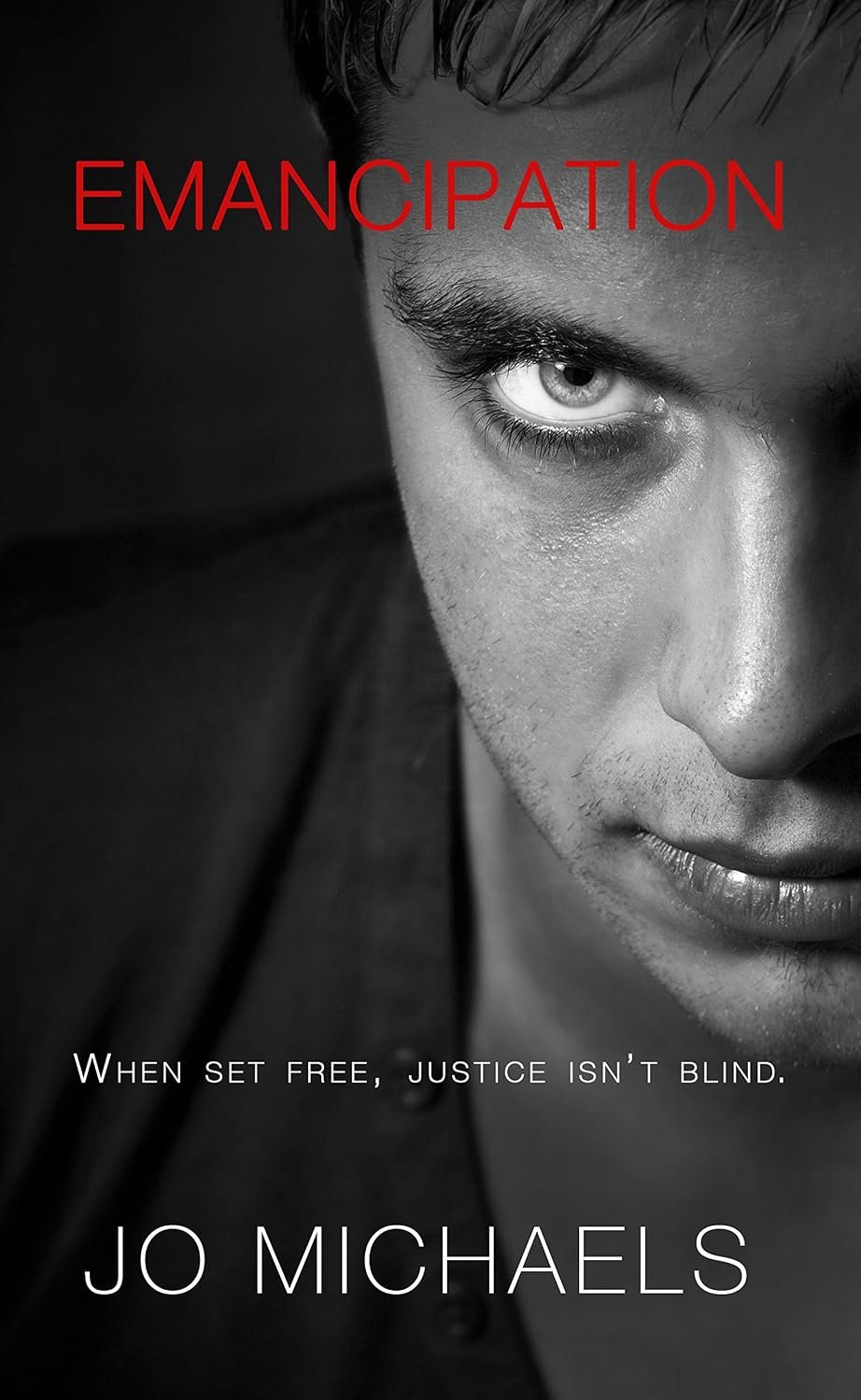
Emancipation
A lawyer tries to free a convicted murderer whose private intentions undermine the very innocence she believes in.
Books worth discovering. Authors worth knowing.
Death-row inmate Tobias Butler exchanges letters with Jess, a lawyer convinced he was wrongly convicted.
Tobias Butler, Jess, a pen-pal correspondence and a dangerous gulf in knowledge.
A correspondence with fatal stakes
Jo Michaels’s *Emancipation*, the first book in the Pen Pals and Serial Killers series, begins with a disturbing arrangement: a man on death row finds diversion through a correspondence program. Tobias Butler was convicted of a brutal murder and has spent years in prison. A young lawyer named Jess eventually writes to him believing she may be able to overturn the conviction. That is the premise described in the book’s original release announcement. It is already charged with contradictory possibilities, because the correspondent who may help secure freedom has only a partial view of the man she wants to rescue.
The announcement goes further than an ordinary wrongful-conviction hook. It identifies Tobias as guilty and aware of it. That fact changes the way readers approach the story. The suspense is not built solely around proving what happened in the past; it also depends on the possibility that a person working toward justice may be badly mistaken about the intentions of someone she trusts. A feature should not pretend that public premise is a secret, but it can leave the later consequences undisclosed. Readers know enough to recognize the danger, while Jess’s choices and the developing correspondence remain the narrative’s source of tension.
The danger of a persuasive narrative
Letters can make a stranger feel familiar. They offer the writer time to select words, manage impressions and tell a version of events without the interruptions of daily life. In *Emancipation*, that feature of correspondence becomes potentially perilous. Tobias’s position invites sympathy from someone concerned about miscarriages of justice, yet the announcement suggests that sympathy may give him access to a person he sees in predatory terms. The gap between how someone writes and what they intend is a productive foundation for psychological suspense.
It is worth separating that fictional scenario from real correspondence and legal advocacy. The book’s plot should not be taken as a general judgment about incarcerated people or lawyers who investigate convictions. In the world of the novel, a specific man with a specific secret is engaged in a dangerous relationship with a specific woman. What gives the story force is the power imbalance created by incomplete information, not the claim that hope or professional dedication is inherently foolish. Jess’s belief may be sincere even when the reader has reason to fear what the belief exposes her to.
Jess and the conviction she challenges
Jess is described as a bright young lawyer convinced of Tobias’s innocence. Her task, as presented in the announcement, is to build a challenge to the legal judgment that put him on death row. That framework gives the thriller two kinds of conflict: institutional and interpersonal. One concerns evidence, procedures and the system that determines guilt. The other concerns what happens when one participant in a private exchange is deliberately concealing the information that would transform the other’s understanding.
The contrast can produce intense dramatic irony. The reader may possess a crucial fact that Jess does not, and each effort she makes to help Tobias can therefore raise anxiety rather than relief. This mechanism does not require invented courtroom outcomes or secret conspiracies. The public premise supplies a strong enough ethical predicament on its own. Jess wants to prevent an injustice; the man she advocates for knows something that complicates her mission. Readers are invited to watch how advocacy, attachment and danger intersect, without assuming the book delivers any particular verdict on the justice system.
Freedom means different things to different people
The title *Emancipation* usually suggests release from control. Here its meaning is sharply unstable. To Jess, freeing Tobias may represent the correction of an error. To Tobias, release promises something far more threatening, because the announcement explicitly identifies violent intentions toward her. The novel therefore asks readers to think about how the same desired outcome can carry incompatible meanings depending on whose account is believed. It is a dark use of a positive word, and it suits a thriller organized around deception.
That double meaning is also what prevents the plot from being an ordinary procedural puzzle. An investigation may involve evidence, timelines and legal strategy, but the personal stakes are shaped by Tobias’s agency. His choices are not merely reactions to the machinery of the courts. The promotional description establishes him as someone capable of calculating what he wants from the relationship, which makes the pen-pal framework more unsettling. The fear comes from intimacy that is not what it appears, rather than from an external villain who arrives without warning.
Why the pen-pal device works
A story told around correspondence can amplify absence. The two people do not share an ordinary environment, and distance makes unanswered questions harder to resolve. Each message can seem both revealing and carefully controlled. The time between letters may encourage hope, speculation or dependence. These are possibilities suggested by the setup, not verified claims about the narrative’s chapter structure. The original announcement does not explain exactly how Michaels presents the messages or how frequently the characters meet, so a responsible feature cannot invent those mechanics.
Still, the format offers a clear route into the book’s psychological territory. Jess may bring professional confidence and a desire to act; Tobias possesses knowledge about his past that she lacks. Their interaction invites the reader to notice signs of manipulation and ask what it takes to remain skeptical while trying to help. This can interest fans of morally tense fiction more than a conventional whodunit. The attraction is not a tally of clues pointing toward a surprise murderer but a known threat whose eventual reach has yet to be disclosed.
The novel’s central misunderstanding can also illuminate a broader storytelling convention: readers often want to believe that patient attention will uncover a hidden innocence. Michaels turns that desire into a potential liability. The twist in the public premise is not that caring about another person is inherently wrong; it is that a convincing request for help may contain a deliberate omission. That framing gives the thriller its moral discomfort. Good intentions are real, but they cannot alone determine whether the story someone tells about themselves is reliable, particularly when one person stands to gain freedom from another’s advocacy.
A thriller that asks for careful reading
The 2016 release announcement calls the book a psychological thriller and places it at the start of a series. Readers should expect a dark premise involving murder, incarceration, potentially coercive relationships and threats of violence. The marketing summary even makes Tobias’s intended harm explicit, so the content is worth considering before choosing the book. It would be inappropriate to promise that every question is answered or that the narrative provides a tidy moral balance; those judgments require engagement with the full text.
*Emancipation* may appeal to readers who enjoy suspense built through unequal knowledge, unreliable self-presentation and the danger of trusting an appealing story. Its distinctive premise is not that a convicted man might be innocent, but that the person arguing for his freedom appears not to understand his guilt. This Journal article is based on the author’s launch material rather than a firsthand reading, and it leaves later plot events unclaimed. The central question is whether a sincere effort to free someone can survive the discovery of who that person actually is.
About the book.
A psychological thriller in which a death-row inmate and an idealistic lawyer communicate while he conceals violent intentions.
Independent MarketAnyBook editorial book feature. Based on verified published descriptions and contextual analysis; not a firsthand reading, full-book review, rating or guarantee. WordPress cover and featured media are resolved by the publisher.
Found a book worth opening?
Books worth discovering. Authors worth knowing.
Return to the Journal →