
Seldom Dreaming
A celestial cover and an open-ended title invite curiosity about imagination, distance, and the meanings readers bring to a book.
Books worth discovering. Authors worth knowing.
A celestial cover and an open-ended title invite curiosity about imagination, distance, and the meanings readers bring to a book.
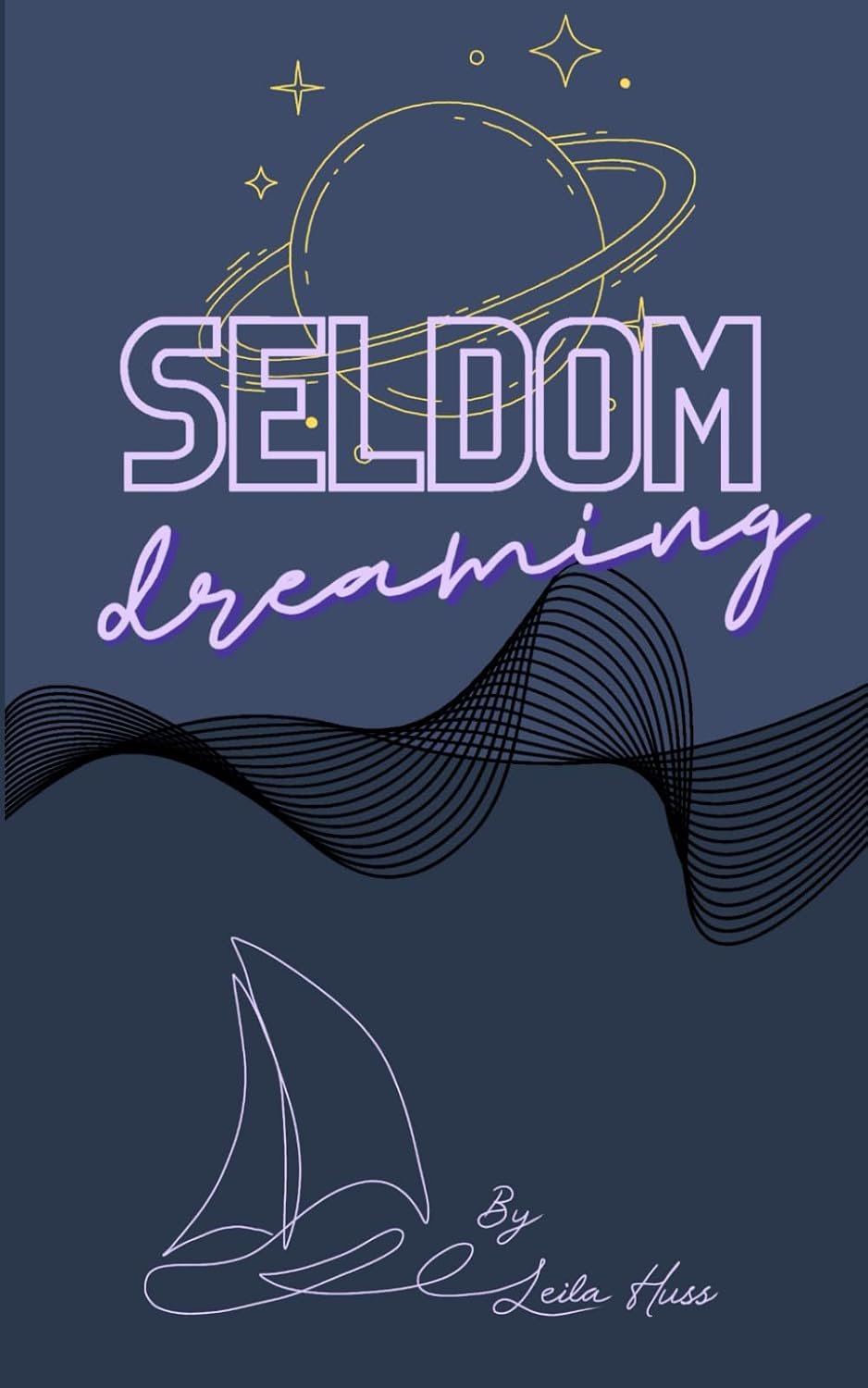
The cover pairs a ringed planet and stars with flowing lines and a sailboat-like outline; the underlying literary form is not independently confirmed.
A title that leaves room for wonder
Seldom Dreaming is an unusually open invitation. Two ordinary words create a question rather than an answer: is dreaming rare, precious, interrupted, or something the speaker wants to recover? The verified information available for this feature identifies Leila Huss as the credited writer and confirms the title on the matching cover. It does not establish a plot, a table of contents, or even a definitive literary category. That distinction shapes the most useful way to introduce the book. Instead of assigning characters and dramatic turns that no reliable source supports, readers can begin with what the edition actually puts before them: a phrase that joins scarcity to imagination, and a cover that places movement beneath a wide, almost cosmic sky. This is a limited-source editorial spotlight about the book’s presentation and the questions it opens. It is not a review of passages we have not seen. Honesty about that boundary leaves room for curiosity without disguising guesses as discoveries.
When an adverb changes the feeling of a word
The word seldom gives the title its unusual weight. Dreaming by itself can suggest hope, sleep, fantasy, planning, memory, or the strange privacy of the mind at night. Put seldom before it, and the phrase changes direction. It asks why something apparently natural is infrequent. Perhaps the person associated with the phrase is practical; perhaps dreaming has become difficult; perhaps the title is ironic. None of those possibilities is confirmed content from Huss’s pages. They are distinct ways a reader may hear the same pair of words before opening a book. That is a worthwhile exercise because literary titles often frame our attention before their meaning is explained. A reader who expects comfort will notice one kind of detail; one who expects loss will notice another. Good reading keeps both responses provisional. The title should sharpen attention, not turn an initial guess into a compulsory interpretation.
The visual promise of a wide horizon
The actual cover helps locate the atmosphere without revealing a hidden synopsis. Against a muted blue field are gold-toned celestial shapes, a ringed planet, fine flowing wave-like lines, and a spare drawing suggestive of a sailboat. The title is large, while the author credit appears near the bottom. These are observable elements of the supplied jacket artwork. Their arrangement is striking because it places two kinds of travel close together: something immeasurably distant overhead and something human-scaled associated with a boat. The planet cannot tell us whether a story takes place in space, and the vessel cannot establish an ocean voyage. Covers can use metaphor, fantasy, or purely decorative design. What these choices do offer is a way to think about scale. The ordinary self may feel small beside a vast imagined world. The horizon can promise escape or simply represent the distance between a wish and its realization.
How to approach a book without prewriting it
A reader coming to a little-documented title has a special challenge: the temptation to substitute a plausible narrative for the actual one. With Seldom Dreaming, even genre assumptions deserve care. The name alone does not identify the work as a novel, poetry collection, memoir, or self-help guide. A useful opening strategy is therefore to treat the first pages as evidence. Look for the form: continuous scenes, short prose sections, poems, reflective passages, or something that crosses categories. Notice whether the speaking voice belongs to a named character, an unnamed narrator, or an argument addressed directly to the reader. Mark the first concrete setting if one is given. Ask whether the book uses dreams literally or figuratively. These questions create a more accurate reading than any confident prediction based only on a jacket. Curiosity stays active while the text earns the meanings attached to it.
The difference between aspiration and escape
One productive lens for the phrase seldom dreaming is the tension between aspiration and escape. A dream can mean an imagined future one hopes to build, yet it can also mean a temporary retreat from present pressures. Literature treats these meanings differently. An aspirational dream raises questions about choices, work, and obstacles; an escapist dream may ask what reality has become too painful or dull to face directly. The title could ultimately mean neither. Still, bringing the distinction into the reading experience can help us recognize what the work itself emphasizes. Are imagined possibilities followed by practical action? Does an imagined place stand against an ordinary one? Does the language make dreaming seem safe, unsettling, embarrassing, or necessary? Readers should answer only after finding supporting lines or scenes. A theme becomes criticism when it is traced through the work; before that point it remains a question worth asking.
Reading an image without turning it into evidence of events
The jacket’s flowing dark curves are particularly interesting beside the clean, sharply outlined stars. One creates a sense of rhythm; the other suggests fixed reference points. This contrast offers a visual experience of motion and orientation, but it does not prove that either is a literary motif inside the book. The same caution applies to the sailboat-like outline and distant celestial forms. They might relate directly to what readers discover, or they might simply communicate an expansive mood chosen for the cover. Readers sometimes speak about imagery as though every decorative shape were a coded clue. That can make discussion lively but also misleading. The better approach is comparative: once you have read, return to the jacket and ask which elements gained meaning. If a wave resembles the movement of a sentence, or a distant light recalls a described desire, you can then explain the connection with evidence instead of claiming it from the start.
What uncertainty can teach us about discovery
The market often favors familiar descriptions: a hero faces a crisis, a method delivers transformation, a collection explores a list of subjects. Those summaries help readers choose but can also narrow their first encounter. A book with minimal accessible documentation reminds us that discovery and certainty are different experiences. The absence of a detailed online synopsis does not make a work better, more mysterious, or less accomplished. It simply changes how responsibly a feature can discuss it. Here the verifiable case is compact: title, credited author, specified purchase link, and a matching cover in the owner’s archive. Any claim about chapters, characters, literary quality, or author biography would require more. The constructive response is to name those limits and give readers an attentive way into the material. That is a real service, even if it is less dramatic than a fabricated account of imagined content.
A reading conversation to keep open
For a book club, a classroom writing exercise, or an individual journal, the title can become a starting prompt. Before reading, write down what seldom seems to modify: the act of dreaming, the permission to dream, or the memory of having dreamed. After a meaningful portion of the actual text, return to the note and revise it. Which formal choices surprised you? Did the voice invite identification or resist easy interpretation? Was there an image repeated often enough to carry significance, or did the book work through discontinuity? These are discussion methods, not assertions about Huss’s technique. The distinction matters: a respectful reader gives an unfamiliar author the opportunity to be unlike the book imagined in advance. Even a cover as evocative as this one should not become a substitute for the sentences that follow it.
Who may want to explore it
Seldom Dreaming is best approached by readers comfortable making an independent discovery rather than relying on a detailed advance synopsis. The spare title and celestial, wave-filled cover may appeal to people drawn to reflective or imaginative presentation, but those cues cannot guarantee a particular genre, tone, or content level. Readers selecting a book for a specific age group, classroom objective, or preferred type of narrative should consult a preview or edition description before deciding. Someone who enjoys thinking about the relationship between a title, its design, and the eventual text may find this a rewarding candidate for deliberate exploration. The invitation here is not to expect a story we have invented, but to let Leila Huss’s actual work define itself.
The credited author and the honest next step
The supplied book record and on-cover signature attribute Seldom Dreaming to Leila Huss. No reliable biographical record, prior bibliography, or verified description of the contents was located for this feature, so none is supplied. The linked listing remains the owner’s chosen place to inspect the edition. A complete content-led review would require an accessible publisher synopsis, sample pages, or author-supplied description. Until then, this is an explicitly limited-source book spotlight: an accurate identification, a close look at what the cover communicates, and a practical set of questions for readers who choose to go further.
About the book.
A limited-source editorial introduction grounded in verified title, author, queue listing and the matching cover; contents and genre remain unconfirmed. Research-based editorial feature, not a firsthand review.
Independent, limited-source book feature based on the exact queue record and verified cover presentation, not on a claimed full reading. The available evidence did not support a detailed plot or poem-by-poem review; the commentary labels questions as questions. Cover placeholders await owner Python processing. Editorial review is recommended before publication.
Found a book worth opening?
Books worth discovering. Authors worth knowing.
Return to the Journal →