
Was It a Dream?
Larada Horner-Miller explores grief, family bonds, travel and renewal across years of reflective poetry.
Books worth discovering. Authors worth knowing.
Larada Horner-Miller explores grief, family bonds, travel and renewal across years of reflective poetry.
The first Navigating Life’s Journey Through Poetry volume blends lived experience and reflective verse about loss and hope.
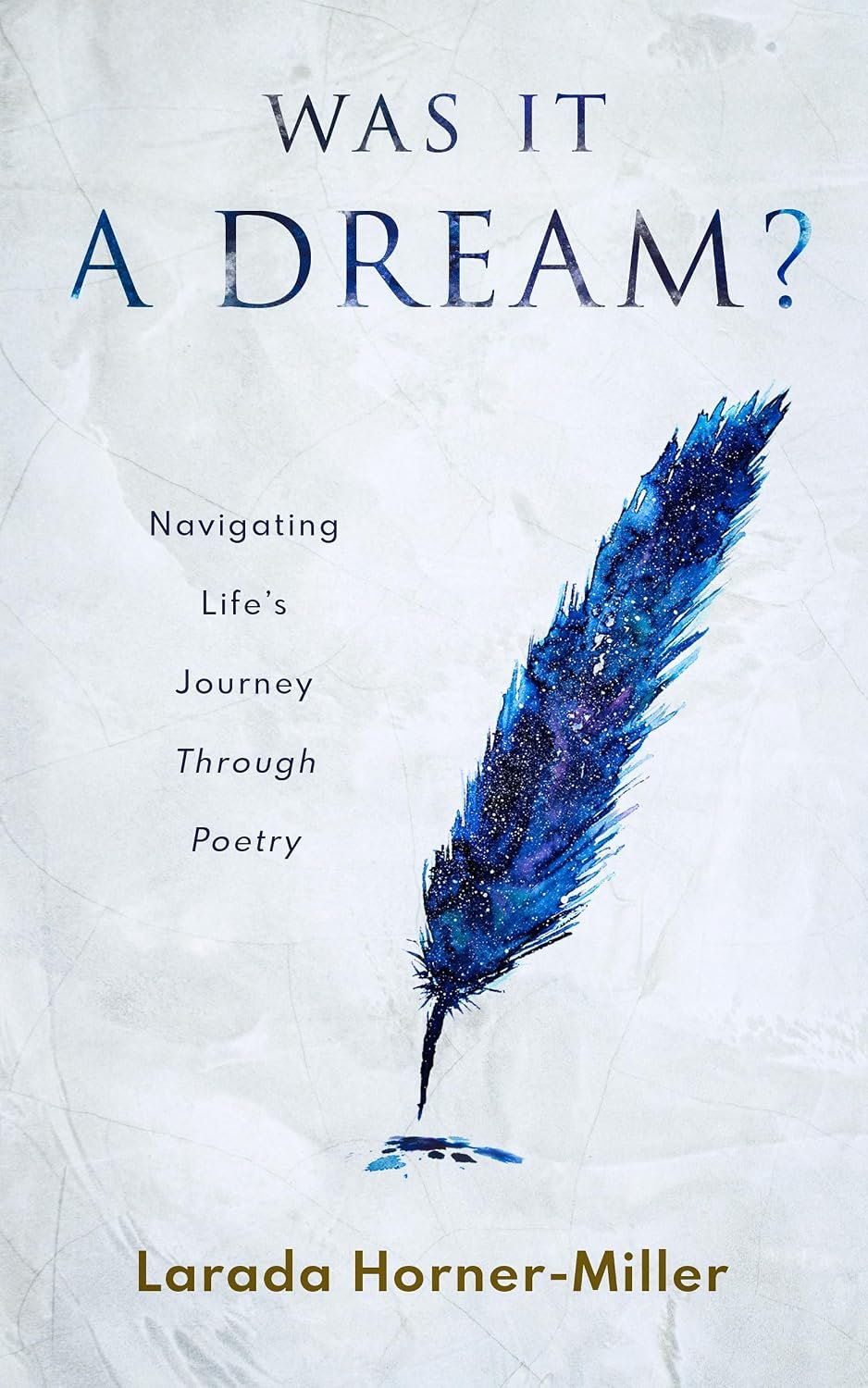
Poetry across a changing life Larada Horner-Miller’s Was It a Dream? is described by the author as the opening volume in her Navigating Life’s Journey Through Poetry series. Its subject is not a single fictional quest or a neatly packaged moment of triumph. The collection follows human experience through loss, healing, family relationships, nature, and travel. The poet draws on memories and observations accumulated across years, making the title’s question feel like an invitation to consider how the past changes when we look at it from the present. What seemed clear while it happened may become mysterious with distance; what was once painful may eventually carry a different kind of meaning.
The author’s own account identifies poems about her father’s death, travels to Mexico, changes in relationships, and experiences of renewal. These points give the collection a specific emotional and autobiographical shape without requiring a reviewer to invent lines of verse. Poetry often compresses a long experience into a small verbal space, and Horner-Miller’s chosen framework makes that movement between memory and present understanding central to the book’s appeal. Readers can approach each piece as a moment in a larger life while still giving it the attention it deserves on its own.
Grief that does not erase affection Loss is one of the confirmed concerns of Was It a Dream?. The poet’s references to her father’s death and the process of grieving suggest writing as a way of staying in contact with difficult memories. Grief poems do not need to convert sorrow into a neat lesson to matter. They can make room for unfinished feelings: gratitude, anger, affection, surprise, or the shock of remembering a detail after years of forgetting. The collection’s advertised movement toward hope should therefore not be mistaken for a claim that pain vanishes when a person finds the correct phrase.
For readers who have experienced bereavement, the value of reflective poetry can be its permission to feel more than one emotion at once. Someone might find that a memory comforts on one day and unsettles on another. The poet’s subject matter allows room for that variability. This article cannot identify the exact order or wording of each poem without the complete text, and it would be careless to invent images and call them quotations. What is verified is that grief and recovery share space within a broader collection about human relationships and time.
Family as a map of memory Family bonds offer more than background in a book organized around a life. They influence how people tell stories about their childhood, adulthood, and changing responsibilities. Horner-Miller’s public description presents family relationships as one of the volume’s touchstones, alongside nature and travel. A poem might locate a feeling within one remembered encounter, or use a familiar place to recover an earlier version of the self. The reader does not need to know every biographical detail to recognize the human difficulty of discovering that relationships continue to shape us after the people and places involved have changed.
The series framing also emphasizes a long time span. A life considered over decades will contain contradictions that a single inspirational statement cannot hold. People can feel both grateful for what came before and uncertain about what they lost. Readers may find it productive to notice the difference between a poet’s younger observations and the retrospective understanding available to the person arranging them later. That tension is an interpretive possibility, not a claim that every poem explicitly announces its date or offers a straightforward autobiography.
Nature as companion to reflection The author’s description points to mountains, valleys, and nature’s quiet wisdom as recurring sources of attention. Such imagery can offer a contrast to immediate emotional turmoil. A landscape continues through seasons while an individual’s inner world changes rapidly, and that difference may create space for perspective. Poetry about the natural world can also register small beauties that prose summaries overlook: a shift in light, a remembered breeze, or the feeling of being briefly still. The book’s public materials invite readers to expect this kind of attentive observation without establishing specific unquoted lines for each image.
Travel contributes another form of perspective. Horner-Miller mentions visiting Mayan ruins in Mexico and writing across different periods of her life. Encounters with unfamiliar places can unsettle fixed assumptions about time, history, and identity. Rather than suggesting that travel automatically produces wisdom, the collection’s framing recognizes that a remembered place can become a means of thinking. A reader may respond less to the destination itself than to the act of bringing personal experience into contact with a much larger world. That possibility is central to reflective writing at its best.
Writing that accommodates humor and light Was It a Dream? is not described as an unbroken sequence of sorrow. The author also mentions gentle humor, wonder, and the celebration of small moments. That tonal range matters. A collection centered only on its darkest material might miss the surprising ways delight appears beside grief. A remembered joke, an odd observation, or a scene of beauty can be sincere without denying suffering. In a long life, the return of amusement can feel like a kind of renewed connection to the ordinary world rather than a betrayal of what has been lost.
Readers unfamiliar with poetry sometimes assume that every piece must conceal a single difficult answer. This collection may offer a more hospitable entry point: look for the emotional occasion, the movement of attention, and the human situation that gives the language urgency. When a poem seems ambiguous, the uncertainty may be productive. There is no obligation to extract a motivational message from it. Horner-Miller’s public description emphasizes shared experience, and that may be a better invitation than promising easy interpretation or uniform emotional effects.
The place of this volume within a series The author describes Was It a Dream? as the first book in a multi-volume poetry series. That context suggests a project of organizing personal writing across time, rather than treating a single collection as the final word on an entire life. The first volume invites readers into a sequence whose later parts may revisit familiar issues from different ages or circumstances. It is useful to keep the distinction clear: the existence of a planned series does not establish the contents of every later book, and readers should check the current catalog for the specific volumes available.
A series of personal poetry also gives the reader permission to read nonlinearly. A single poem may deserve repeated attention before moving on. A reader might return to a piece about loss after encountering one about travel and hear a different undertone. That is not a prescription for how the collection must be used; it is one practical approach to a form in which the relationship between individual works and the collection as a whole can be especially rewarding. The author’s stated themes support such patient exploration.
Who may connect with Was It a Dream? Horner-Miller’s volume may appeal to readers of accessible contemporary poetry, reflective memoir-in-verse, family-centered writing, and poems concerned with travel, natural landscapes, and resilience after loss. It is not advertised as a practical grief-treatment workbook or a replacement for mental-health support. Nor should readers expect a conventional plot-driven novel. Its interest lies in the experiences gathered across time and in the possibility that personal images may resonate beyond the person who first wrote them.
This sponsored book feature is based on the poet’s own published descriptions and series notes, not a claim of firsthand assessment of all the poems. The verified material supports its themes of family, grief, travel, observation, and renewal, but the article does not manufacture quotations, awards, or chapter contents. Readers can use the exact book link to identify the edition and decide whether its style suits them. The collection’s enduring question is not whether every moment was literally a dream; it is how memory transforms lived experience into something we can revisit, examine, and share.
About the book.
The first Navigating Life’s Journey Through Poetry volume blends lived experience and reflective verse about loss and hope.
Sponsored book feature according to the MarketAnyBook Journal Queue. This is a research-based introduction, not a firsthand review, star rating, or guarantee. WordPress cover media are resolved by the publisher.
Found a book worth opening?
Books worth discovering. Authors worth knowing.
Return to the Journal →