
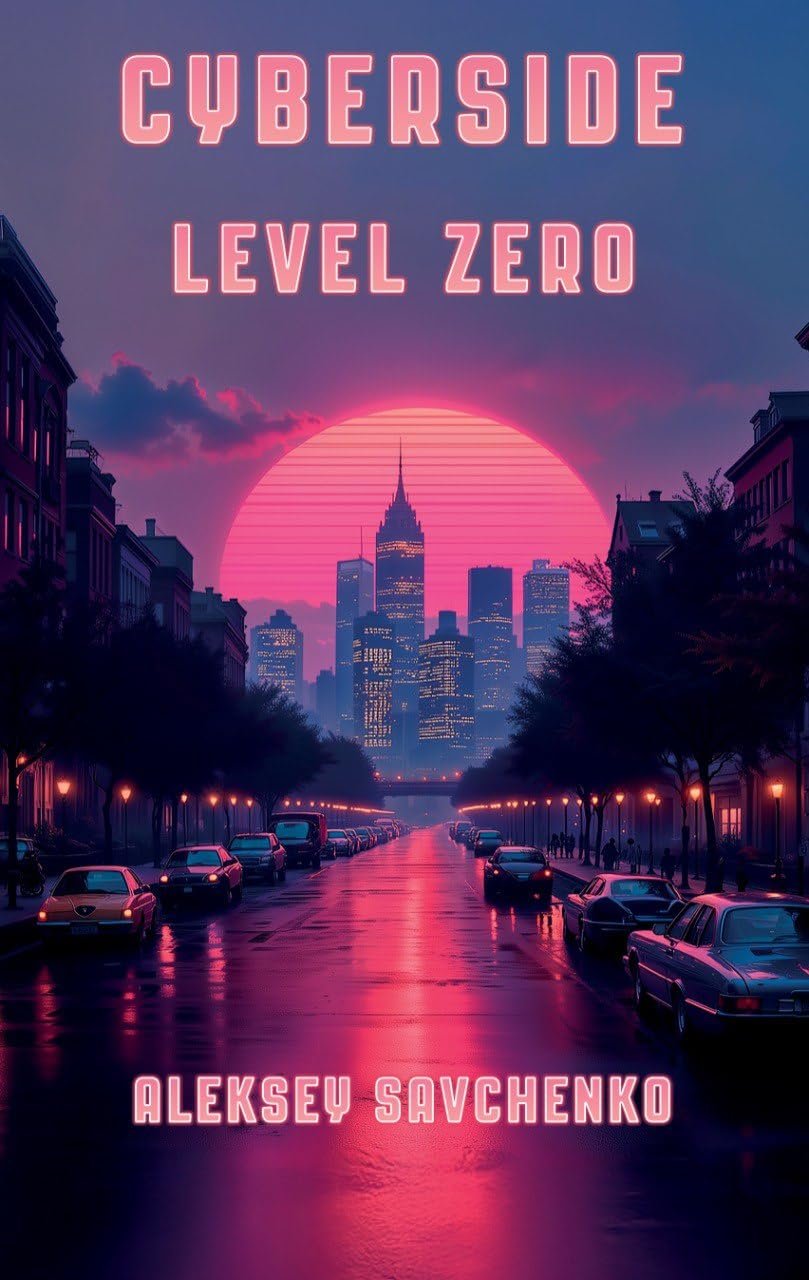
Cyberside: Level Zero
Inside the origins of Fall Water Lake, a videogame company creates the digital system that will ensnare humanity.
Books worth discovering. Authors worth knowing.
A virtual world begins as an entertainment success before its ambitions threaten to become impossible to escape.
The author’s official site describes the 1997–2030 prequel, the company Fall Water Lake, and a massively popular game evolving into an oppressive simulation.
Before the virtual trap closes
Cyberside: Level Zero by Aleksey Savchenko approaches dystopian science fiction through the origin of an entertainment system. According to the author’s official site, Fall Water Lake is a game-development and data company responsible for Cyberside, a hugely popular video game that eventually becomes a virtual simulation trap for humanity. The book’s action spans a reimagined history from 1997 to 2030, blending corporate ambition with the technological decisions that make an immersive world possible. It functions as a prequel to the earlier Cyberside story. Rather than inviting readers to accept a frightening digital future as inevitable, the premise asks them to look at the choices that built the infrastructure behind it.
That change of perspective matters. Dystopias often begin with a system already in power, leaving protagonists to fight its consequences. A prequel can illuminate how ordinary commercial incentives, practical compromises and excitement about innovation slowly generate exceptional risk. The result need not depend on an instantly recognizable villain. An institution may pursue growth, convenience or user engagement while failing to recognize how interconnected decisions narrow future choices. The author’s description supports this broad interpretation, though it does not supply the exact sequence of corporate deals or the identities of everyone responsible.
A game company at the center of the future
Fall Water Lake is not announced as a military government or a religious order. It is a company in the entertainment and data business. That positioning is particularly suggestive because players generally enter a game by choice. Enjoyment, exploration, social connection and imaginative agency are normal reasons to engage with digital worlds. The dangerous turn comes when systems built to attract attention gain more influence over users’ choices than those users can reasonably evaluate. Cyberside’s promised evolution into a trap makes that boundary the critical subject of the prequel.
Calling a game a simulation does not by itself establish that every technical process described by the novel would work in reality. This is speculative fiction, not a consumer safety finding or a prediction of particular products. Its value as a thought experiment is to ask how a desirable experience can become a mechanism of dependence or control. Readers familiar with gaming culture may be especially interested in the way apparently benign design goals can become entangled with business models. The narrative’s announced setting allows that conversation to happen within a thriller rather than a policy paper.
Three decades of imagined development
The official synopsis places the story between 1997 and 2030. That range lets Savchenko draw upon an era when games, networks, business models and expectations of digital life changed dramatically. A long timeline is well suited to showing how technological power accumulates. Early decisions may seem too modest to matter; later systems can make those decisions difficult to reverse. A reader can look for the continuity between the motivations of developers at the start and the consequences of products at the end, without treating an imagined timeline as verified technical history.
The author’s choice to build an alternate history also creates useful dramatic tension. Readers know where real digital culture eventually went, but the novel can ask what would happen if certain tendencies intensified along different paths. The familiar language of upgrades, platforms, immersion and data becomes part of the speculative vocabulary. Each step invites a question about governance: who can inspect the system, who benefits when it expands and who bears the cost if its effects become impossible to escape? The book’s publicly accessible description establishes those concerns thematically, not an exhaustive list of scenes.
Corporate greed as an engine of suspense
Savchenko names corporate greed, complacency and abuse of power among the book’s themes. These are not merely slogans when combined with an entertainment system whose reach becomes global. A company can describe increasing participation as success even when that metric obscures who has meaningful control. It can call a barrier to exit a form of seamless integration, or treat objections as resistance to progress. In a thriller, such linguistic shifts can be as ominous as a visible act of force. The announced plot invites attention to the language institutions use to explain their ambitions.
The distinction between personal malice and structural incentive is important. Not every employee must foresee or approve a harmful outcome for an organization to produce one. People can contribute small parts of a large product while understanding only their assigned tasks. Others may recognize warning signs but lack authority to change direction. These are interpretive possibilities of the corporate-dystopian premise, not invented character histories. The threat becomes more unsettling because it resembles a problem of scale, coordination and accountability rather than a single switch that one hero could simply turn off.
Entertainment, data and human agency
A video game invites users to inhabit rules they know are designed by someone else. That is part of the pleasure: a crafted environment creates a challenge, a story or a space to explore. The concern in Cyberside emerges when the distinction between chosen play and unavoidable experience becomes unstable. Who knows that an environment is shaped? Can participants leave? Are their preferences being respected or predicted and redirected? Those questions resonate beyond science fiction, but the text’s fictional premise should remain separate from factual claims about existing commercial systems.
The author’s website describes the novel as a warning about powerful games and simulation. A warning story can be most effective when the attractive features of its invention are not ignored. If the system had no appeal, the scale of its reach would be hard to explain. That observation offers a useful lens for reading the book: the danger may be tied precisely to what originally made the product compelling. A world people want to inhabit is a more complicated ethical problem than a prison they never willingly entered.
From insider knowledge to imagined consequence
Savchenko’s professional background supplies unusual context. Public author material identifies him as an experienced game developer, and industry publicity links his career to major studios and projects. Such experience can inform an author’s sense of how creative work, engineering and corporate hierarchy intersect. It should not be mistaken for a guarantee that every speculative technology in the book is technically feasible. Expertise in making games provides a grounded professional viewpoint; the novel still uses imagination to connect present decisions with extreme future outcomes.
That professional frame may distinguish Cyberside: Level Zero from a generic anti-technology parable. A storyteller who knows the attractions and difficulties of game development can imagine both the exhilaration of creating a compelling virtual space and the risks of scaling it beyond the control of its original builders. Readers can evaluate how well the narrative handles that tension after reading it. This feature confines itself to the verifiable premise and public statements of intent.
The importance of a prequel
Readers approaching Level Zero without prior knowledge of Cyberside should understand its place in the sequence: it looks backward toward the system’s origin. Knowing that a celebrated game later becomes oppressive does not necessarily spoil the prequel. It shifts suspense away from whether something goes wrong and toward how the conditions for harm accumulate. A story about a preventable disaster can hold tension even when its destination is broadly known. Indeed, the reader may become alert to moments that seem insignificant to those living through them.
The title Level Zero carries a useful metaphor of origin and tutorial, but the publicly available material does not confirm that its chapters literally follow game levels. Readers should avoid forcing a mechanical structure onto a book because of the name. The confirmed attraction is a corporate techno-thriller in which the construction of a global virtual world exposes the dangers of unchecked influence. It asks readers to imagine the making of power as an unfolding process.
Who should read it
Cyberside: Level Zero is positioned for readers of dystopian science fiction, cyberpunk-inflected corporate thrillers and speculative fiction about virtual realities. People interested in video games as businesses and designed experiences may find its central premise especially resonant. Readers seeking a straightforward adventure entirely inside a game should note the substantial company-history and prequel framing announced by the author. The book’s warnings are fictional extrapolations, not established forecasts of how current games will develop. Savchenko offers a lens on corporate incentive and digital dependency from the perspective of a working game developer, and this feature relies on his official synopsis and professional profile rather than a claim of direct textual review.
About the book.
Speculative corporate dystopian techno-thriller / science fiction. The author’s official site describes the 1997–2030 prequel, the company Fall Water Lake, and a massively popular game evolving into an oppressive simulation. Research-based editorial feature, not a claim of firsthand reading.
Independent editorial book feature; marked not sponsored in the source queue. Research-based commentary using verified public material, not a firsthand review. Cover media fields await the owner’s publishing automation.
Found a book worth opening?
Books worth discovering. Authors worth knowing.
Return to the Journal →