
Amsterdam’s Compleat Fools
A visual archive preserves the programs and graphics of Amsterdam’s Festival of Fools from 1975 through 1984.
Books worth discovering. Authors worth knowing.
A festival ends when its final performance is over; its printed traces can tell another story for decades.
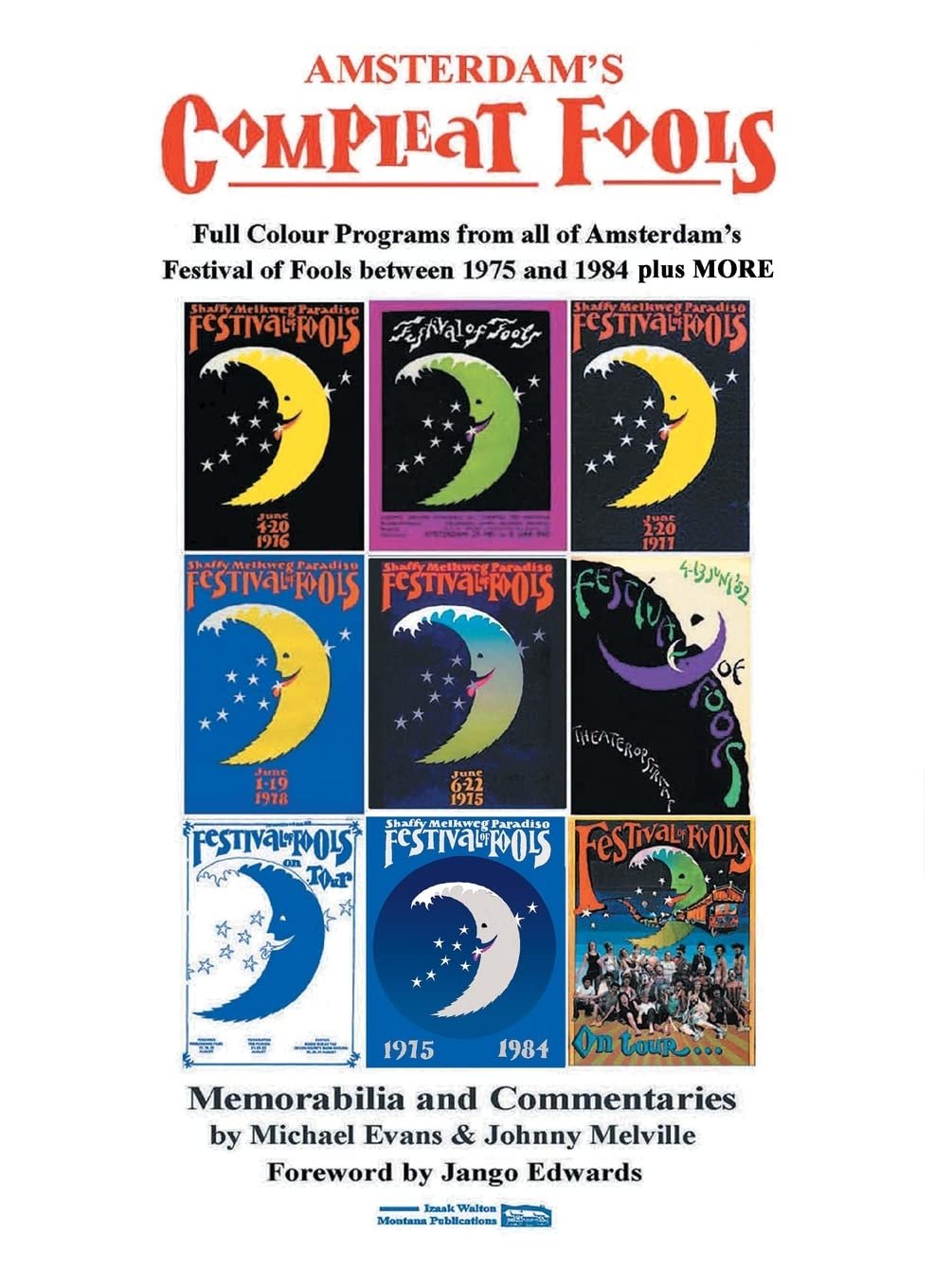
Catalog descriptions confirm complete full-colour festival programs, related graphic material and introductory essays by Evans and Johnny Melville.
An archive of performance that might otherwise disappear
Amsterdam’s Compleat Fools, compiled by Michael R. Evans, collects full-colour programs from Amsterdam’s Festival of Fools between 1975 and 1984, alongside graphics and records from associated festivals. Bookseller descriptions identify introductory essays by Evans and Johnny Melville, and the bibliographic record places the large-format volume with Izaak Walton Montana Publications. This is not a conventional novel or a fresh program for a future event. It is a historical sourcebook documenting a lively period of experimental performance through materials that once served practical, immediate purposes: telling audiences what was happening, when to arrive and whom they might encounter.
The value of those everyday objects is easy to underestimate. A performance can transform an evening and then vanish when the audience leaves. Photographs and reviews preserve fragments, but a festival program records a different perspective: what organizers intended to present, how artists were named, which venues mattered and what visual language surrounded the event. A complete run of programs can reveal changes that an isolated souvenir cannot. The book’s announced ambition is preservation on a scale that allows readers to place individual festivals within a longer story.
Why a program is more than a list
Festival programs combine the functional and the expressive. They may help visitors navigate performances, but their design can also embody a creative community’s taste, humor and values. Typography, illustration and layout carry messages about what an event expects from its audience. Even an apparently minor note of introduction can reveal whether the festival imagined itself as established institution, temporary gathering or deliberate challenge to conventional culture. These are reasons to study programs as historical evidence, not assertions about specific pages in Evans’s book that this feature has not inspected directly.
The stated inclusion of full-colour reproductions matters for this kind of project. A black-and-white transcription might preserve names and dates while losing much of the visual energy of original materials. Colour can make posters, graphic jokes and design choices legible in ways a bare list cannot. At the same time, reproduction is not the same as experiencing a live performance or handling an original object. The archive preserves one layer of the festival’s life, while readers must imagine sound, movement and the changing atmosphere of a public gathering.
Ten years of a changing scene
The dates 1975 to 1984 situate the primary programs within a decade of artistic experimentation and changing urban culture. The value of collecting every annual program is partly comparative. Readers can look for recurring performers, shifting themes, newly adopted design conventions and evidence of changing organizational scale. A single year’s material may seem idiosyncratic; placed beside nine others, it can show a community developing its own memory. The book promises that longitudinal perspective rather than a retrospective built solely from one narrator’s recollections.
A broad festival history requires care with labels. The word fool can invoke clowning, tricksters, satire and challenges to authority, but the available retail summary does not provide a verified list of every artistic form or performer represented in this exact volume. It is more accurate to describe the book as an archive of Amsterdam’s Festival of Fools and related performance materials. That phrasing avoids reducing a wide-ranging arts project to a single genre based on its playful name.
The people behind ephemeral events
An event is often remembered by a handful of celebrated names. Programs can restore visibility to the larger network of performers, organizers, designers and collaborators who made it possible. This is one of the strongest arguments for preserving complete source material. When the historical record depends only on later celebrity, modest contributions can disappear. A festival’s printed record allows researchers to ask who shared stages, how collectives identified themselves and which artists returned across years. It may also reveal overlooked participants whose careers followed different paths.
The book’s related publication, The Gathering Fools, describes a broader effort to document performers, musicians, dancers and productions associated with the festivals and their later spread beyond the Netherlands. That companion project’s description helps situate Evans’s interest in preservation. It should not be treated as proof that each of its later historical claims or production lists appears identically in Amsterdam’s Compleat Fools. The titles are related but distinct objects with their own scope and editions.
Amsterdam as a meeting place
A festival can be a temporary city within the city, organizing its own routes between venues and its own networks among visiting artists. Amsterdam’s position as a cultural meeting point is relevant to the documented festival history, especially where connected projects describe international growth. International artists may carry ideas, techniques and performance traditions across borders, creating conversations that no single national history can capture. Programs provide evidence of that exchange through names, languages, images and performance descriptions.
Yet it is important not to romanticize every historical gathering as uniformly open or egalitarian. Access to travel, performance space and funding has always been uneven. An archive can be read with questions about who appeared in the printed record and who may have remained outside it. Such questions make the volume useful for scholarship without demanding that it provide all the answers. The program reproductions preserve the festival’s public face; more complete histories may require oral interviews, press archives and memories from participants.
Introductory essays as interpretive bridges
Bibliographic descriptions identify special introductory essays by Johnny Melville and Michael Evans. Their presence matters because collections of primary documents benefit from historical orientation. A contemporary reader may know little about the conditions in which a program was designed or the meaning of a local reference. Essays can provide context, indicate why the archive was assembled and help readers approach materials that were originally made for audiences with shared knowledge. The feature does not claim to have read those essays or summarize their arguments; it records their confirmed inclusion.
A well-used archive invites readers to distinguish the voices of its documents from later commentary. A program speaks from the time of an event and may celebrate its aims, while a retrospective essay can assess the longer influence of the scene. Neither perspective is automatically complete. The combination creates opportunities for historical dialogue: what did participants think they were making, and what can later observers recognize about its legacy? That distinction is especially important for performance history, where memory and documentation are necessarily partial.
The art of keeping unstable things
Live performance is ephemeral by design. The moment shared by performers and an audience cannot be reproduced exactly. Preserving paper records therefore requires acknowledging both their richness and their limitations. A poster cannot carry a performer’s timing; a program cannot recreate audience laughter; a photograph may capture one gesture without the sequence that gave it meaning. But these objects offer concrete points of return. They allow a later reader to trace the outlines of a creative community that might otherwise survive only through anecdotes.
The volume’s considerable size and colour emphasis suggest a book intended for consultation and visual exploration as much as linear reading. It may reward opening to different periods, following names and comparing the graphic language of annual programs. These are uses suggested by the documented format, not claims about the exact binding quality, print reproduction or organization of the pages. Buyers should confirm the edition’s dimensions and cost before treating it as an ordinary trade paperback.
Why this history matters now
Independent and experimental arts scenes often face the problem of disappearance. Temporary spaces close, programs are discarded, websites are redesigned and participants move on. A carefully assembled record can support artists, historians and readers who want to understand how creative communities made their own institutions. It is also a reminder that an artistic tradition is never simply inherited; someone must choose what evidence to preserve and how to make it available to others. Evans’s compilation states that preservation purpose through its selection of festival programs and associated graphics.
The title’s archaic spelling, Compleat, gives the project a playful archival personality. Its essential promise remains straightforward: a visual record of a particular festival era, supplemented by related materials and essays. Readers should approach the volume as primary-source-rich cultural documentation, not a definitive history of every European performance experiment of the period.
Who should read it
Amsterdam’s Compleat Fools is suited to theatre historians, performers, designers, archivists, collectors of countercultural ephemera and readers fascinated by European experimental arts. It may be useful as a visual reference for how festivals represented themselves in print over time. Those seeking a conventional narrative history should note that the principal attraction is the reproduced program material and supporting essays. Because the public sources offer edition summaries rather than a fully inspectable page-by-page archive, readers should verify the format and specific contents before buying for research. Michael R. Evans’s compilation preserves the traces of performances that once existed chiefly in the moment, making a disappearing artistic world more available for careful study.
About the book.
Performing-arts history / archival festival-program collection. Catalog descriptions confirm complete full-colour festival programs, related graphic material and introductory essays by Evans and Johnny Melville. Research-based editorial feature, not a claim of firsthand reading.
Sponsored book feature. Research-based commentary using verified public material, not a firsthand review. Cover media fields await the owner’s publishing automation.
Found a book worth opening?
Books worth discovering. Authors worth knowing.
Return to the Journal →