
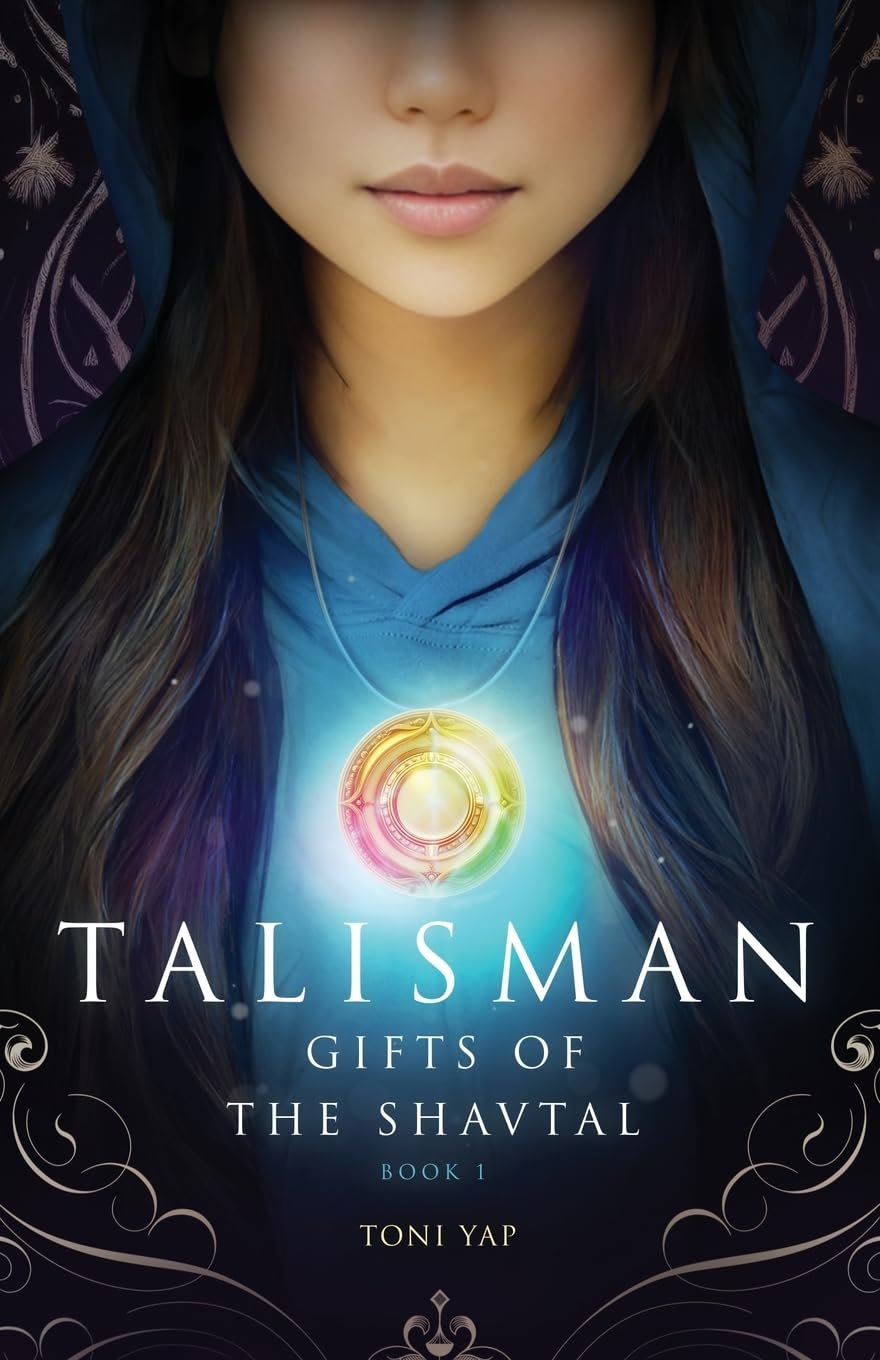
Talisman: Gifts of the Shavtal
A young girl’s ability to see auras opens an Other World mystery against a background of family danger and questions about revenge.
Books worth discovering. Authors worth knowing.
A young girl’s ability to see auras opens an Other World mystery against a background of family danger and questions about revenge.
Twelve-year-old GiGi gains new awareness of her powers after calling for help for her mother, then encounters fae ancestry and a talisman.
When the hidden world appears inside an unsafe home
Toni Yap’s *Talisman: Gifts of the Shavtal* introduces twelve-year-old Georgina Trabeck, called GiGi, in circumstances that are frightening before any magic appears. She finds her pregnant mother unconscious and calls emergency services despite her stepfather’s demand that the family keep what happens at home secret. GiGi has long been able to see colors surrounding people, a gift that helps her interpret danger, but a new intensity in those visions coincides with her decision to resist abuse. The author’s official synopsis makes the overlap between domestic peril and supernatural power central to the story. It is not a fantasy in which magical discovery simply replaces the ordinary world’s problems. GiGi has responsibilities that no child should have to carry alone. She worries about her younger sister, Chrissy, and faces bullying at school connected to her Filipino identity. The synopsis also introduces her best friend Danae Jenkins and a Sidhe fairy named Irra, who brings a talisman and the revelation of a family connection. Those ingredients establish a world where friendship, belonging and questions of heritage intersect. They also create a difficult temptation: when someone has been powerless for years, the ability to make another person afraid can feel like justice. The story’s explicit warning about revenge raises a question that matters more than any single magical effect.
An aura as a way of reading danger
The ability to perceive auras works at several levels in the documented premise. On the literal fantasy level it is GiGi’s supernatural gift. On the emotional level it resembles the heightened alertness of someone who has learned to watch adults carefully for signs of danger. The author describes a black cloud around her stepfather that GiGi comes to understand in relation to her developing powers. Those facts allow an interpretation about perception without claiming that auras exist as a scientifically established phenomenon. The book is fantasy; its imaginative system should be understood in that genre. That distinction matters because stories of abuse sometimes risk implying that victims can save themselves if only they discover hidden strength. Real children need safe adults, credible institutions and practical protection; an enchanted object is not a solution available outside fiction. Yap’s premise may be compelling precisely because it offers a fictional language for the desire to protect loved ones when ordinary structures have failed. GiGi’s decision to call 911 is as consequential to the human situation as any later magical encounter. The act of seeking outside help is grounded in the book’s official opening description and keeps the drama connected to real-world responsibility.
The talisman and the temptation of revenge
Irra’s arrival expands the story into a realm of fae ancestry and special objects. The author says the fairy warns GiGi not to use the talisman for revenge. That warning transforms power from an uncomplicated reward into a test of intention. A young person facing cruelty may understandably want those responsible to feel the same fear. Fantasy can dramatize that impulse with unusually vivid consequences. Whether the protagonist accepts, questions or violates the warning over the whole novel is not established by the limited synopsis, so it should not be invented here. The reliable focus is the conflict between urgent self-protection and the risk that retaliation changes the person wielding power. The author’s story description connects the talisman to a mystery involving Danae’s parents. The result is an expanding set of obligations: loyalty to a friend, care for family, curiosity about hidden origins and responsibility for extraordinary abilities. This is fertile ground for a coming-of-age fantasy because adolescence is already a period of discovering that personal choices affect other people. The magical inheritance intensifies that awareness. The book’s real emotional stakes are not simply whether GiGi can do something extraordinary, but whether she can decide what she owes to herself and those she loves.
Filipino identity and a story of belonging
An independent BookLife review identifies the novel as a coming-of-age story about a Filipina-American girl facing both domestic abuse and racism. These two forms of harm should not be collapsed into one generic obstacle. Bullying tied to ethnicity can shape a child’s experience of visibility and belonging, while danger at home threatens the place that is supposed to offer safety. GiGi’s encounter with an Other World heritage adds another layer of identity. The premise asks whether a child can become more secure in who she is while discovering that others have tried to define or limit her. The fantasy’s value does not depend on treating GiGi as representative of every Filipino-American child. Rather, her specific circumstances make room for a protagonist whose identity is not incidental to the narrative. The author has publicly described herself as Filipino-American and a veteran, a biographical fact that can help explain the interest in this perspective without assuming every fictional scene is autobiographical. Readers should also note the book’s sensitive themes. A young protagonist does not automatically make a novel suitable for every child, especially when its central setup includes violence and threats within a family.
A series opening with questions larger than a gift
*Gifts of the Shavtal* is presented as a series, and retailer information identifies *Talisman* as its first installment. Series orientation matters because a debut adventure may reveal a wider mythology without completing every thread. Readers drawn to origin stories can watch the implications of ancestry and ability unfold. The available descriptions suggest that GiGi’s powers have costs and limits; they do not license a definitive inventory of rules or the outcome of future installments. The author-site synopsis is the safest basis for understanding what the first book promises. The narrative combines at least three forms of mystery: what GiGi’s auras mean, how the fairy world connects to her family and what happened to people important to Danae. None of those should be solved in a promotional article. The more revealing question is why these mysteries matter to this particular heroine. She is not merely curious about a secret kingdom; she needs to protect people in a life already complicated by fear. The fantasy thus appears to use revelation as a way to examine responsibility rather than as an excuse to abandon a grounded emotional situation.
Who should read Talisman
Readers who favor emotionally grounded young-adult fantasy, paranormal gifts and protagonists negotiating difficult family circumstances may find *Talisman* engaging. It may especially appeal to those who want magic intertwined with questions of accountability, heritage and friendship. Because the premise includes domestic abuse and racism, caregivers and younger readers should assess content suitability before choosing it. It is not a book to recommend casually as a lighthearted fairy adventure, even though fantastical beings play a role. For the right reader, its compelling starting question is what a young person should do when the ability to fight back finally arrives—and how to use that power without letting revenge become the only answer.
About Toni Yap
Toni Yap’s official site supplies the book’s plot summary, and her Authors Guild profile identifies her as a Filipino-American writer of fantasy and historical fiction. Atmosphere Press and BookLife also describe *Talisman* and its themes. Those sources ground this feature; no invented personal experiences or unsupported claims about the novel’s ending have been included.
About the book.
Young adult paranormal fantasy / coming-of-age adventure. Twelve-year-old GiGi gains new awareness of her powers after calling for help for her mother, then encounters fae ancestry and a talisman. Research-based editorial feature, not a firsthand review.
Independent editorial book feature. Research-based commentary using verifiable published sources, not a claim of a complete firsthand reading. Cover placeholders await the owner’s Python automation.
Found a book worth opening?
Books worth discovering. Authors worth knowing.
Return to the Journal →