
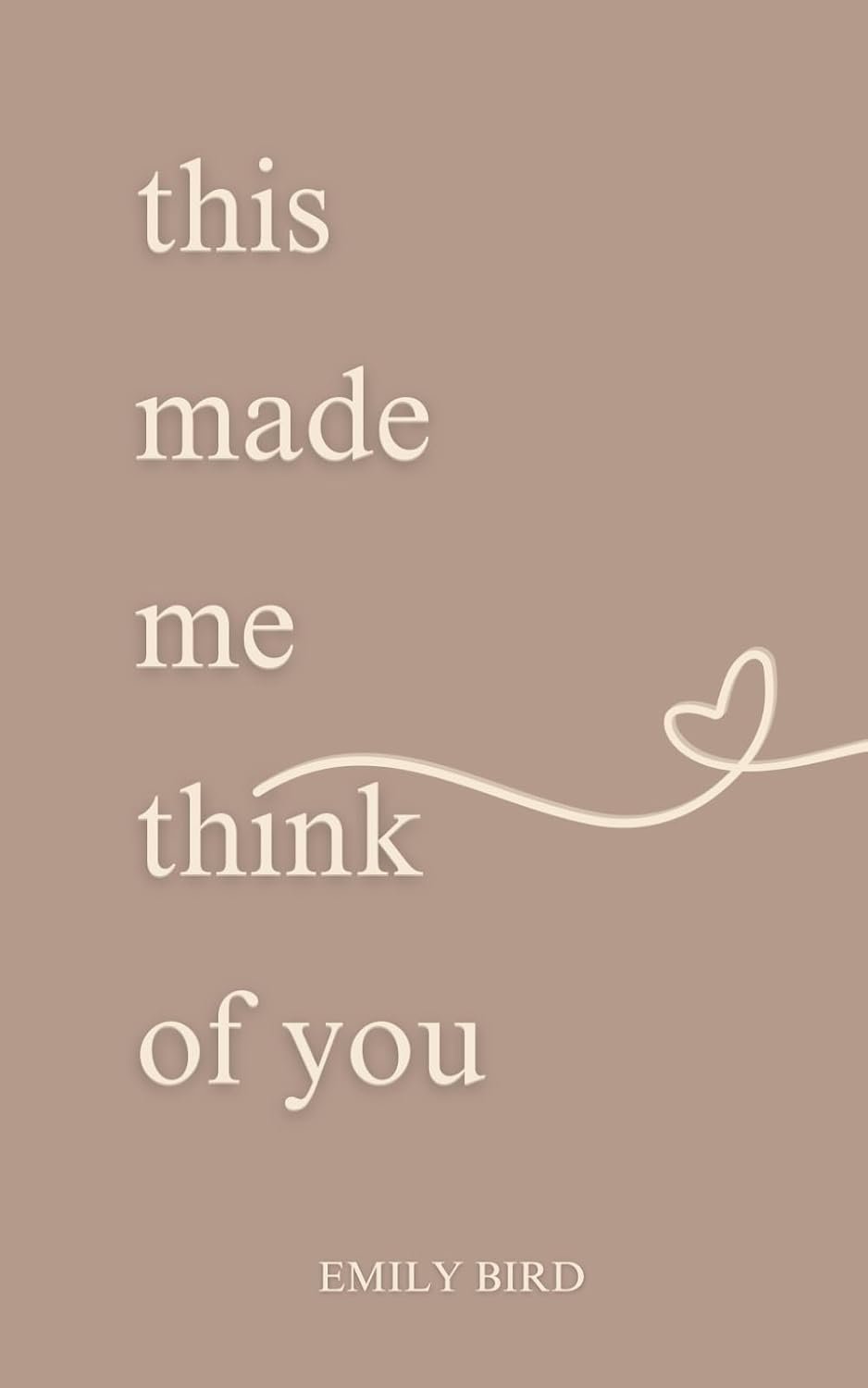
This Made Me Think Of You
A poetry collection about the everyday moments that unexpectedly bring someone you love to mind.
Books worth discovering. Authors worth knowing.
A poetry collection about the everyday moments that unexpectedly bring someone you love to mind.
A song on the radio, a sunset, or a passing sentence can return someone to mind without warning.
The small moment that becomes a message
A song on the radio, a sunset, or a passing sentence can return someone to mind without warning. Emily Bird’s poetry collection This Made Me Think Of You is built around precisely that everyday phenomenon: affection is often most vivid not during a grand occasion but in the ordinary instant that makes one person think of another. The publisher’s description presents romantic poems meant to be shared with someone significant, and it points toward memories, gratitude, companionship, and the understated rituals of closeness. That is a specific literary proposition. The poems are not being presented as an epic storyline, a manual for making relationships work, or proof that a particular kind of love is universal. They are brief invitations to recognition. The book’s premise is a useful reminder that a relationship also exists in the mind while the other person is absent. An association can turn a place or object into private shorthand. Bird appears interested in the language that crosses the space between feeling something and finding words another person can receive. Readers looking for romance that starts with noticed details rather than spectacular declarations will recognize the appeal.
Love poetry that travels between people
The available bibliographic description calls the work a collection of heartfelt poems about the person who lingers in one’s thoughts. It also explicitly positions the book as something readers may annotate, personalize, and give. That invitation changes the social life of a poetry collection. A book can be read in solitude, but it can also serve as a conversation between the giver and the recipient. Underlining a line or adding the date of a shared memory turns a printed page into a record of two lives. Bird’s marketing emphasizes couples, yet the broader act of association is familiar in friendship and family too. It is important not to claim that individual poems address all those relationships when only the collection’s romantic focus is reliably described. More cautiously, the book’s central concept shows how personal memory supplies an extra layer to any lyric: two people reading the same words may attach very different experiences to them. This is why intimate verse can invite a response rather than dictate one. A reader’s own associations complete the exchange without requiring the author to explain every private detail.
A language for ordinary tenderness
Public descriptions emphasize the first flutter of attraction, gratitude for small things, and the steadiness of established love. These are widely recognizable dimensions of romantic attachment, but they are not identical experiences. Early excitement is marked by possibility; long familiarity tends to depend on accumulated gestures and mutual attention. A collection gathering both registers invites readers to notice change without assuming affection must remain at its first intensity. Its title puts the moment of recognition ahead of any claim to define love comprehensively. For a reader who is not naturally expressive, such writing may be a useful starting point for articulating something specific: the way a partner remembers a preference, provides company during a difficult day, or understands an apparently unimportant joke. None of those scenes is asserted as an actual poem in Bird’s book. They are the everyday situations that make this category of poetry meaningful. The value of a short romantic text lies partly in what it does not prescribe. One can take the emotional prompt and translate it into one’s own vocabulary, rather than borrowing a ready-made declaration that does not sound true.
Reading a collection without demanding a plot
Poetry collections reward a different pace from novels. A scene need not lead to another scene, and the next page may bring a shift in mood rather than an advancing story. That matters when deciding whether This Made Me Think Of You is the right gift or companion. Readers expecting a memoir of a specific relationship should not assume that the collection supplies one; the descriptions identify poems, not a continuous narrative or detailed autobiographical sequence. Instead, the reading experience is organized around emotional recognition. Moving slowly through a handful of poems may allow a phrase to settle more deeply than consuming the book in one sitting. Reading aloud can shift the meaning again, because the voice of the person sharing the words becomes part of the experience. The book’s promotional material specifically suggests reading together, and that is a plausible use of this format without inventing anything about the wording of unpublished poems. The question is less whether each poem resolves an argument than whether it leaves a generous opening for someone else to say, ‘Yes, that reminds me of us.’
What makes a personal gift feel personal
The commercial description presents the collection as suitable for birthdays, anniversaries, and other moments when affection deserves expression. Those occasions can create pressure to choose the perfect words. A book does not remove that pressure automatically; it may even feel generic if given without thought. Bird’s suggested practice of personalizing pages offers a better way to approach the gift. The most meaningful inscription often names a real moment instead of merely repeating a romantic ideal. A bookmark placed beside a meaningful page, a note explaining why the title fits, or a shared reading ritual can make the volume feel less like a product and more like a particular exchange. Again, the specifics of such gestures are reader suggestions, not instructions purportedly lifted from the poems. There is also value in respecting different tastes. Some people love openly sentimental writing; others communicate through humor, service, or quieter routines. A useful gift should fit the recipient rather than oblige them to respond in a scripted way. The title’s modest wording makes space for that individuality.
What can and cannot be established from the sources
The book is listed under Emily Bird’s name in bibliographic records and retailer catalogs, with poetry and romantic themes clearly identified. Sources vary by edition and format in page counts and publication details, so this feature does not treat a single length as universal. Retail descriptions provide a general thematic map, but they do not give a complete table of contents or a basis for judging the craft of every poem. It would be misleading to invent favorite passages, an exact sequence of emotional stages, or a firsthand response to the whole collection. What can be said is that its official positioning emphasizes shareability, affectionate memory, and accessible expression. Readers can evaluate that proposition for themselves. They can notice whether the language feels intimate or overly familiar, whether a poem helps them say something they could not express alone, and whether the gesture of passing the page to another person is comfortable for both. These are legitimate reading questions, not disguised claims about having read passages unavailable to this feature.
Who should pick up This Made Me Think Of You
This collection is especially suited to readers who like short romantic poetry and want words that invite shared memories. It may also appeal to people choosing a thoughtful gift for someone who appreciates written affection more than an elaborate display. Couples who enjoy reading aloud or leaving notes for one another may find the format inviting. Readers seeking narrative romance, sharp satire, or a broad exploration of every kind of relationship should understand that the published descriptions emphasize a narrower and more tender register. The best use is unhurried and personal: sample the poetry, consider which sentiments match a real relationship, and allow your own language to accompany the author’s. That leaves room for both sweetness and honesty, rather than turning the book into a test of how a couple ought to feel.
About the poet
Emily Bird is credited as the author of This Made Me Think Of You in multiple bookseller and bibliographic listings. Public descriptions characterize her work as romantic poetry intended for sharing; beyond those sources, no additional biographical milestones are asserted here. Her central editorial idea is simple enough to travel far: being reminded of someone is a small event that can carry a large emotion. The reader decides which memories give that idea its meaning.
About the book.
Romantic poetry collection. A poetry collection about the everyday moments that unexpectedly bring someone you love to mind.
Sponsored book feature. Original research-based commentary, not firsthand complete-book reading. The owner’s Python automation will resolve the cover placeholder.
Found a book worth opening?
Books worth discovering. Authors worth knowing.
Return to the Journal →