
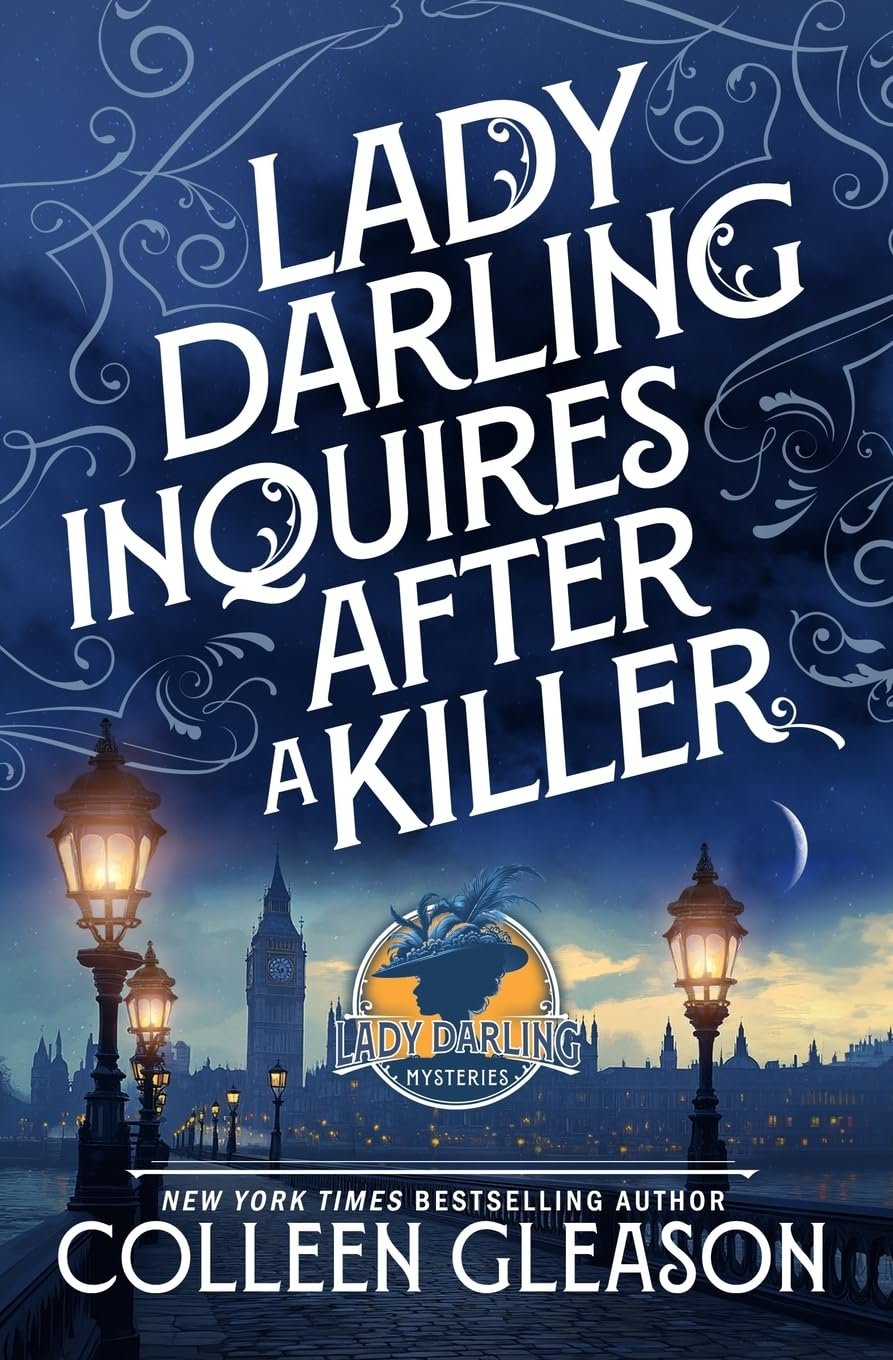
Lady Darling Inquires After a Killer
A wealthy, fifty-year-old Victorian widow seeking peace among her gardens and pets investigates a murder at a dinner party.
Books worth discovering. Authors worth knowing.
A wealthy, fifty-year-old Victorian widow seeking peace among her gardens and pets investigates a murder at a dinner party.
Colleen Gleason introduces Lady Darling as a fifty-year-old widow in Victorian London who has already managed the socially approved business of her family: her children are grown, successfully married and established.
A Widow Who Has Earned Her Peace
Colleen Gleason introduces Lady Darling as a fifty-year-old widow in Victorian London who has already managed the socially approved business of her family: her children are grown, successfully married and established. She has status, influence, money and something less readily granted to women in fiction: the desire to be left alone. Gardens, books and beloved animals are enough of a plan for a woman who no longer wishes to perform society’s expectations. Then a guest dies at a dinner party, and a decidedly inconvenient investigation finds its way into her life. The central situation in Lady Darling Inquires After a Killer is instantly clear, but it carries an amusing inversion. The woman who would rather not be bothered becomes the person most willing to notice what others overlook. Gleason’s official description positions this as the first Lady Darling Mystery, a Victorian-set whodunit interested in both criminal puzzles and the intelligence of someone society has underestimated.
An Older Sleuth, Not an Afterthought
Fifty may not sound old to a modern reader, but Gleason’s introduction makes explicit that London society treats her protagonist’s age as a reason to consider her uninteresting or eccentric. That assumption creates a useful disguise for a detective. Someone regarded as peripheral may hear remarks others reserve for supposedly harmless listeners; someone outside the marriage market may move through social settings without being scrutinized in quite the expected way. Lady Darling, however, is not powerless. Her title and resources can open doors closed to others. The combination of social invisibility and extraordinary influence offers a lively engine for the mystery. It also invites the reader to question why fictional investigators so frequently require youth, athletic daring or official positions to be compelling. Experience can sharpen the ability to read evasions, contradictions and awkward silences. A person who has already managed a household and raised children may know a great deal about motives without ever having collected evidence for the police.
Murder Interrupts the Dinner Party
The murder arrives in the very setting where a woman of Lady Darling’s position is expected to maintain elegant composure. Dinner parties are engineered for civility: invitations carry meaning, seating arrangements reveal status and apparently gracious conversation can conceal rivalry. A death turns those arrangements inside out. The official premise establishes the murder and Lady Darling’s presence but keeps the victim and solution under wraps, which makes restraint essential in a spoiler-conscious feature. The interesting question is not which guest committed the crime but why a smart, wealthy widow would choose to take it upon herself. She could plausibly let others handle the ugliness. Instead, her competence seems to leave her unwilling to accept a mystery unresolved. Such a decision instantly changes the terms of her promised retirement. Quiet leisure is an aspiration, but curiosity and a sense of responsibility may prove stronger than the wish not to be involved.
Gardens, Books and Unconventional Companions
Gleason specifically identifies Lady Darling’s pets, gardens and books as pleasures worth protecting. These are not incidental accessories; they help define a character whose everyday life has value apart from solving crimes. The details can also set the emotional rhythm of a cozy historical mystery. The reader returns from suspicious conversations to a familiar home, living creatures and a heroine who might prefer a peaceful afternoon to another public encounter. Gardens are cultivated spaces, built around careful observation and patience; books invite attention to overlooked clues and competing interpretations. Those connections are thematic possibilities, not claims that any specific plant or volume reveals the killer. Animals can bring levity and warmth without reducing the murder to a game. If the mystery works as an ongoing series, these domestic pleasures create an appealing continuity as the criminal cases change. They suggest that the detective’s personality will matter as much as the cleverness of a final reveal.
Victorian London as a Social Puzzle
The historical setting allows Gleason to connect investigation with rules about gender, class and reputation. A nineteenth-century aristocratic widow can wield informal power even where professions and institutions remain male-dominated. A servant, a younger relative and a titled dinner guest might possess the same fragment of evidence but face very different consequences for speaking about it. That uneven social landscape makes the detective’s judgment unusually significant. Contemporary readers know that the Victorian period cannot be described by a single code of behavior, so a feature should not pretend to settle historical questions on the strength of a book description. The fiction’s appeal lies in what the setting makes imaginable: formal conversation used as a cover for maneuvering, polite behavior masking private hostility, and a heroine who turns social literacy into investigative skill. Mystery readers may enjoy watching the protagonist negotiate what she is permitted to ask and what she decides to ask anyway.
Humor Without Forgetting the Stakes
The author presents the story as a charming Victorian mystery, comparing its spirit with narratives about unconventional investigators. That signals a playful tone, though it does not establish that every scene is lighthearted. A dinner-party death is a serious act; the comic opportunity grows from social expectations, sharp exchanges and the contrast between Lady Darling’s desired solitude and the demands of a case. Mature heroines in mysteries often succeed because they refuse to accept the labels assigned to them, and Lady Darling appears designed around that possibility. A woman considered intimidating or eccentric can repurpose both reputations to her advantage. Readers who appreciate dry wit may be drawn as much to her attitude as to the puzzle. A good cozy mystery invites attention to people and relationships as well as clues, giving the investigation personal texture while retaining the uncertainty that keeps pages turning.
The Start of a Continuing Series
Colleen Gleason’s official bibliography lists Lady Darling Inquires After a Killer as Book One and identifies a second entry, Lady Darling Vexes a Villain. That order matters for readers deciding where to begin. The first volume offers the opportunity to meet the detective before the reader has formed assumptions based on later cases. Gleason is an established writer with work spanning mysteries and speculative historical adventure, yet this new protagonist has a distinct premise: a socially powerful widow who sees no reason to retreat from intellectual life merely because her children have established theirs. The official listing dates the volume to September 2025 and identifies Oliver Heber Books as publisher. Edition-specific details should be checked against the selected link, since covers and formats can vary. What should remain stable is the introduction of an investigator whose age and social position are not disadvantages to be overcome but parts of her particular method.
For Readers Who Prefer Their Detectives Observant
Lady Darling Inquires After a Killer is a natural discovery for readers seeking a Victorian mystery with a self-possessed older heroine, a drawing-room crime and room for wit. It is also a plausible starting point for readers tired of protagonists who must prove competence through frantic action. Here the dramatic promise comes from attention: who has been ignored, whose remarks do not quite match and which respectable habits hide useful information? The official synopsis deliberately withholds the answer, and this feature does the same. The most appealing question may be how long Lady Darling can claim she wishes to be left alone when a problem worthy of her abilities appears. That friction between chosen privacy and involuntary responsibility offers more than one murder’s worth of story. This overview is grounded in the author’s description and public bibliography, not a first-person claim about reading the complete novel; it highlights a confident premise without pretending to solve its mystery in advance.
About the book.
Victorian cozy mystery with a mature amateur sleuth. A wealthy, fifty-year-old Victorian widow seeking peace among her gardens and pets investigates a murder at a dinner party.
Editorial book feature, not paid sponsorship. Independent research-based commentary based on publicly available book details; not a claim of first-hand full-text review. The designated cover placeholder will be resolved by the owner’s publishing automation.
Found a book worth opening?
Books worth discovering. Authors worth knowing.
Return to the Journal →