
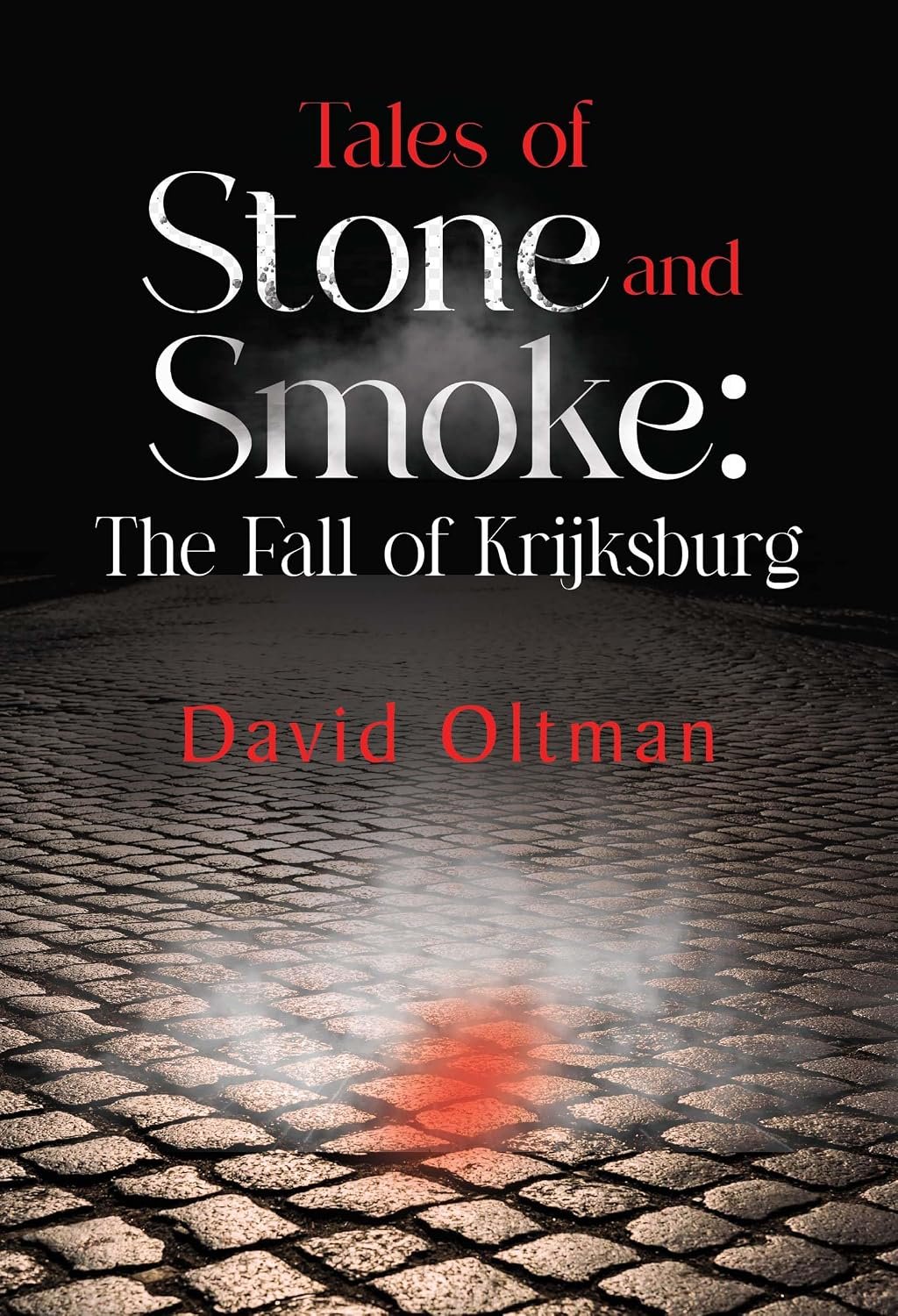
Tales of Stone and Smoke
A thief, a sentient black Labrador, an air-pirate skeleton and an embattled city collide as Krijksburg approaches upheaval.
Books worth discovering. Authors worth knowing.
A thief, a sentient black Labrador, an air-pirate skeleton and an embattled city collide as Krijksburg approaches upheaval.
David Oltman’s Tales of Stone and Smoke: The Fall of Krijksburg introduces a cliffside port where several apparently separate adventures begin converging toward crisis.
A City on the Edge of Disorder
David Oltman’s Tales of Stone and Smoke: The Fall of Krijksburg introduces a cliffside port where several apparently separate adventures begin converging toward crisis. A daring thief approaches a surreal castle to steal a mysterious book; elsewhere the skeleton air pirate Long Jake returns to provoke panic; below the city, a representative named Luthor tries to guide a quarrelsome council through a dangerous escape. These details come directly from the publisher and author descriptions, and they establish a fantasy world already in motion rather than one waiting to be explained by a single chosen hero. Krijksburg seems to contain competing interests, people caught by surprise and hidden structures that matter when public order begins to fail. The title’s reference to stone and smoke evokes both enduring buildings and the signs of disturbance rising around them. Readers who like fantasy with several interlocking threads have a compelling entry point.
A Castle That Refuses to Stay Still
The publisher’s summary opens with one of the book’s most memorable elements: a surreal, ever-shifting castle containing a mysterious object worth stealing. A building that changes its own geometry alters the usual contract between explorer and landscape. Finding a route cannot be reduced to memorizing corridors, and the supposedly reliable shelter of stone becomes unstable. Yet the thief is not alone. A sentient black Labrador and two enigmatic beings intervene, apparently redirecting the quest toward hidden truths and questions about desire. This combination makes an unusual promise. The adventure is interested in what a person wants, but also in how that wish survives contact with beings who possess different knowledge. The source does not reveal the book’s final secret or the motives of every participant, so a feature should not supply answers. It can appreciate the way the setting itself demands uncertainty and raises the stakes of moral choice.
Long Jake and the Return of Fear
Among Oltman’s cast is Long Jake, a skeleton air pirate whose return unsettles the disgruntled inhabitants of Krijksburg. The image is extravagant, but it has a practical narrative function: a recognizable threat from outside ordinary civic life can expose the instability already present inside a city. The publisher describes Krijksburg as unhappy and vulnerable to panic, which suggests that the pirate does not arrive in a neutral political atmosphere. His appearance may become a catalyst rather than the sole source of danger. Fantasy adventure often invites readers to measure a villain by destructive capacity; this premise encourages attention to what communities believe, how quickly rumors spread and which authorities retain credibility. Since the promotional synopsis does not spell out Long Jake’s full intentions, it is better to discuss the tension his return creates than to attribute invented crimes or speeches to him. His skeletal identity gives the drama an immediately distinctive silhouette.
The Council Beneath the Streets
Luthor, identified as a Rumanil representative, is described as leading a desperate escape through dank caves with a bickering council. A council should represent collective decision-making, yet the difficulty of cooperation can become acute when time is short and information scarce. Oltman’s choice to send political or civic figures underground creates a striking visual counterpoint to the chaos above. Their argument may reveal fractures that were manageable only while everyday life remained predictable. The specific meaning of Rumanil politics is not independently detailed, so readers should discover it in the story rather than through confident extrapolation. The verifiable situation already allows meaningful analysis: leadership is complicated when a group cannot agree about what danger means or who has the right to act. Such passages can give a sprawling fantasy the texture of competing human priorities, not just a sequence of physical confrontations.
Moira and the People Who Must Improvise
Street urchin Moira and her sister form an alliance while the city lurches toward upheaval. Their perspective potentially shifts the scale of the narrative from officials and spectacular intruders to people who have fewer resources and less protection. That is important in fantasy stories about political collapse. A map may show castles, trade routes and city gates, but the consequences of disorder register most sharply in the decisions of people who cannot command soldiers or alter laws. The official blurb confirms the sisters’ alliance without specifying its partners or ultimate cost. Preserving that uncertainty leaves the reading experience intact. It also makes clear why they are relevant: their survival requires practical intelligence and negotiation at a level the council may not understand. If Krijksburg is to change, readers can expect the outcome to matter not only to powerful figures but to people who have spent their lives working around power.
Magic and the Shape of Moral Choice
Publisher copy emphasizes intrigue, magical encounters and moral choices. Those terms describe a particular fantasy appeal: extraordinary abilities do not eliminate the need to decide what should be done with them. The thief’s desire for the mysterious book offers one form of ambition, while the council’s arguments and Moira’s alliance offer other pressures. The presence of a speaking animal or a shifting castle may seem whimsical, yet whimsy and danger need not cancel each other. Indeed, a fantastical world can sharpen a familiar ethical problem by removing everyday explanations that make indecision easy. A reader may ask whether an act undertaken for survival has different moral weight from one undertaken for status or control. Oltman’s official introduction does not provide an explicit answer, so it is more accurate to regard those questions as possibilities raised by the premise than as judgments the novel necessarily endorses.
The Writer Behind Krijksburg
David Oltman describes this as his debut novel, published by Olympia Publishers in September 2024. His publisher biography places him in North Carolina and notes degrees in English and dramatic art, a combination that may interest readers attentive to dialogue, staging and ensemble casts. These background facts do not prove any particular stylistic success, but they provide context for a story that must coordinate many moving parts. The author’s own website uses substantially the same detailed synopsis as the publisher, giving unusual confidence that the thief, Labrador, Long Jake, Luthor and Moira belong to this particular book. Publicity descriptions are not a substitute for reading the novel, and they cannot resolve whether every thread receives satisfying closure. They do, however, support a clear understanding of the book’s identity: a fantasy built from intersecting situations rather than a generic account of a single hero discovering a sword.
Who Should Enter This Port City?
Tales of Stone and Smoke: The Fall of Krijksburg is worth exploring for readers who enjoy imaginative cities, unlikely alliances, multiple protagonists and adventures with both whimsical and political dimensions. Its recognizable anchors are vivid: a restless castle, a sentient Labrador, a pirate skeleton and a population approaching rebellion. Beyond those details lies the prospect of different characters being forced to revise their loyalties as rumors and fears travel. The novel’s most interesting promise is that truths revealed in one corner of the city may affect decisions made in another. Readers seeking a straightforward linear quest may find the ensemble setup a different kind of invitation; those who relish complicated worlds may welcome it. This sponsored feature is based on the author’s and publisher’s public description and does not claim a firsthand complete-text review. The book remains free to surprise readers with the alliances, consequences and revelations that promotional copy leaves unresolved.
About the book.
Epic fantasy, magic, adventure and rebellion. A thief, a sentient black Labrador, an air-pirate skeleton and an embattled city collide as Krijksburg approaches upheaval.
Sponsored book feature. Independent research-based commentary based on publicly available book details; not a claim of first-hand full-text review. The designated cover placeholder will be resolved by the owner’s publishing automation.
Found a book worth opening?
Books worth discovering. Authors worth knowing.
Return to the Journal →