
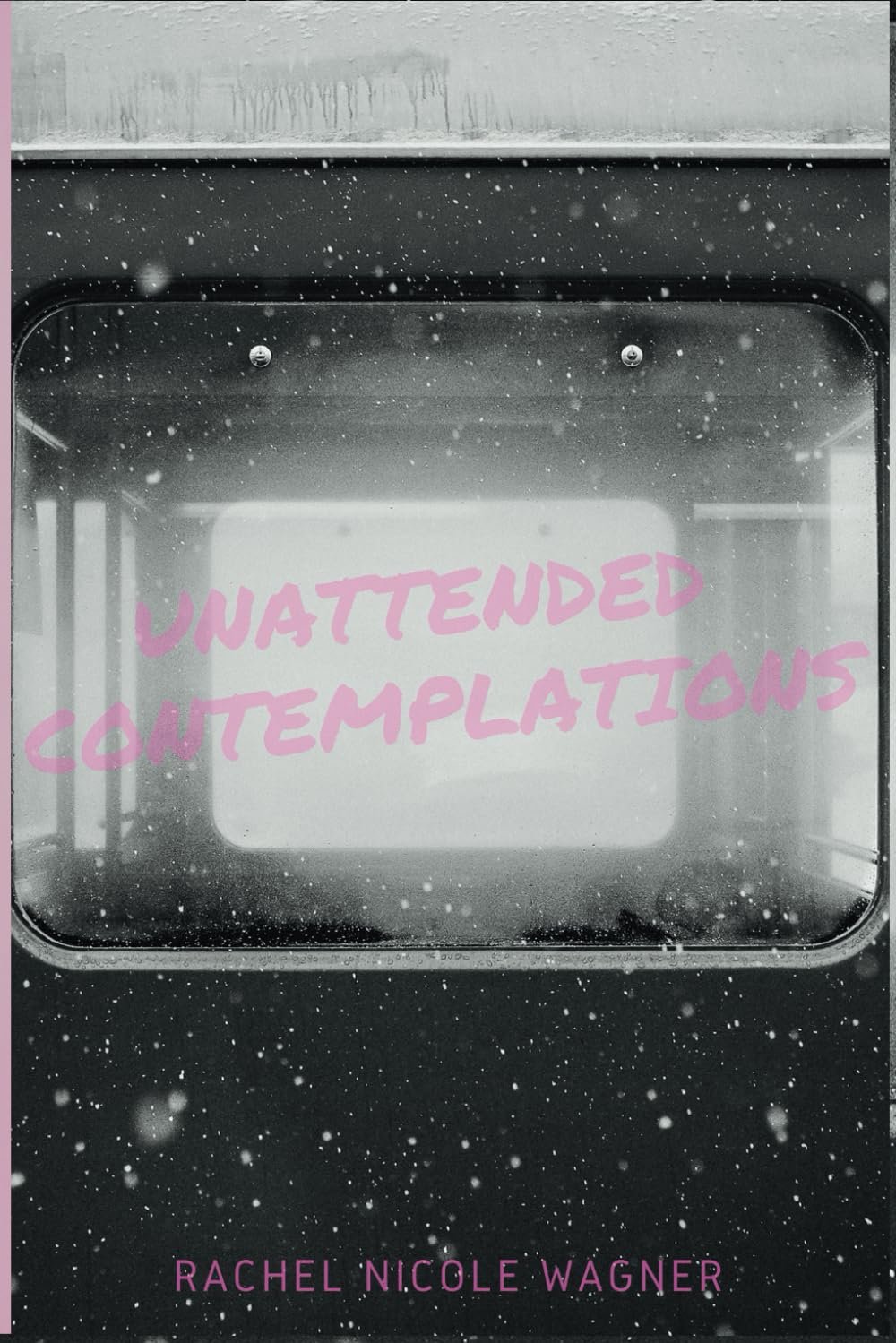
Unattended Contemplations
A second poetry collection turns sudden thoughts, grief and longing into invitations to question how the self keeps changing.
Books worth discovering. Authors worth knowing.
A second poetry collection turns sudden thoughts, grief and longing into invitations to question how the self keeps changing.
R.
Thoughts That Refuse to Arrive on Schedule
A poem can begin with a sudden observation that would be easy to forget. Rachel Nicole Wagner’s Unattended Contemplations takes its name from that unpredictable mental traffic: perceptions, doubts and memories that demand attention when daily life appears to be moving elsewhere. The public description identifies it as Wagner’s second poetry collection and describes a journey through self-discovery, loss, longing and questioning. Those are broad themes, but the title gives them a particular texture. It suggests that reflection is not always a carefully arranged quiet hour. Sometimes the mind interrupts itself with something that has been waiting to be noticed.
The available publisher-facing description is brief and includes a few lines associated with the collection, along with a reference to the title’s poem, Proof. It does not provide a complete table of contents or authorize assumptions about the setting and speaker of individual poems. A responsible feature therefore focuses on what the collection advertises and what a reader might look for in poetry of this kind. That is still a meaningful conversation. The idea of unattended thought invites us to consider how language can make fleeting experiences available for a second look.
Self-Discovery Without a Single Answer
Self-discovery is sometimes marketed as a dramatic moment when a hidden, authentic self is revealed. Poetry often works against that tidy notion. A line written after one experience may contradict a line written after another; both can record something honestly felt. Wagner’s stated interest in questioning suggests a collection oriented toward the process of inquiry as much as toward any fixed conclusions. The poems may offer images or situations through which readers recognize their own uncertainties, even when their personal circumstances differ from the poet’s.
A reader need not approach the book expecting a program for self-improvement. One of the strengths of reflective verse is its willingness to stop before an answer arrives. An incomplete question can feel more truthful than an inspiring formula that solves everything at once. The word contemplations also implies repeated looking, not merely a first impression. In reading a short poem, one might encounter a phrase that becomes less obvious the longer it is considered. That slow work can be worthwhile even if the poem never states a clear instruction.
The Presence of Loss
The collection is publicly described as engaging with loss and longing. Those are related but distinct experiences. Loss concerns what has ended or been taken away; longing can concern something never possessed or something whose return is impossible. The distance between them is rich material for poetry because both are difficult to measure in ordinary language. A concrete image can hold an absence more effectively than a generalized statement of sadness. The reader supplies associations that need not replicate those of the writer.
It is important not to turn these advertised themes into claims about Wagner’s own biography. A poem’s speaker is not automatically its author, and personal-looking language may be shaped by imagination, craft or composite experience. The public profile identifies Wagner as a nurse, musician and writer, but that does not make every poetic line a clinical observation or a diary entry. A poetry collection deserves the freedom to make art from emotion without requiring an audience to decode the writer’s private life. Readers can take loss seriously while respecting the boundary between creative voice and biographical fact.
Why a Second Collection Matters
A second book of poems creates an opportunity for an author to return to language with a changed sense of what it can do. Wagner’s public listing identifies Unattended Contemplations as her second collection and contains a brief note in which she expresses excitement at sharing it. No full comparative study of her earlier work was available for this feature, so it would be misleading to declare a formal evolution or a radical new style. Still, the fact of a second collection speaks to persistence. It suggests a writer has continued gathering, revising and choosing language after the completion of an earlier project.
That continuity may also matter to readers who take pleasure in discovering a poet outside the most familiar publishing lists. Small-press and self-published poetry can circulate through direct recommendations, author communities and personal connections rather than high-profile publicity. Its value should not be measured solely by how often it appears in a mainstream review column. At the same time, a book’s obscurity is not proof of its quality. The sensible invitation is to open the collection with curiosity, attend to individual poems and develop one’s own response rather than borrow an unsupported verdict.
Words, Music and Rhythm
Wagner’s public biography mentions music alongside writing and nursing. It would be speculative to conclude that every poem uses a particular meter or is intended for performance. But a poet who is interested in music draws attention to the relationship between line and sound. Even free verse has rhythm shaped by breaks, stresses and silences. The placement of a pause can alter the emotional direction of a sentence; an unexpected repetition can make a question linger. These possibilities are useful things for readers to listen for, regardless of whether the collection favors regular stanza patterns.
Reading poetry aloud can transform the experience without requiring specialist knowledge. A line that appears straightforward on the page may hesitate when spoken, or a sequence of words may establish an insistence that silent reading conceals. The best reading approach may be experimental: read a poem once for its images, again for the sounds that connect them, and once more for the places where the speaker seems uncertain. This is a method for approaching reflective poetry generally, not a claim about poems whose full text has not been verified.
The Importance of Unfinished Questions
The published description uses questioning as a key word, and that may be the most suggestive element of its framing. Questions can open space between the world as it is and the explanations we have adopted. They can also expose anxieties that ordinary routines keep out of view. In poetry, a question need not be answered before the final line. Leaving it alive can be a deliberate artistic decision. A reader may finish a poem with a sharper awareness of a feeling rather than a solution, and that awareness can itself be valuable.
The notion of unattended thought is especially relevant in a culture that prizes productivity. Not every mental experience can be sorted into an item on a task list. Daydreaming, memory and quiet grief may resist being scheduled, yet they still shape a person’s understanding of events. A book of contemplative poems can acknowledge those experiences without turning them into performance. It invites attention for its own sake. That invitation will resonate differently depending on whether a reader arrives in grief, curiosity, exhaustion or simply a desire for language that moves more slowly than a news feed.
Finding Your Own Reading Rhythm
Unattended Contemplations appears best approached as poetry rather than as a set of promised life outcomes. Readers can browse, return to an appealing title, or leave room between poems to consider what they have encountered. The available description does not establish a particular narrative sequence, so the experience should not be oversold as a tightly plotted autobiography. Its declared concerns—self-discovery, longing, loss and uncertainty—are sufficient to tell readers what emotional territory the collection invites them to explore.
This research-based feature does not offer a verdict on the full volume’s poetic technique or the quality of every individual work. Those judgments require direct reading. What can be offered is a clear reason to look: Wagner’s title catches the strange way important thoughts arrive without permission, and her description suggests an interest in giving those arrivals shape. For anyone drawn to brief, reflective encounters with language, that is a worthwhile starting point. The poems themselves should have the final say.
About the book.
Unattended Contemplations is identified as Rachel Nicole Wagner’s second poetry collection and advertised as exploring self-discovery, loss, longing and questioning; a public listing mentions the title poem “Proof”.
Sponsored book feature. Independent research-based commentary using publicly available descriptions and author material, not a claim of first-hand full-text review. The cover placeholder will be resolved by the owner’s publishing automation.
Found a book worth opening?
Books worth discovering. Authors worth knowing.
Return to the Journal →