
Old Timers Day
God and Satan draft an all-time baseball lineup for a cosmic contest on a legendary diamond.
Books worth discovering. Authors worth knowing.
God and Satan draft an all-time baseball lineup for a cosmic contest on a legendary diamond.
S.
The Impossible Baseball Game
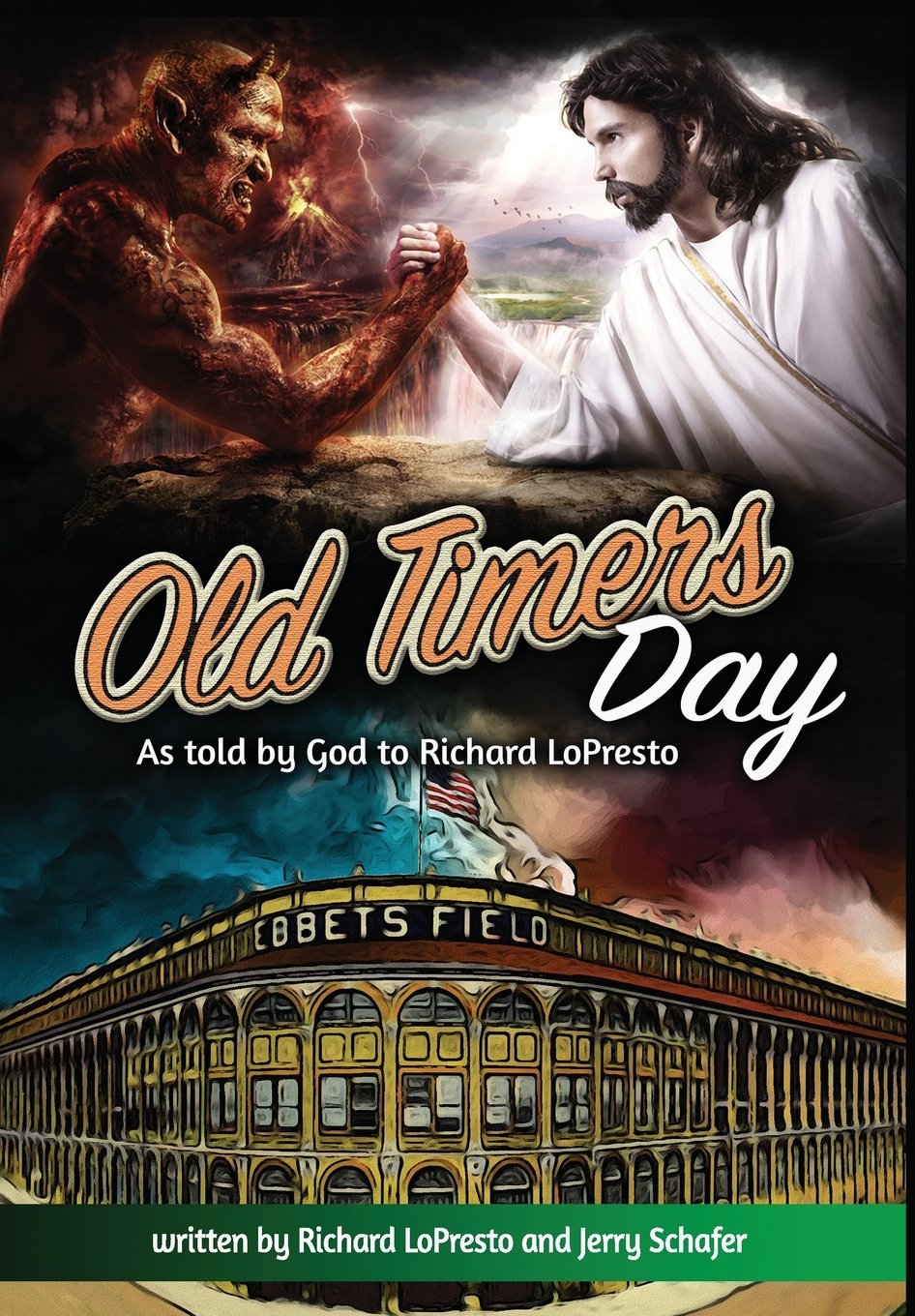
The premise of Old Timers Day: As Told by God to Richard Lopresto is disarmingly easy to picture and impossible to stage: God and Satan choose opposing sides for a baseball game involving celebrated players from different generations, living and dead. The contest takes place in an imagined version of historic Ebbets Field, and the fate of humanity hangs on the result. Bibliographic descriptions and the project’s official website agree on this combination of vintage baseball and a conflict between good and evil. It is sports fantasy played at the highest conceivable stakes.
Those elements belong to distinct storytelling traditions. An all-star baseball game asks who belongs on the roster, how different eras compare and what a perfect contest might look like. A moral allegory asks what principles guide the struggle and why the outcome matters beyond the competitors. Bringing them together turns the diamond into a symbolic battlefield. The game’s rules are familiar, but its participants and consequences extend far outside ordinary sport. Readers are invited to enjoy baseball history while considering why the game has become a vehicle for questions about power, loyalty and redemption.
Ebbets Field and the Pull of Memory
The advertised setting carries a specific nostalgia. Ebbets Field, associated with the Brooklyn Dodgers, occupies a vivid place in the memory of baseball fans, even though the historic stadium no longer stands. Setting a game there is not the same as picking an anonymous ballpark. It suggests an imagined meeting with a vanished era, one in which legendary athletes might again step onto the field and spectators could witness a contest that history never allowed. The book’s public synopsis speaks of the ghost of the old stadium, making memory central to its theatrical appeal.
That choice also lets the story connect generations. Supporters often imagine how a famous pitcher from one period would face a slugger from another. Such questions have no final statistical answer because conditions, training and rules change. Fantasy can dispense with the limitations and stage the meeting anyway. The result is not a documented historical game, and it should never be treated as one. It is an imaginative tribute to the sport’s collective memory. The promise of seeing icons from multiple eras in one impossible matchup may be the most immediate hook for baseball-loving readers.
Two Managers, One Cosmic Question
The contest’s rival selectors are God and Satan. In the official project’s account, the sides represent a larger struggle between love and the desire for power. That framing gives the baseball draft unusual significance. On a normal team, a manager chooses players for their ability to win games. In an allegory, the composition of a team may also stand for competing moral visions. Who is selected and why can become as meaningful as what happens on the field, even though the public synopsis does not list every player or establish an inning-by-inning narrative.
The fantasy uses a deliberately extravagant conceit, but its central question is recognizable. What would change if a competition were about more than winning? Spectators can love the drama of a close game while also recognizing that courage, fairness and sacrifice matter. The cosmic stakes elevate that idea into an explicit spiritual conflict. The text is advertised as a story of faith, not a neutral statistical thought experiment. Prospective readers should therefore expect religious symbolism to matter as much as the athletic setting. The pleasure lies in seeing these two structures coexist.
Baseball as an Allegory for Choice
Sport is a natural language for moral stories because it dramatizes pressure, teamwork and decisions made under uncertainty. A player may choose between individual achievement and collective success. A manager may prioritize immediate advantage or trust in a teammate. A crowd can be swept toward generosity or hostility. The public descriptions do not authorize assigning such scenes to named players in Old Timers Day. But the general dynamics help explain why baseball could serve as a setting for an allegory about good and evil without feeling arbitrarily attached to the spiritual material.
The project’s official site places the contrast between love and the love of power at the center of its message. This is a broad ethical opposition, and a sports contest gives it concrete shape. The game can move forward through visible acts while readers consider the values those acts are meant to represent. A score tells us who is ahead, but it does not by itself say whether a side has acted with integrity. That gap between measurable success and moral worth is fertile ground for religious fiction. The premise promises more than a fantasy box score.
Richard LoPresto’s Personal Inspiration
Richard LoPresto’s authorial account, reproduced in bibliographic entries, describes experiencing an intense religious prompting while visiting church in Henderson, Nevada. He explains that notes from those experiences contributed to the story and that he sought help from his longtime friend Jerry Schafer, a writer, producer and director, in developing the manuscript. This is presented as LoPresto’s own account of inspiration. A book feature should respect the sincerity of that testimony without reporting his spiritual experience as an independently verifiable external event.
The collaboration deserves attention because the source Sheet’s author cell says only “English edition,” while multiple catalogue records name LoPresto and Schafer. LoPresto’s familiarity with baseball and Schafer’s production experience help explain the appeal of the premise as a story with both sporting detail and theatrical scope. Their credited roles come from public edition records, not from an attempt to infer authorship from the title alone. Before publication, a catalog editor may wish to correct the source author cell so future features and metadata consistently acknowledge the collaboration.
More Than One Edition
Google Books records include a 2017 edition through Celestial Baseball Association LLC and a later 2025 listing through Writers Branding LLC. The entries carry different page counts, making it important not to present one length as universally true of every version. The core scenario is consistent across them: heaven and hell meet through a legendary baseball game, and the implications reach beyond the stadium. The latest official project page also discusses a screen adaptation and a broader faith-based initiative connected to the book.
These are useful edition and project details, not proof that every proposed adaptation has already been completed or released. An editorial feature should distinguish the existence of promotional plans from a finished film. The book remains the focus. Its longevity across editions suggests that the combination of sports nostalgia and spiritual drama continues to be central to the author’s work. Anyone trying to locate the precise version in the Journal queue should use the exact linked retailer listing and its ISBN rather than relying on a generic title search.
The Problem of Comparing Legends
An all-time baseball roster almost inevitably invites debate. Fans can argue across eras about pitchers, hitters, defensive specialists and players whose reputations were shaped by different leagues and conditions. Such conversations are part of the sport’s pleasure. In a fantasy, impossible matchups become possible because the writer controls the premise. The quality of a roster in an actual game would depend on measurable ability; the effect of a roster in a work of fiction also depends on the emotional associations fans bring to the names.
The public synopsis says that one hundred great players, living and deceased, are involved. It does not identify all of them or disclose the final score. It would be easy to decorate a feature with an invented lineup or dramatic final inning, but that would misrepresent the source. Instead, prospective readers can approach the story with their own imagined selections and then discover the author’s choices on the page. That preserves the sport’s enjoyable argument and respects the narrative’s surprises. The impossible game is a stage for memory as well as for spiritual symbolism.
When the Final Inning Means More
Old Timers Day offers a distinctive entry for readers who enjoy baseball lore, spiritual allegory and improbable contests involving legendary figures. Its central image is memorable: one famous field, athletes drawn from the entire history of the game, and two rival managers playing for something far larger than a championship. The official materials present a message about love, faith and redemption, so readers who want purely secular sports history should approach it with that expectation in mind.
A research-based feature cannot pronounce on the quality of an inning it has not read or disclose an ending that promotional summaries do not provide. It can accurately identify the strange, affectionate and morally serious invitation the book makes. By gathering generations of baseball into a single fantasy afternoon, LoPresto and Schafer turn a familiar American ritual into a setting for ultimate questions. The pleasure of the premise is that it treats a beloved game not as a trivial distraction from human meaning, but as a place where that meaning can be imagined anew.
About the book.
God and Satan select baseball greats living and dead to compete at the spectral Ebbets Field, with enormous stakes for humanity; Richard LoPresto credits Jerry Schafer as coauthor in editions documented by Google Books.
Editorial book feature, not paid sponsorship. Research-based commentary from named public sources, not a first-hand complete-book review. The cover placeholder will be resolved by the owner’s publishing automation.
Found a book worth opening?
Books worth discovering. Authors worth knowing.
Return to the Journal →