
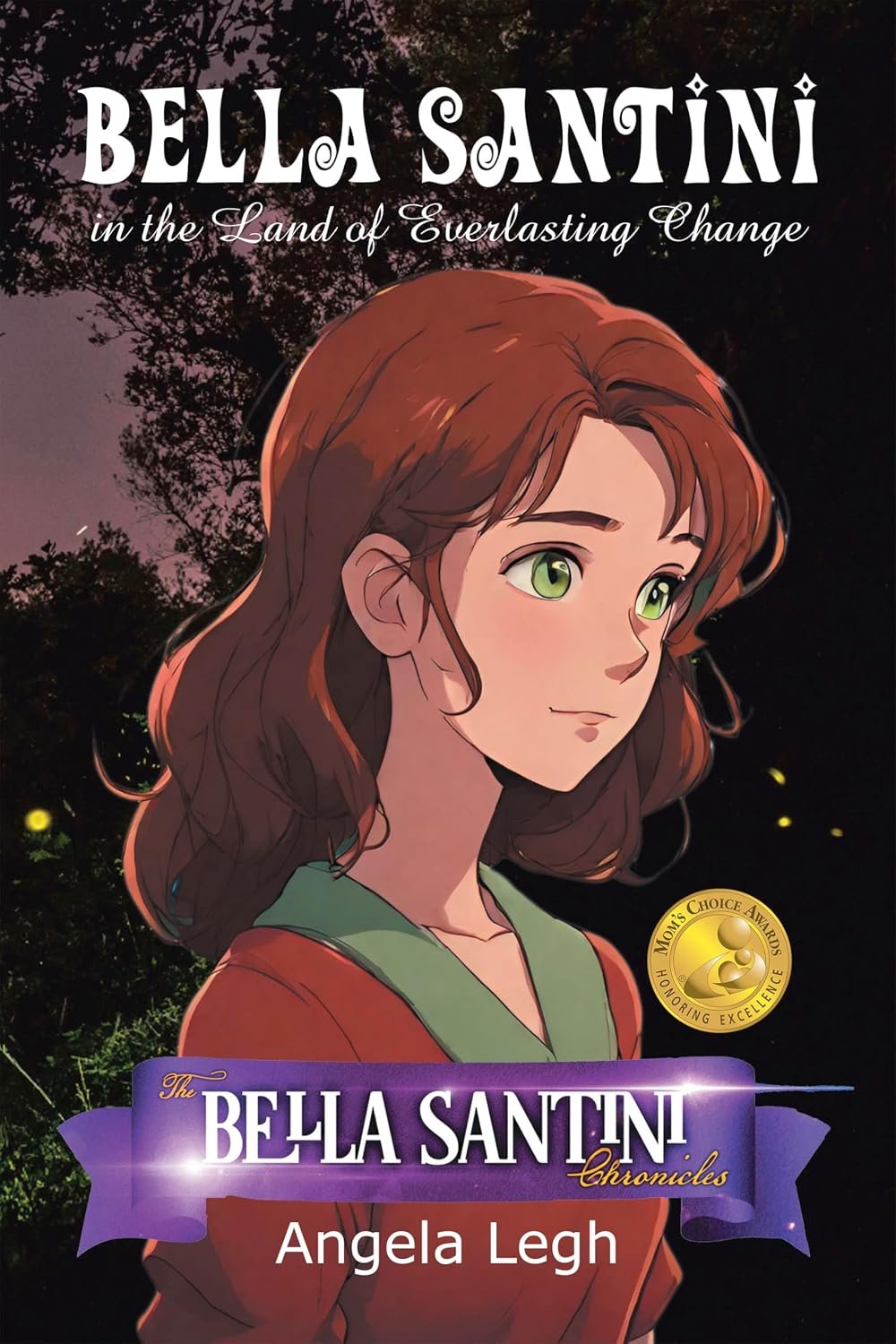
Bella Santini in the Land of Everlasting Change
A strange fairy ceremony sends Bella into the Land of Everlasting Change, where school trials and shifting allegiances test her confidence.
Books worth discovering. Authors worth knowing.
A strange fairy ceremony sends Bella into the Land of Everlasting Change, where school trials and shifting allegiances test her confidence.
S.
A Glimmer in the Woods
Angela Legh’s Bella Santini in the Land of Everlasting Change starts with a young protagonist who feels different from the people around her. Publisher and author descriptions emphasize Bella’s sensitivity, her difficulty understanding where she belongs and her tendency to notice what others overlook. Then a trail of glowing lights draws her into the woods. What appears to be an innocent curiosity turns out to be an encounter with fairies, who are neither as harmless nor as predictable as the decorations and bedtime tales of Bella’s ordinary world.
The transition is a familiar fantasy pleasure with an unsettling twist. Bella does not step through a doorway because she has been chosen for an honor. She intrudes on a ceremony and is taken into the Land of Everlasting Change, where powerful beings judge her actions by rules she could not have known. The sudden reversal makes the magical world feel like a society with its own interests rather than a playground arranged for the visitor’s amusement. The fairy realm might be beautiful, but beauty does not guarantee welcome or fairness.
A Trial Before an Education
The public synopsis describes Bella being brought before a fairy tribunal and compelled to remain in the new world. Her hope of finding a route back to Earth becomes tied to learning magic, especially through Yelimoon fairy school. Yet access to the school is not straightforward. She must complete initiation tasks before she can properly begin. That structure allows the novel to combine a school story with a quest. A classroom represents the possibility of belonging, while the trials insist that belonging is conditional and must be negotiated.
This matters emotionally because Bella already arrives with uncertainty about herself. She may see other people move through familiar situations with ease while she hesitates. In the realm of the fairies, everyone becomes strange to her, turning private insecurity into a visible challenge. Learning new rules is not merely a magical inconvenience; it is also an exercise in deciding whether to trust her own judgment. The school offers an imagined community, but it also tests the independence of someone who has not yet found confidence in either world. The premise invites readers to recognize that growth can be uncomfortable before it becomes empowering.
Magic Does Not Remove the Need for Courage
The book’s descriptions include initiation quests, old forces, monsters and dangerous opposition. It would be tempting to treat magic as the obvious answer to all of Bella’s difficulties. The advertised arc points toward a different approach. Bella hopes magical learning will enable a return home, but the tasks put her under pressure before she has acquired the skills she wants. Courage therefore precedes competence. She must enter unfamiliar situations without any guarantee that she already knows what to do.
This is an appealing structure for middle-grade fantasy because it avoids making the hero’s first success dependent on being the most powerful person in the room. A character can respond thoughtfully, accept help or keep trying before mastering a spell. The publisher’s framing emphasizes friendship and emotional resilience, ideas that can develop through practical actions rather than speeches. The available synopsis does not authorize a list of every trial or a report of how each opponent is defeated. Keeping those discoveries for the reader also preserves the book’s pacing and sense of adventure.
The Seelie Court Is Not a Simple Sanctuary
The fairy kingdom is more than the background for Bella’s education. Earlier promotional descriptions identify Queen Tatiana’s effort to maintain the balance of power and the threat posed by dark forces. Other summaries speak of unrest among the fairies and a possible troll uprising across the wider series. These details suggest a realm undergoing conflict of its own. Bella’s arrival does not cause every problem, nor does the society suspend its political tensions to welcome an outsider. She must learn which rivalries matter and where trust can be placed.
That larger setting creates opportunities for moral complexity. A fantasy court may describe itself as orderly or benevolent even while individuals within it act unjustly. Bella has already experienced accusation and confinement, so she has reason to question authority. Yet fairies also appear as potential friends and guides. The challenge is to make judgments without deciding that all inhabitants of an unfamiliar place are alike. This is a useful reading lens for fantasy built around cultural difference and self-discovery. The magical creatures make the situation extraordinary, but the need for fair judgment is a familiar human concern.
Emotional Resilience Within the Adventure
Angela Legh’s author materials explicitly connect the Bella Santini stories with emotional awareness and resilience. That does not mean the novel is a medical treatment or a substitute for counseling. It means the author intends the adventure to make room for conversations about feelings and the choices people make under pressure. Bella’s situation provides several natural entry points: embarrassment after a mistake, fear when confronted by powerful strangers, frustration at rules that seem unfair and the uncertainty involved in making new friends.
Children’s fantasy can make these experiences easier to approach because it gives them a symbolic shape. A trial in a fairy school might stand beside the experience of entering a new classroom; an encounter with a bully may echo social conflict in ordinary life. Those parallels should not be turned into a rigid one-to-one code. The story’s enchantment matters on its own terms. But readers and families who enjoy discussing the feelings behind a protagonist’s actions may find opportunities here. The author describes the magic as a setting for discovering strength rather than evidence that difficult emotions simply vanish.
The Importance of Friendships
The publisher’s older series information highlights Bella’s work with companions as she faces trials and threats. The friends named in later volume descriptions, such as Matteus and Shibohna, indicate that relationships become important to the continuing story. Without treating events from subsequent books as scenes in this first installment, it is reasonable to say that the broader series values collective problem-solving. A young protagonist thrown into another dimension cannot know everything about its dangers. Listening to others and offering help can be as crucial as individual cleverness.
Friendship in fantasy works best when it does not instantly solve every problem. Trust grows through shared decisions, and newcomers may have to learn whether an invitation is genuine. Bella’s early treatment by fairy authorities gives the reader reasons to remain cautious. The world includes people who would help her and forces that would use or harm her. That uncertainty creates tension while making successful relationships meaningful. The advertised blend of fantasy adventure and emotional self-knowledge invites the reader to notice how Bella’s confidence changes when she is no longer entirely alone.
An Author Revisits Her Imagined World
Legh’s series has appeared in multiple editions, including records for 2020 and 2025 versions with different publishers, page counts and presentation. The author’s current website and Balboa Press catalogue supply descriptions of the newer Land of Everlasting Change edition. An earlier feature at The Children’s Book Review identifies a different publisher and edition details. These variations should not be collapsed into one immutable bibliographic fact, especially when a queue links to a particular ebook edition.
The continuity is in the central character, her entry into fairyland and the themes of courage, belonging and emotional growth. Legh has said she developed Bella’s story into a larger sequence, dividing material that was too extensive for a single children’s book. This helps explain why the first installment combines an immediate adventure with an unfolding magical world. It introduces rules, friends and threats that can matter beyond a single volume, but the reader should still be able to care about Bella’s immediate predicament without needing to know every later development.
Who Might Follow the Lights?
Bella Santini in the Land of Everlasting Change is a promising fit for readers who like young heroines, magical schools, court intrigue and fantasy trials with emotional stakes. Its central character is someone who feels out of place before being transported to a realm where almost everyone would feel lost. That makes the fantastical challenge accessible. The reader does not have to possess wings or magical abilities to understand the fear of being judged unfairly or the relief of discovering a dependable ally.
The book’s best introductory question is whether Bella can find confidence without surrendering her sensitivity. Following mysterious lights changes her surroundings, but it does not immediately tell her who she ought to become. The advertised journey asks her to survive tests, seek knowledge and negotiate new relationships while holding onto a sense of self. Legh’s fantasy invites a reader to watch a girl who begins as an outsider discover that belonging may be created through courage and friendship rather than awarded by someone else’s permission.
About the book.
Teen Bella follows glowing lights and is transported to a fairy realm, where she faces a tribunal, enrollment at Yelimoon fairy school, dangerous initiation trials, and a wider conflict affecting the Seelie Court.
Editorial book feature, not paid sponsorship. Research-based commentary from named public sources, not a first-hand complete-book review. The cover placeholder will be resolved by the owner’s publishing automation.
Found a book worth opening?
Books worth discovering. Authors worth knowing.
Return to the Journal →