
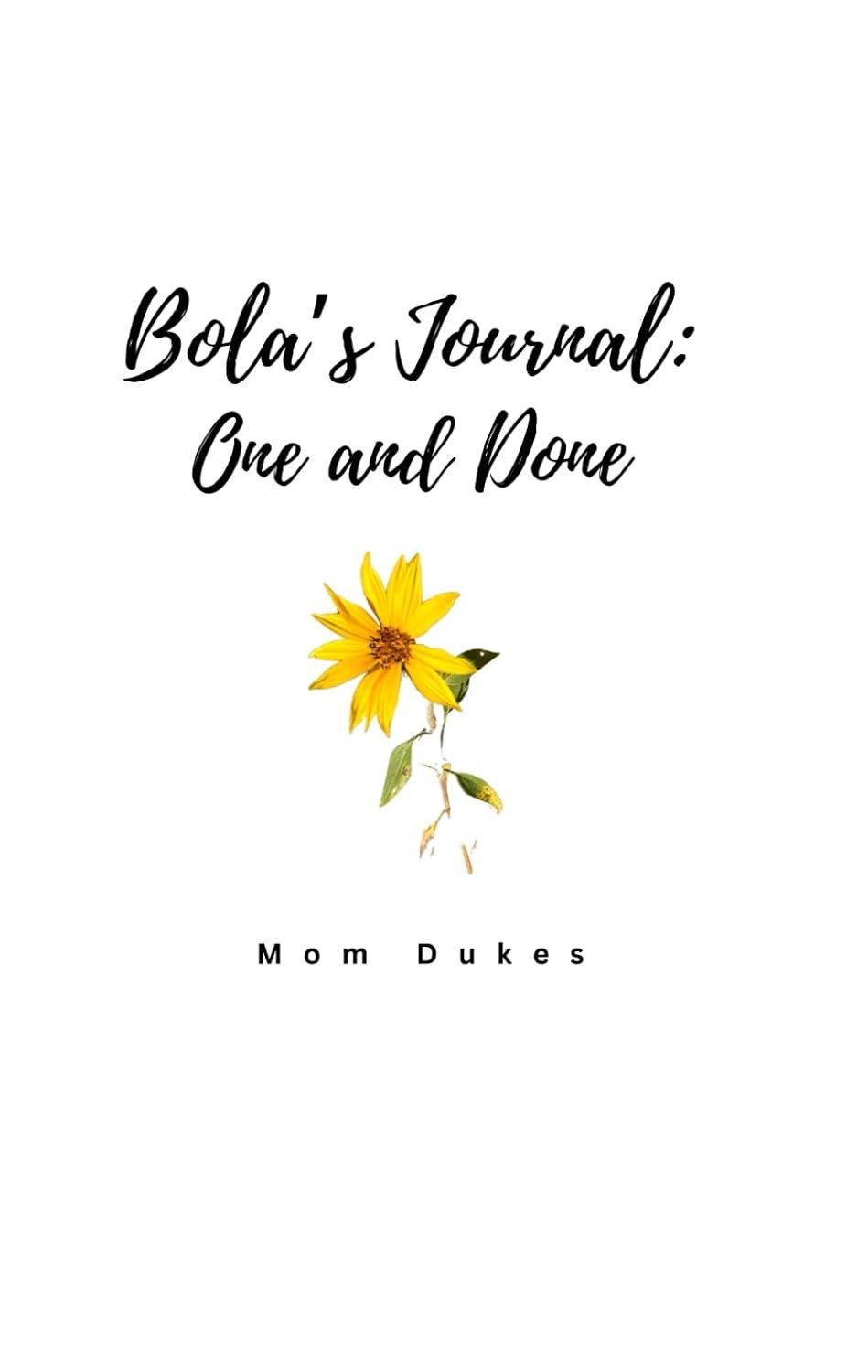
Bola’s Journal: One and Done
A journal-titled work credited to Mom Dukes and Alison Edmonds invites questions about voice, singular choices and personal storytelling.
Books worth discovering. Authors worth knowing.
A small, unusually personal book whose title and credited creative team are documented, even while its interior contents remain largely unavailable to independent researchers.
S.
The Title Is a Promise, Not a Synopsis
Some books enter public view surrounded by interviews, sample chapters, critical discussion and detailed publisher copy. Bola’s Journal: One and Done enters through a smaller doorway. Its title, authorship and credited editorial collaborators can be established, but an independently verifiable account of what happens between the covers is difficult to locate. That distinction matters. This feature is an invitation to discover the book, not a claim to have read, reviewed or reconstructed pages unavailable to public researchers. Its most reliable starting point is the object itself: a work presented under the name Mom Dukes, associated with Alison Edmonds, and bearing a title that places a journal and an unusually final-sounding phrase side by side.
Those few facts are more interesting than an invented synopsis would be. A personal title can create an immediate intimacy with prospective readers. The word journal hints at a place where experience might be recorded in a closer, less ceremonious voice than conventional exposition. It does not, however, prove that this particular book consists of dated diary entries, confession, biography or fiction. The responsible way to read the invitation is to recognize its suggestive shape while keeping the form itself open. Readers can be curious about what Bola records without being told by an article that a particular scene, experience or relationship appears in a book whose contents have not been independently confirmed.
One and Done: An Intriguing Frame
The phrase One and Done is compact, rhythmic and capable of carrying several meanings. It might point to a single opportunity, a decisive action, a turning point or an attitude toward completion; a title alone cannot tell us which interpretation the author intended. That ambiguity gives the book a distinctive shelf presence. It is neither a generic memoir label nor a long promise about self-transformation. Instead, it asks a question by withholding part of its answer. Readers familiar with journals, family stories or intensely personal independent publishing may find the tension between a potentially open-ended record and a definitive closing phrase especially compelling.
There is also an editorial virtue in keeping unanswered questions unanswered. Too many online book descriptions borrow their certainty from assumptions. A cover suggesting intimacy is converted into a fabricated account of private trauma; a short phrase about closure becomes an invented scene of reconciliation. Neither move helps the author. For this title, the more useful questions concern the relationship between the book’s voice and its organizing idea. Does the material unfold as reflection, observation, an unfolding narrative, or something less easily categorized? Does the word done signal resolution or a deliberate challenge to expectations? Those answers belong to the actual text, and a reader choosing the book should be allowed to discover them there.
The Person Behind a Pen Name
One detail can be grounded beyond the listing: a public testimonial for an independent research and consulting service is signed by Alison S. Edmonds and identifies the signer as Mom Dukes, author of Bola’s Journal: One and Done. Public book-author catalogues list both names in connection with the title. That establishes an association without explaining the full personal history behind the pseudonym. Mom Dukes has a warm, recognizable social resonance; Alison Edmonds is the name under which the testimonial appears. How the writer uses those identities inside the book is not established by the available evidence, and this feature will not put thoughts or intentions into her mouth.
Pen names can do more than obscure a legal identity. They may carry family associations, signal an approachable public voice, or distinguish creative work from another professional life. Those are general possibilities rather than specific claims about Edmonds. In this case, seeing both names documented gives readers a practical way to identify the right title across different catalogues. It also protects against a surprisingly common problem: assuming that two records with different bylines refer to two different books. The public documentation points to one work, with a recognizable author alias and additional named editorial support.
Editorial Labor Is Part of the Story
The book’s metadata lists Heidi Breuer-Gross and Charles Overby as editors. It also indicates an additional contributor without specifying that person’s identity in the Sheet’s abbreviated credit. Those details should not disappear simply because a short web listing foregrounds the primary name. Editing is often invisible to a reader skimming a retail page, yet editorial labor can shape the clarity, organization and accessibility of a manuscript. The presence of credited editors tells us who is named in that production process; it does not justify speculation about what either editor changed or which passages they helped write.
For independent titles in particular, accurate contributor metadata is a form of respect. Writers, editors, designers and other collaborators may take different routes to bring a book into print. The precise division of responsibility is known to the people involved and to complete publishing records, not necessarily to every reseller. Here, the verified names are worth retaining even when the narrative details remain inaccessible. This is also why the original purchase link matters: it gives a reader the ability to compare an edition’s displayed credits and formats directly rather than depending on a secondary feature that may simplify the creative team.
What a Reader Can Ask Before Buying
A useful discovery feature should help readers approach a listing with better questions. For Bola’s Journal, readers interested in first-person writing may want to determine whether the book is primarily reflective nonfiction, a story told through journal form, or another type of work entirely. Readers who value candid accounts of decisions and consequences may be drawn to the book’s phraseology, but they should verify the subject matter from an official description or sample before assuming that those topics are present. Edition information, intended audience and any content guidance should be checked at the linked listing rather than supplied here without evidence.
The same caution applies to tone. A journal-titled book need not be sad, instructional, comic or therapeutic. It could contain more than one register, and it might deliberately resist a simple category. Readers often enjoy discovering books that cannot be summarized in a line, but discovery should not be confused with mystery created by missing research. The strongest approach is to distinguish intriguing presentation from confirmed content. That allows an independent book to remain discoverable without being misrepresented as a story about events the author may never have written.
Independent Publishing and Discoverability
This title offers a useful example of a wider problem facing small-press and independent books: the information about a work may be scattered across bibliographies, author profiles and isolated professional references. A book’s existence can be easy to establish while its premise remains hard to verify. Search tools sometimes amplify unrelated material with similar phrases, creating a false impression of plentiful sources. Careful research has to reject such noise. A credible page should not substitute a different book about a character named Bola, draw meaning from an unrelated popular memoir, or paste a generic synopsis onto this particular title.
There is value in a modest spotlight that gets the verifiable details right. A reader learns how the book is titled, which primary author names to search, which editors are credited, and where to find the supplied edition. The page also makes clear what it cannot certify. That kind of transparency is not a weakness of the discovery process; it is the difference between showing readers an authentic path toward a book and creating an imaginary version of it. When more official information becomes available, the feature can be expanded with confirmed descriptions, author statements and, ideally, carefully attributed extracts.
The Invitation Stays Open
Bola’s Journal: One and Done is worth noticing for its compact title, its documented connection to Mom Dukes and Alison Edmonds, and the credited editorial team behind the edition. It would be easy to fill the surrounding silence with confident claims about the journal’s subject, purpose or emotional trajectory. That would be unfair to both the creator and the reader. A better invitation leaves the text free to speak for itself. Anyone drawn to its name can follow the book link, confirm the edition details and decide whether the available description or preview resonates with their interests.
The phrase one and done sounds like a conclusion, but the discovery of a book is almost always a beginning. Even an elusive title has a place in a well-curated journal when the evidence is handled with care. What readers deserve is not an artificially complete portrait; it is a clear account of what is known, an honest description of the limits and a practical route toward the author’s own work. That is the editorial promise behind this spotlight—and the reason it is marked for additional sign-off before publication.
About the book.
The book is bibliographically listed as Bola’s Journal: One and Done, attributed to Mom Dukes and Alison Edmonds with credited editors. Independent public descriptions do not establish a reliable synopsis or genre, so the feature discusses its presentation rather than inventing content.
Sponsored book feature. Research-based commentary from named public sources, not a first-hand complete-book review. Limited-source spotlight; plot, genre and interior material were not independently verified. Editorial approval is required. The cover placeholder will be resolved by the owner’s publishing automation.
Found a book worth opening?
Books worth discovering. Authors worth knowing.
Return to the Journal →