
Blue Candles to Love
Michael Cameron’s novel brings an evocative blue-and-maritime cover to a title about candlelight and love.
Books worth discovering. Authors worth knowing.
Michael Cameron’s novel brings an evocative blue-and-maritime cover to a title about candlelight and love.
Source-based review: verified bibliographic facts and independent interpretation, without a claim to full-text reading.
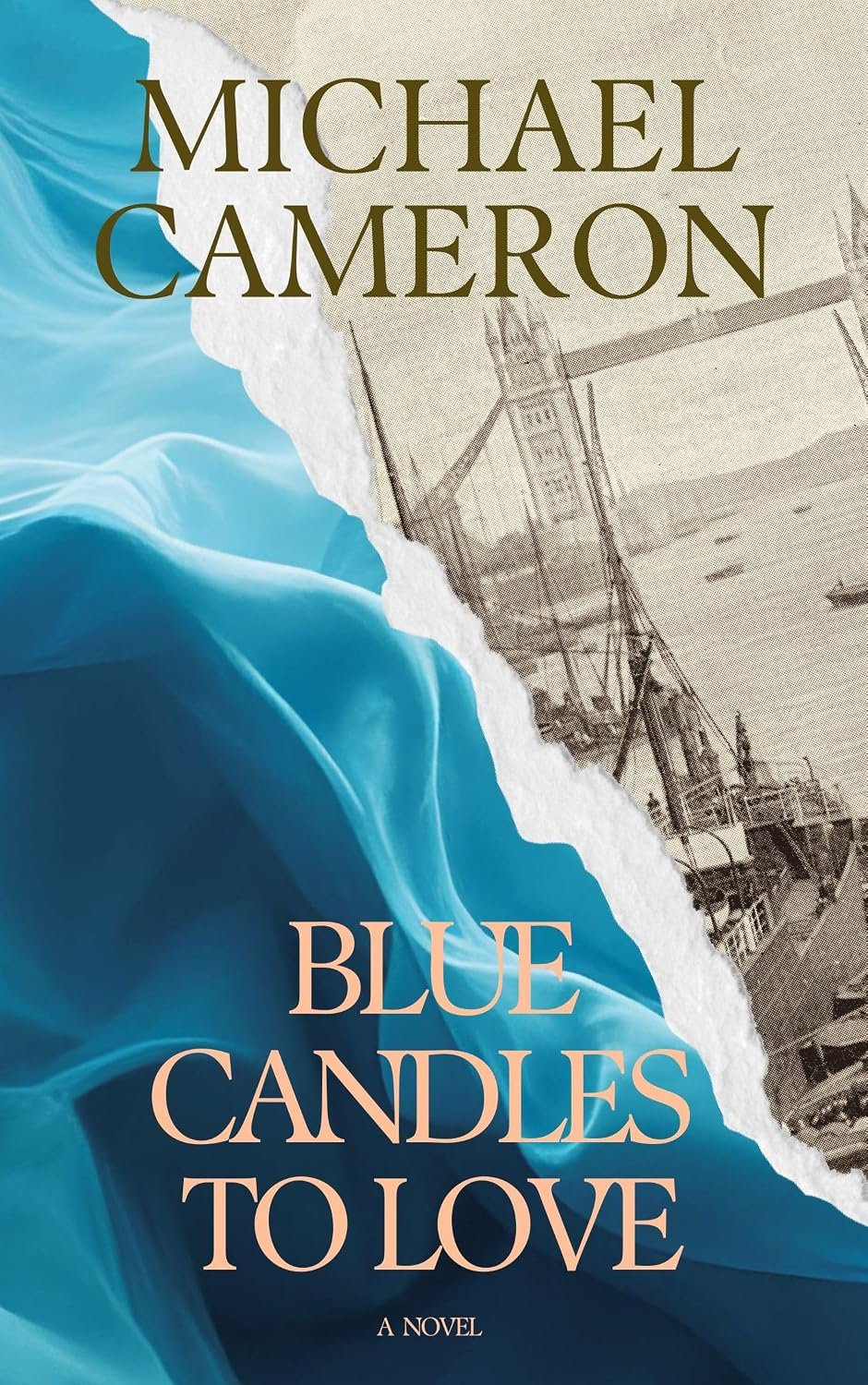
Blue Candles to Love by Michael Cameron is identifiable as a novel on its verified cover. The image combines blue fabric-like shapes with a sepia maritime scene, while the title places colour, candlelight and affection in one curious phrase. Goodreads records the book under Cameron’s name, but accessible bibliographic material does not provide a reliable plot synopsis. That limits what a responsible review can claim. Rather than presenting invented lovers, voyages or twists, this introduction considers the book’s observable presentation, the possible associations it invites, and the questions a reader can bring to its actual pages.
The work a title performs
Some titles describe their plots; others establish a mood before any action begins. Blue Candles to Love belongs, at least in its wording, to the second kind. Blue can suggest calm, sadness, distance, clarity or memory, depending on the context. Candles evoke light that is intimate and temporary. Love is both a broad subject and a word complicated by its many forms. Together these elements sound more like an image to interpret than a summary to memorize. It would be a mistake to settle that image’s meaning before the author has given it a narrative context. Its initial appeal is that it leaves room for more than one emotional register.
The cover identifies the book as a novel, so we may reasonably expect some kind of sustained prose narrative rather than a poetry collection or instructional manual. We cannot, however, determine whether the central relationships are romantic, familial, historical or something else. The verified materials do not tell us the century, the location, or the identity of its protagonist. Readers sometimes appreciate promotional copy that reveals as little as possible, but there is a difference between the pleasures of mystery and an editor’s obligation to be accurate. Here the uncertainty is a source limitation, not a marketing promise of twists or suspense.
The visual conversation between sea and fabric
The book’s cover brings together pale blue forms and the image of a vessel. That pairing gives the design movement: soft curves contrast with the structured lines of a ship. A viewer might read it through ideas of travel, distance, shelter or remembered places. None of those interpretations confirms that a particular journey occurs in the novel. A cover can be symbolic rather than descriptive. This distinction matters because illustrations often compress several ideas into one image; their role is to make a reader curious, not provide a reliable scene-by-scene record.
The maritime imagery is interesting alongside the words Candles to Love because a ship implies an outward movement, while candlelight feels inward and domestic. Their contrast might point a reader toward questions of belonging and departure, but the story may use the motifs differently. The editorial task is to draw attention to the design without converting possibilities into declarations. Readers who are drawn to books with suggestive imagery may find this an inviting starting point, while those who depend on a detailed premise will need more information than the jacket supplies.
Emotional expectation versus narrative evidence
A title containing love naturally creates an expectation that relationships will matter. Yet love can be the cause of conflict, a form of care, a memory, an ethical commitment, or a feeling people cannot clearly explain. It does not automatically mean the novel belongs to the romance genre or ends happily. The word can also be used with irony. A thoughtful approach to Blue Candles to Love leaves all those outcomes undecided until the actual writing can be consulted. It is more useful to ask how the author defines love in this particular world than to import a ready-made romance formula.
Another fruitful question concerns time. Candles burn down; voyages unfold; memories may alter as people revisit them. Those associations can prompt a reader to look for the novel’s treatment of duration and change. Again, they are potential interpretive lenses, not the book’s documented themes. This form of curiosity respects the central achievement of fiction: narrative meaning emerges through choices, language and consequences, not through symbolic shorthand alone. Readers should evaluate whether the images that first attracted them gain significance in the story or remain primarily decorative.
How to approach a lesser-documented novel
When few trustworthy descriptions exist, a cautious review is not obliged to fill the silence. Readers can begin with a sample if one is offered, listen for the narrator’s voice, and determine what kind of stakes the opening establishes. Does the prose invite intimacy, create urgency, or hold the reader at a reflective distance? Does the narrative move quickly, or ask for a slower attention to place? These are ordinary critical questions, but the answers must come from the text itself. No one should be told a book is beautifully written, tightly plotted or emotionally devastating without examining the writing.
A book’s modest online footprint does not make its artistic ambitions smaller. It simply means that claims about it should be proportionate to the available record. Cameron’s name and this title are publicly indexed, and the verified image identifies a novel. That supports an introduction, not an invented appraisal of its execution. Readers who encounter the book in an online shop can make an informed choice by distinguishing what is known from what is merely suggested by art and wording.
Who might consider it
Blue Candles to Love is likely to catch the eye of readers who enjoy visually evocative novels and titles that sound reflective rather than explanatory. It may appeal to someone open to discovering lesser-documented fiction without relying on extensive reviews. The words love and the cover’s maritime contrast are reasons for curiosity, but not evidence of a historical romance, an ocean voyage, or any specified ending. Readers seeking particular content boundaries, a verified genre, or a precise synopsis should consult a preview or the publisher before purchase. For those comfortable with uncertainty, the novel can be approached without a prefabricated plot in mind, allowing its actual structure and emotional register to emerge during reading.
This review does not claim the full book was read, does not borrow descriptions of Cameron’s other works, and does not invent characters or settings. It records the book as a distinct title and considers the invitation created by its cover. The rest—the voice, the relationships, the journey if there is one—belongs to the novel and the reader who opens it.
About the book.
Michael Cameron’s novel brings an evocative blue-and-maritime cover to a title about candlelight and love. Review framing reflects documented descriptions and clearly limited sources.
Sponsored book: the MarketAnyBook source queue marks this listing as sponsored. This is a research-based review-style editorial discussion and not an assertion that the writer read the complete book. When interior text was unavailable, analysis of themes or possible reading questions is explicitly interpretive and not presented as documented plot.
Found a book worth opening?
Books worth discovering. Authors worth knowing.
Return to the Journal →