
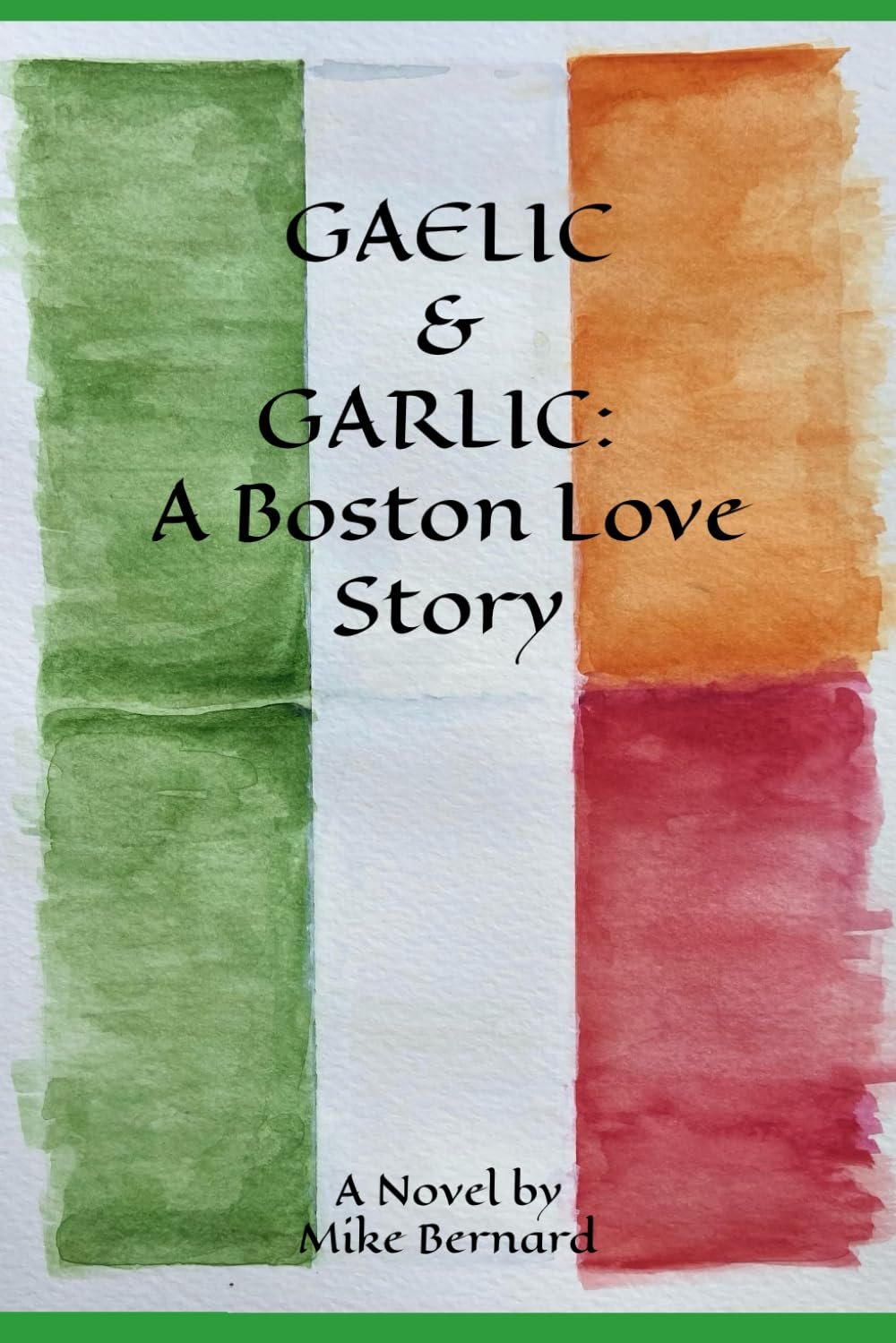
GAELIC & GARLIC: A Boston Love Story
In Boston’s Irish and Italian neighborhoods, two people find that family tradition and unexpected love rarely follow the same map.
Books worth discovering. Authors worth knowing.
In Boston’s Irish and Italian neighborhoods, two people find that family tradition and unexpected love rarely follow the same map.
Original editorial introduction, grounded in the verified book edition and public descriptions.
A city is never merely a setting when the people who live there carry different versions of its history. In Mike Bernard’s GAELIC & GARLIC: A Boston Love Story, the documented premise brings together East Boston’s Antonio PrestiDiGiovanni and Charlestown’s Margaret Katherine O’Shaughnessy. The author’s published description places their encounter against Irish and Italian family traditions, old rivalries, and the unpredictable consequences of a decision that changes how a life unfolds. Those particulars give the novel a recognizable local character without reducing its appeal to readers who happen to know Boston. The larger invitation is familiar: what happens when affection crosses an inherited boundary, and how much of a person’s future belongs to their own choices rather than the expectations of those who raised them?
A Boston built from neighborhoods and affiliations
The book belongs to Bernard’s Boston Irish Belt sequence, alongside The Crossing Guards and Crossing the Sagamore. The author identifies Charlestown as the particular geographical center for GAELIC & GARLIC, while the two central figures are linked to East Boston and Charlestown. That placement matters because the neighborhoods are more than decorative names. In the description, family identity, neighborhood loyalties, and ethnic heritage shape the assumptions characters bring to an unexpected relationship. Readers do not need a detailed street map to recognize the pattern: familiar streets can support a sense of belonging while also defining which partnerships other people think are acceptable. The novel’s advertised humor and warmth seem designed to keep the tensions human-sized rather than turning them into a sweeping historical argument.
The title itself joins two traditions at the dinner table. “Gaelic” and “garlic” can be read as shorthand for identities that families preserve through language, food, and everyday ritual. The pairing is playful, but the question beneath it is serious: when communities insist they are different, are those differences necessarily barriers? Bernard’s synopsis acknowledges a history of suspicion between Irish and Italian groups in Boston. That historical framing is the author’s description of the novel’s world, not evidence that every family or neighborhood lived the same experience. The interesting literary possibility is how large inherited stories become smaller, messier and more changeable when particular people have to face each other rather than repeat what they have been told.
Romance as a question about permission
The published account introduces the central couple with full, extravagantly long names and gives them the more manageable identities of Richie and Mary Kate. Those choices advertise an affectionate tone: a book willing to enjoy the extravagance of family naming customs may also have room for disagreement and absurdity. Yet it would be a mistake to assume comedy cancels out conflict. In a family-centered romance, the prospect of loving someone may be inseparable from the fear of disappointing someone else. The core premise asks readers to think about whether belonging to a family requires agreement with every family expectation. The book’s description does not establish precisely how the lovers navigate that tension, so any promised reconciliation or final outcome would be speculation.
The idea of one decision altering a life’s trajectory is central to the available synopsis. It suggests a narrative concerned with the lasting consequences of moments that may not look monumental when they happen. Romance often organizes its emotional movement around the decision to approach, the decision to remain, or the decision to speak. Here, the stated emphasis on tradition adds another layer: a choice made by one individual can reverberate through relatives who believe the choice reflects on them. What makes that premise resonant is not a guaranteed ending but a dilemma many readers know in other forms. The household may want stability and continuity; the individual may need the freedom to discover what continuity should mean.
The complications of family loyalty
Bernard describes the novel in language that celebrates both the comforts and the aggravations of family. The result is a useful reminder that affectionate fiction need not pretend relatives always behave sensibly. Families protect stories about themselves. They also create customs for managing disappointment, affection, embarrassment and pride. A romance built within that structure can ask whether the very people who sustain a character also make change difficult. Readers interested in intergenerational relationships may recognize how protective behavior and possessiveness can resemble each other, and how complicated it becomes to thank someone for their care while rejecting part of their advice.
This is one reason the book’s regional specificity is an advantage rather than a barrier. A family with strong Irish or Italian roots in Boston may use different language and rituals from a household elsewhere, yet its underlying negotiations can be strikingly similar. A chosen partner might be unfamiliar to parents; a career or a place to live might challenge a family’s inherited idea of success. The question extends beyond the central romance: where does a tradition provide nourishment, and where does it become a demand? The title’s culinary playfulness invites readers to imagine different ingredients sharing a table rather than one erasing the other. That is an editorial reading of the metaphor, not a claim about a particular dinner scene in the novel.
Humor without dismissal
Public descriptions repeatedly position GAELIC & GARLIC as both heartwarming and humorous. Humor is especially useful in fiction about community because it can expose the distance between how solemnly people take an argument and how improbable that argument may look from outside. In a story about ancestral loyalties, an inflated name or overconfident family opinion can puncture the idea that inherited boundaries are sacred. But humor works best when the feelings beneath it remain believable. The reader can laugh at how a conflict is expressed while still seeing why the people inside it feel vulnerable. The accessible sources do not allow a judgment about the prose’s comic timing, only a grounded account of the tone the author promises.
Bernard’s background as a screenwriter and playwright, documented on his author site, offers another point of context. That fact does not establish that the novel uses a theatrical structure, dialogue-driven chapters, or a particular pacing. It does suggest a creative practice extending across forms that depend on character interaction. Readers may approach the book with attention to conversations and changes of perspective, while withholding claims about formal technique until they encounter the text. For readers curious about an author’s wider Boston project, the trilogy connection provides an inviting route into the surrounding books without requiring the assumption that this story’s people appear in the others.
What the reader can bring to the story
An especially useful question for a book like this is whether the communities depicted should be understood primarily through rivalry or through the surprising amount they share. The synopsis emphasizes clashes, but family pride and fierce loyalty can appear on both sides of a cultural divide. That symmetry may be a source of comedy; it can also be the beginning of mutual recognition. A reader can ask which beliefs are inherited and which are chosen, what a tradition means when it is no longer compulsory, and whether the characters’ idea of home grows more capacious over time. These are questions to take into the novel rather than answers this article can guarantee.
Who might enjoy this book
GAELIC & GARLIC is a natural prospect for readers who enjoy character-led contemporary stories about families, local identity, and affection complicated by expectations. Those with ties to Boston, Charlestown or East Boston may especially enjoy seeing neighborhoods associated with a romance that explicitly acknowledges Irish and Italian heritage. It may also appeal to readers who prefer warmth and comedy to relentless darkness, and to those interested in the way adult relationships push families to renegotiate their assumptions. Someone looking primarily for an extensively researched social history should instead approach this as a novel whose public description draws on historical tensions, not as a comprehensive history of those communities. Someone seeking a suspense thriller or an entirely solitary romance should likewise note the emphasis on extended family and local culture. Above all, the book invites readers who believe that love stories can be about belonging as well as attraction.
An invitation shaped by place
The most distinctive promise of GAELIC & GARLIC is the combination of a sharply named Boston setting, two families’ expectations, and an apparently lighthearted willingness to test boundaries that once felt immovable. The documented premise contains enough to make the novel specific without requiring a manufactured account of its chapters or conclusion. A good way to approach it is to keep one question in view: how does a person honor the place that formed them without allowing that place to make every decision? Bernard’s Boston love story offers that question through an Irish-Italian pairing and the affectionate contradictions of family life. The reader discovers the answers, if any, by opening the book itself.
About the book.
In Boston’s Irish and Italian neighborhoods, two people find that family tradition and unexpected love rarely follow the same map. Public bibliographic details have been distinguished from editorial interpretation.
Independent editorial feature: this is a source-based introduction, not a firsthand review of the complete book. Bibliographic descriptions and author or publisher statements are interpreted with clear source limits. The original purchase URL remains unchanged; WordPress cover media is added later by the owner’s publisher.
Found a book worth opening?
Books worth discovering. Authors worth knowing.
Return to the Journal →