
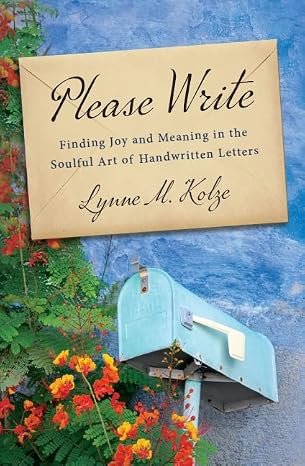
Please Write
Lynne M. Kolze makes a warm, research-informed case for the handwritten letter as a gift, a bridge and a record of a life.
Books worth discovering. Authors worth knowing.
Lynne M. Kolze makes a warm, research-informed case for the handwritten letter as a gift, a bridge and a record of a life.
Original editorial introduction, grounded in the verified book edition and public descriptions.
The small act of putting pen to paper can carry a surprising amount of emotional weight. An envelope might arrive weeks after a conversation, outlive the people who wrote it, or preserve a voice that would otherwise vanish from family memory. Lynne M. Kolze’s Please Write: Finding Joy and Meaning in the Soulful Art of Handwritten Letters makes that ordinary object the center of a sustained argument for connection. The publisher describes a combination of research, personal memoir, and stories from other letter enthusiasts. Kolze’s own account adds examples of older family letters and correspondence that acquired meaning through being saved. Rather than asking readers to abandon digital communication, the book argues for making space for an older, deliberate form of expression that still has uses we may underestimate.
More than nostalgia for paper
A project about handwriting can easily be mistaken for a rejection of modern life. Kolze’s framing is more useful when considered as an inquiry into what different forms of communication make possible. Speed has enormous value: a message can confirm safety, share news, or reconnect people across distance almost instantly. A handwritten letter does something else. It requires the sender to choose a physical object, commit words to a surface, and entrust them to a slower route. That process may encourage reflection, although it will not automatically make every sentence wise or every relationship close. The book’s argument is strongest as an invitation to consider this extra layer of care, not as a claim that one medium is morally superior to another.
The publisher says Please Write combines facts, memoir and anecdotes. These are distinct ways of making a case. Research offers context; memoir shows what a practice has meant in a life; stories from other people widen the range of experiences a reader can recognize. In the author’s essay about the book, she describes letters from a nineteenth-century family member, from a wartime pilot and from relatives writing across ordinary distances. Such documents remind us that the value of correspondence changes over time. A note might be casual when sent and historically absorbing decades later. The book appears interested both in the immediate pleasure of receiving attention and in the unexpected archive that written attention can create.
The presence of an actual hand
A handwritten letter carries marks that a typed message usually standardizes away. The slant of a line, the pressure of the pen, a corrected word or the spacing between sentences can become recognizable traces of the writer. It would be sentimental to say handwriting always communicates more honestly: a person can conceal feelings on paper as easily as on a screen. Yet the marks create another dimension for memory. Readers who have saved cards or notes from loved ones may know how the object becomes emotionally significant even when the message is brief. Kolze’s project makes room for that familiar experience while arguing that it deserves intentional practice rather than being left entirely to chance.
Thinking about handwriting also raises a useful question of accessibility. Not everyone can write comfortably or legibly by hand; some people rely on assistive technologies, and others communicate most openly through alternative formats. A meaningful reading of Please Write need not insist on one physical technique for everybody. Its deeper proposition is about offering attention in a personal form and preserving that attention when it matters. A reader might adapt the principle through a typed but carefully composed letter, an audio recording, or another accessible ritual. That extension is an editorial implication of the book’s theme, not a claim that Kolze specifically instructs readers to use those alternatives.
Letters as family history
A family archive is often built without anyone declaring that they are building one. Birthday cards collect in drawers; a holiday note remains inside an old book; a message from a parent survives alongside household paperwork. The author’s examples show why ordinary correspondence can become a source of historical interest. Details that seemed too trivial to record formally can reappear in personal language: what worried someone, whom they loved, how they described a distant event. These fragments do not provide a complete or necessarily impartial record. They do preserve experiences that institutional histories might never notice. A reader can ask which voices have been carefully kept and which never had an opportunity to write, send or save a letter.
Kolze’s decision to draw on correspondence linked to different generations invites a second reflection. Writing has always involved a future reader we cannot fully imagine. The person addressed may be a close friend today; years later the words might be read by descendants, researchers or strangers. That possibility calls for respect toward privacy as well as enthusiasm for preservation. The fact that old letters can illuminate history does not mean every private exchange should be shared without care. A thoughtful reader of Please Write might come away wanting both to write more and to handle surviving letters more responsibly.
The emotional discipline of slowing down
Handwritten letters can impose a productive pause between feeling and expression. A difficult thank-you, a message of condolence, or a long-overdue update may resist the speed of an instant reply. That pause creates a chance to ask what the other person needs to hear and what the writer really means. It is not a guarantee of better communication: a delayed message can also become an avoided one. But the ritual of composing and sending can make attention visible. The book’s central appeal is to people who sense that convenience and depth are not always the same thing, and who want simple ways to express care without treating every exchange like another task in an inbox.
The author’s public essays also explain how the book itself came into being. Kolze describes memoir-writing classes, encouragement from others and the challenge of learning to write a book. Her account gives the project an unusual parallel: composing a sustained book about letters required much the same persistence and willingness to revise that meaningful personal writing sometimes asks of us. That context does not prove every chapter’s effectiveness, but it helps explain why the author sees the subject as both intimate and practical. The work emerged from lived enthusiasm rather than an abstract campaign against technology.
A reading practice that can become an action
This is one of those nonfiction titles whose central subject invites the reader to respond before finishing it. A person might recall someone who deserves a note, identify an elder whose memories should be asked about, or decide to preserve a few pieces of correspondence rather than clear them away. The useful test is not whether one suddenly begins writing elaborate letters every week. It is whether one can make room for an occasional act of care that differs from the quick messages of ordinary life. The book’s blend of anecdotes and argument gives readers several points of entry rather than a single required ritual.
Who might enjoy this book
Please Write is especially suited to readers who treasure personal essays, family history, thoughtful gift-giving and the quieter forms of connection that can be overlooked in a busy week. It could appeal to people who have kept letters for years but have not written one recently, and to younger readers curious about how earlier generations maintained relationships across distance. Memoir readers may appreciate the author’s own experiences; local historians and family archivists may find the examples of old correspondence provocative. People seeking a highly technical manual on calligraphy, stationery design or postal history should note that the publisher presents this primarily as a reflection on the meaning and value of letters, not a specialist handbook in those subjects. The book is a compelling prospect for anyone interested in how ordinary words become enduring gifts.
The message beyond the mailbox
The most persuasive question behind Kolze’s book is not whether handwriting will disappear. It is what we lose when we stop making deliberate time for one another, and what might return if we begin again. The author’s combination of documented examples, lived experience and a gentle call to action makes a familiar subject newly worth considering. Readers can enjoy the stories as cultural memory, take the argument as a practical invitation, or use it to think about the communications they want to leave behind. Whatever the response, Please Write treats correspondence as a relationship rather than a relic—and asks us to take that possibility seriously.
About the book.
Lynne M. Kolze makes a warm, research-informed case for the handwritten letter as a gift, a bridge and a record of a life. Public bibliographic details have been distinguished from editorial interpretation.
Independent editorial feature: this is a source-based introduction, not a firsthand review of the complete book. Bibliographic descriptions and author or publisher statements are interpreted with clear source limits. The original purchase URL remains unchanged; WordPress cover media is added later by the owner’s publisher.
Found a book worth opening?
Books worth discovering. Authors worth knowing.
Return to the Journal →