
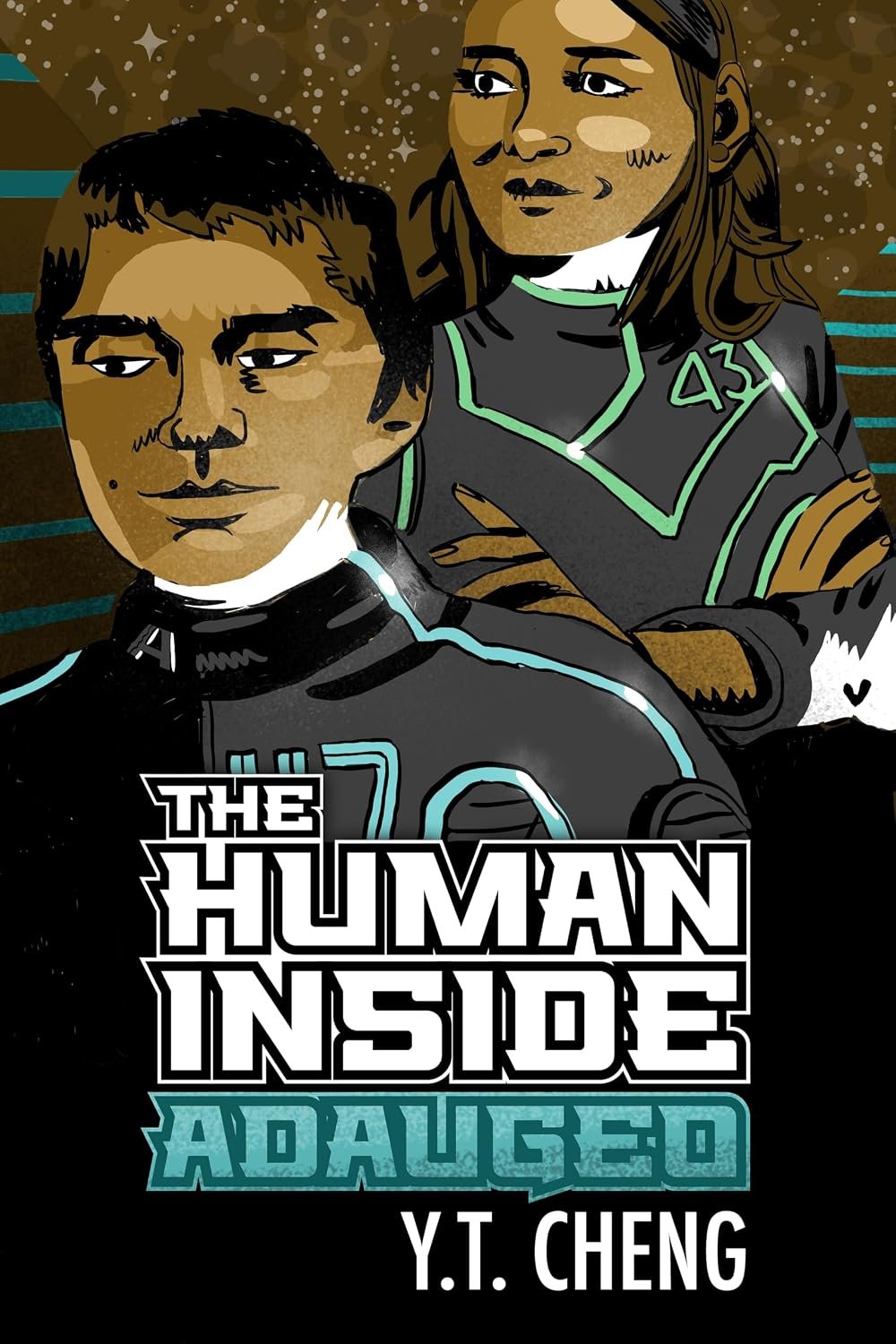
The Human Inside: Adaugeo (English Edition)
The future of humanity is unsettled when cybernetically enhanced protectors must confront a threat they cannot easily see.
Books worth discovering. Authors worth knowing.
A future designed around improved human capabilities can still inherit familiar forms of fear. In The Human Inside: Adaugeo, Y.T. Cheng imagines cybernetically enhanced young adults known as amborgs entering a society that is drifting toward dystopia. They are intended to protect people, yet an opposition force threatens their purpose and perhaps the fragile trust around them. A publicly available review adds a historical framing device set in 2135. These documented premises are enough to raise the book's governing question: what remains recognizably human when the body—and the expectations placed upon it—has been remade?
An editorial introduction to the book and its published premise, not a full-book review.
The amborgs and the promise of protection The publisher summary describes amborgs as a group of cybernetically enhanced young adults deployed in the twenty-second century. Their intended task is protective: they are meant to improve conditions for people living amid disorder. That is a stronger starting point than a neutral story about new technology, because it gives the enhancements a public mission. Someone has decided that extraordinary abilities should be used to make a damaged world safer. The description does not explain the engineering process or the precise capabilities of every amborg, so technical specificity beyond this premise would be misplaced.
The decision to call the characters 'amborgs' also separates them from anonymous mechanical devices. The summary presents them as evolved or altered people, not merely robots assigned an operation. Their humanity is part of the subject, and their treatment by institutions may be as important as their physical advantages.
A society close to dystopia The advertised future is explicitly described as approaching a dystopian condition. That phrase leaves room for uncertainty about how complete the breakdown has become, but it establishes a troubled social environment. The amborgs are introduced as a response to danger, not simply as consumer technology or a fashionable enhancement. This distinction matters. When a technological project begins as a rescue plan, its creators and beneficiaries may disagree about who deserves protection, who makes decisions and what risks are acceptable. The sources do not furnish a detailed political map, so such issues remain interpretive questions rather than documented institutions.
A near-dystopian world can also alter the meaning of heroism. People may celebrate extraordinary protectors while fearing the concentration of power they represent. A public that seeks safety can also demand proof that its defenders are accountable. The official description suggests that the amborgs' actions will be tested in their experiences as an evolved form of humanity.
One boy among the enhanced The publisher's overview identifies a particular boy within the amborg ranks as an important focus. That detail gives a broad speculative concept an individual scale. Stories about transformation become more immediate when a reader can follow someone who must live with its benefits and its costs. The description does not name the boy or summarize his complete arc, so it would be wrong to connect him to every character mentioned elsewhere. What can be said is that the official pitch brings the reader close to one enhanced young person rather than treating the group solely as an abstract experiment.
The book's youth-centered element may be especially interesting to readers drawn to coming-of-age questions inside science fiction. Becoming an adult already involves questions of control, self-definition and how much duty to others one can shoulder. Cybernetic enhancement adds another layer of public expectation.
The history lesson described by a reviewer A BlueInk Review notice, published in October 2026, describes a frame set in 2135. It names Dr. John Kendrick as CEO of A.I. Industries and creator of the amborgs. In that review's account, a high-school senior named Brad meets Kendrick and receives a tour of a secret facility, where a larger history of the enhanced humans is explained. Those details come from a named external review rather than directly from the storefront description. The distinction is worth retaining because an external reviewer may select and compress elements differently from the publisher's own presentation.
The same review identifies a gang-powered uprising, a traitor and a villain seeking to blame the amborgs for a catastrophic plan. These are reported elements of the review's synopsis, not plot points independently confirmed through reading the novel. They suggest a structure in which present-day curiosity opens into an account of earlier crises.
An adversary in the shadows The publisher description says an enemy is preparing to make the amborgs fail. That creates a different kind of problem from a purely environmental crisis. The danger may be deliberate, strategic and concerned with public perception as well as physical harm. In a story about protectors, failure can be personal and civic at once. The availability of greater strength or speed does not automatically solve the challenge of identifying an opponent's motives. No source reviewed here establishes the villain's exact identity, so this feature preserves the advertised mystery.
The tension between visible defenders and a concealed enemy also creates space for questions of trust. A population may see amborgs only when they intervene, not when they make difficult judgments beforehand. Enemies who exploit that gap could threaten their legitimacy. Again, this is an interpretive possibility, not a description of a confirmed scene.
An expanded edition and a larger project A Bookshop listing describes *Adaugeo* as the first part of a series and says the debut has received an expanded or overhauled edition with added characters and content. That edition context matters when comparing reviews, formats and page counts. Different listings show lengths of roughly 668 to 700 pages for particular editions, and the exact version behind the queue's ebook link should be checked before making a page-specific claim. A series label also suggests further territory, but it does not authorize inventing the direction of later installments.
The source metadata deserves attention here. The Sheet credits Y.T. Cheng with Michael Batista as illustrator and Skyler Surber as editor. Those roles should remain visible rather than collapsing all work under a generic author name. A longer speculative novel can involve different kinds of creative labor, and preserving the listed credits is a basic editorial courtesy.
Who might want to enter this future Readers who enjoy cybernetic science fiction, threatened utopias and ethical questions about altered bodies have clear reasons to explore the book. The published materials combine action-oriented dangers with the question of what makes someone human. Readers looking for a fast, short adventure should check the edition length and a sample first; the available listings describe a substantial volume. Those seeking a definitive scholarly treatment of enhancement ethics should remember that this is presented as a novel with fictional characters and conflicts.
What gives the premise staying power is its refusal, at least in outline, to reduce advancement to a simple improvement. New abilities bring new obligations, and protectors can be attacked not only through force but through distrust. The story's larger mysteries belong to its pages. This feature identifies what public sources establish: enhanced young defenders, a society under strain, a shadowed adversary and an expanded first installment. It leaves claims about pacing, prose and resolution to an actual reading, where they can be judged fairly.
About the book.
In a future dystopia, amborgs (cybernetically enhanced young adults) are made to protect people; a published review describes Dr. John Kendrick and a 2135 encounter with Brad.
Non-sponsored Book Feature based on the queue record and cited public materials; this is not a full-book review. Interpretive observations are distinguished from the publicly documented synopsis. Verify all copy before publication. Source research: primary reference and second reference.
Found a book worth opening?
Books worth discovering. Authors worth knowing.
Return to the Journal →