
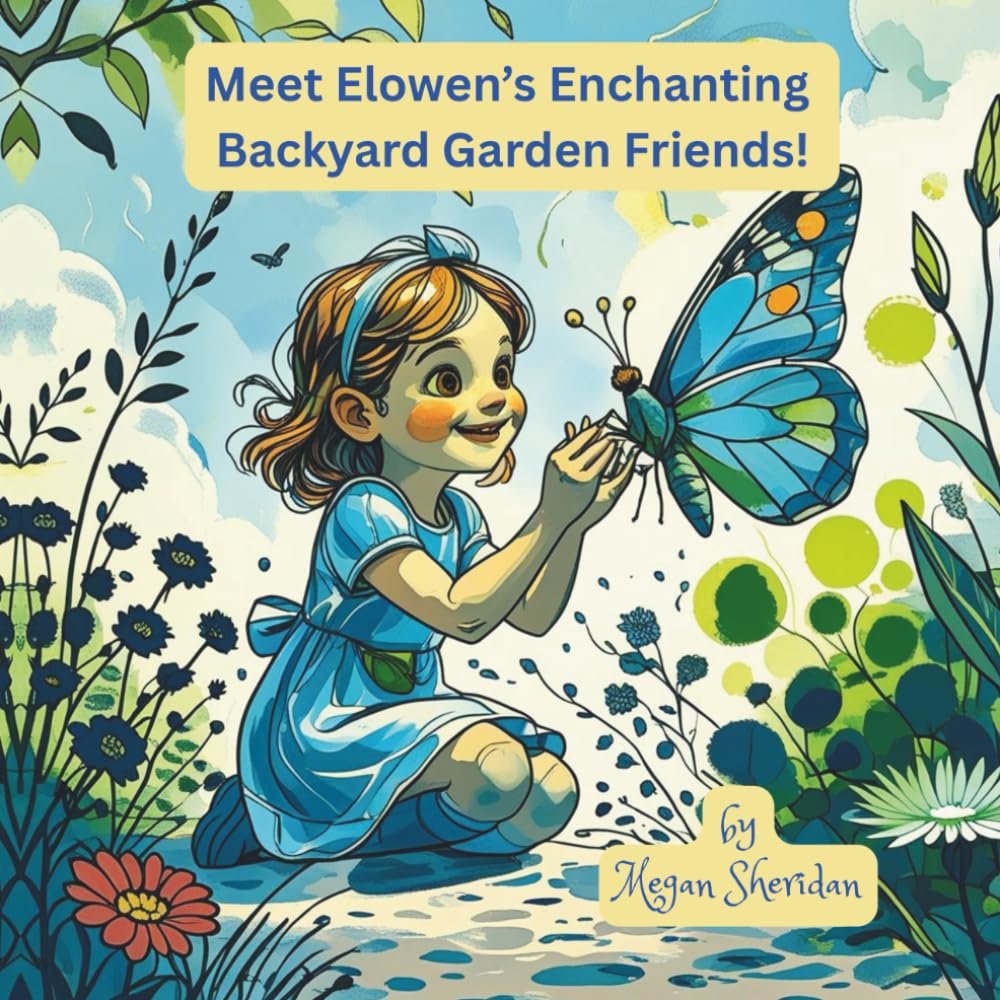
Meet Elowen's Enchanting Backyard Garden Friends!
A small backyard becomes a place to notice familiar animals with fresh curiosity.
Books worth discovering. Authors worth knowing.
A backyard is often the first wilderness a child can explore without going far from home. The ground has small trails, the air has quick visitors, and a familiar corner of a garden can become interesting again when someone takes the time to look. Megan Sheridan's Meet Elowen's Enchanting Backyard Garden Friends! introduces Elowen's discoveries through a few named animal companions. The public description is brief, but it clearly positions the book as a cheerful, accessible discovery adventure for young children. This is a limited-source spotlight, not a claim to have examined every illustrated spread.
A limited-source editorial spotlight, pending human signoff.
The garden as a place to begin The available retailer description identifies Elowen as the child exploring her backyard. That simple location is central to the book's invitation. Young readers do not need a distant kingdom or a complicated map to recognize the excitement of noticing something new. A garden can offer movement, sound and close observation on a human scale. The synopsis does not establish whether Elowen follows a planned route, learns a stated lesson or returns to one particular spot. Those events would be invented if presented as facts.
The premise may appeal to families who already make time for short outdoor observations. It can also suggest a low-pressure activity after reading: looking for birds, insects or the signs that animals have been near. Such a suggestion comes from the reader's world, not from a verified instruction printed in the book. For very young children, an enjoyable story can be an invitation to name what they see and to ask how different creatures share a small environment. An adult can guide that curiosity without turning the reading experience into a lesson plan.
Three named creatures The retailer summary specifically names Sierra the squirrel, Stella the spider and Heidi the hummingbird. Those details are useful because they offer more than a generic promise of cute animals. A squirrel, a spider and a hummingbird move in very different ways and occupy different visual scales. The description calls Heidi fast, but does not give a sequence of encounters or specific speech to any animal. This spotlight therefore introduces the trio without claiming dialogue, personality traits beyond the names or individual episodes not supported by the source.
Animal characters can help young readers build familiarity with creatures they may encounter outdoors. A spider may inspire curiosity in one child and caution in another; both reactions can open a conversation about observing without harming. A squirrel is easier to spot from a distance, while a hummingbird's movement can become a reason to look closely and patiently. These are ideas for shared discussion prompted by the synopsis, not a report about the book's pages. They should remain separate from the actual description of Elowen's adventures.
Reading together without rushing The paperback listing gives a length of 34 pages and an age range of approximately two to eight years. Those are retailer-provided details for an identified edition, not a guarantee that every child in the range will respond the same way. Picture books often invite repeated reading because a familiar character, setting or phrase can become a starting point for new questions. The publicly available material does not confirm rhyme, illustration style, page layout or any recurring refrain, so those common picture-book qualities should not be attributed to this particular book without inspection.
For a caregiver choosing a read-aloud, the strongest verified hook is ordinary nature experienced as adventure. That can be a good match for children who like animals and who enjoy seeing their immediate surroundings treated as worth exploring. Readers seeking a scientifically detailed field guide should not assume the book serves that purpose. The product description promises a fun story, not a taxonomy lesson. The best next step for a buyer is to examine a preview or physical copy to see whether its language and artwork match the intended reader.
Why the limits of this spotlight matter The public synopsis is only a few sentences long. It supplies Elowen, the backyard setting, three named animals and the general idea of discovery, but not enough material to reconstruct the complete plot. In children's publishing, visual storytelling can carry much of the meaning, making it especially risky to describe illustrations one has not seen. This article intentionally avoids claiming that Elowen learns a particular moral, encounters additional creatures or behaves in a specific way on a specific page.
That limitation need not prevent readers from finding the book's basic premise appealing. It simply changes the kind of feature an editor can responsibly publish. Instead of a detailed critical review, this is an introduction to the verified invitation: looking at an ordinary outdoor space with a child's sense of wonder. Before publication, an editor should inspect the relevant edition, verify the cover and confirm that the finished story and artwork are accurately represented. Until then, this spotlight remains an editorial draft requiring signoff.
About the book.
Elowen discovers backyard creatures including Sierra the squirrel, Stella the spider and Heidi the hummingbird; 34-page paperback, ages 2–8 listed by retailer.
Non-sponsored Book Feature based on the queue record and cited public materials; this is not a full-book review. Limited-source spotlight: the plot has not been verified, and editorial signoff is mandatory before publication. Source research: primary reference and second reference.
Found a book worth opening?
Books worth discovering. Authors worth knowing.
Return to the Journal →