
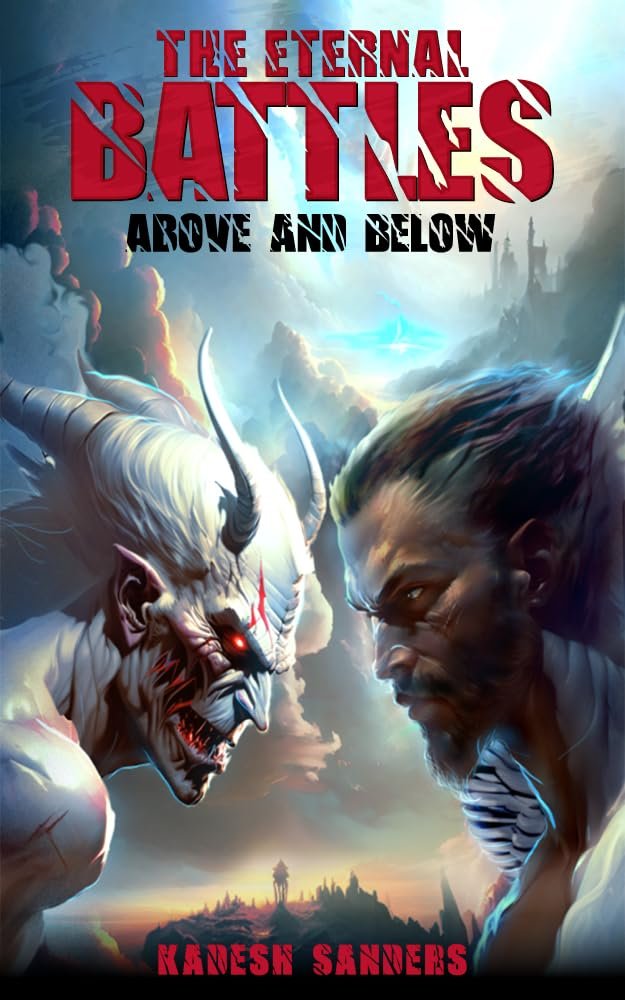
The Eternal Battles: Above and Below
A battle between angels and demons makes an immense claim on a reader’s imagination: it assumes that ordinary human life unfolds inside a struggle whose true.
Books worth discovering. Authors worth knowing.
A battle between angels and demons makes an immense claim on a reader’s imagination: it assumes that ordinary human life unfolds inside a struggle whose true.
Evidence-conscious literary criticism, not a claim of firsthand full-text reading.
A battle between angels and demons makes an immense claim on a reader’s imagination: it assumes that ordinary human life unfolds inside a struggle whose true participants may be invisible. Kadesh Sanders’s The Eternal Battles: Above and Below is described in bookseller material as a supernatural conflict between powers seeking to protect humanity and forces intent on its destruction. Its title establishes two vantage points—heavenly and earthly—and suggests that decisions made on one plane of existence reverberate through the other.
Cosmic scale and personal stakes The available synopsis refers to angels resisting demons as the fate of souls, cities and nations hangs in the balance. Such an enormous scale can produce exhilarating fantasy, but it also risks making individual lives seem merely illustrative. The strongest stories of cosmic war usually give readers something small enough to fear losing. A city is an abstraction until its inhabitants matter; a soul is not only a unit in a celestial contest. This is the central artistic test implied by the book’s premise, although the supplied summary does not establish its answers.
The narrative is framed in terms drawn from Christian angelology, including God and Lucifer. That choice sets up familiar moral symbolism, but familiarity is not automatically a weakness. The challenge is to find tension within the moral architecture: what does courage mean when the combatants believe themselves to be on an eternal side? How does the story treat human choice when supernatural powers exert pressure on people’s destinies? Such questions can give a seemingly straightforward struggle more complexity.
Battles of meaning, not only force Grand confrontations are satisfying when the opposing forces embody distinct ideas about the world rather than simply different weapons. The description promises powerful angels facing formidable adversaries. Readers may therefore expect spectacular scenes and urgent stakes. But a procession of battles cannot by itself carry the full emotional weight of a novel. The consequences must accumulate: exhaustion, sacrifice, loyalties tested, some shift in the way participants understand what they defend.
The first part of the title, The Eternal Battles, implies repetition as much as duration. An eternal struggle suggests the difficulty of believing that one final victory will end all suffering. This can be an intellectually fruitful aspect of spiritual fantasy. It invites consideration of perseverance even when outcomes are uncertain. The danger, on the other hand, is that an everlasting conflict may make changes in fortune feel temporary and therefore less significant. How the author addresses that issue remains open from the accessible material.
The responsibilities of religious fantasy Readers of different faith commitments may approach the cosmology differently. Some will understand the angelic forces through a devotional lens; others may encounter them as elements of fantastical mythology. A thoughtful review should not confuse the book’s fictional representation of spiritual warfare with an independently established account of reality. Nor should it dismiss the religious imagination that supplies its stakes. The critical question is whether the story builds an internally persuasive moral and dramatic world.
Because the author’s wider bibliography includes another installment in an Eternal Battles series, edition and sequence matter. The queue identifies this specific work as Above and Below, and that title should not be exchanged with a later installment merely because the same angels and demons recur. Series identity connects books without making them duplicates.
The human scale of sacred conflict A narrative organized around angels and demons may seem to have determined the moral positions before the first battle begins. Yet the people caught between those powers still have choices. Their courage, fear and susceptibility to manipulation are potentially as important as the spectacular abilities of the supernatural combatants. If all human characters do is wait to be rescued, an enormous war can feel oddly distant. The premise’s reference to people choosing light or darkness offers a way around that danger, provided the story dramatizes choice as a lived difficulty rather than a label imposed from the outside.
The difference between protection and domination is especially important in a book about cosmic guardians. Even a benevolent force can overwhelm the agency of those it wishes to save. An ambitious spiritual fantasy might explore what it means to defend free beings without deciding their lives for them. This is an ethical question the genre invites; it must not be mistaken for a description of a particular scene in Sanders’s book.
The imagery of height and depth “Above and Below” evokes a universe divided vertically. Height traditionally signifies distance, vision and authority; depth can suggest concealment, punishment or the unseen forces beneath ordinary life. But a meaningful story can challenge such easy associations. A character may feel morally lost while standing in a beautiful place, or discover courage in a setting that appears dark. The title gives the author a visual language through which to create contrasts and reversals. Readers should see whether the prose turns this imagery into emotional experience or leaves it as a familiar diagram of good and evil.
Scale also affects pacing. Repeatedly escalating from a person to a city, then to a nation or the fate of the world can produce fatigue if the novel offers no intervals of ordinary attachment. The still moment between battles, where characters discover what has been lost or saved, may ultimately provide the measure of the action. This is why cosmic fantasy depends as much on intimacy as spectacle.
The reader this premise seeks The book is a natural prospect for readers attracted to Christian-inflected speculative fiction, angelic warfare and expansive battles in which the supernatural and mortal worlds meet. It may be less suitable for readers who dislike highly polarized mythic conflicts or who seek realism rather than a spiritual frame. The available description does not disclose enough about prose style, point of view or character development to evaluate those qualities honestly.
As a premise, The Eternal Battles: Above and Below offers the promise of scale and urgency. Its deeper opportunity lies in discovering how cosmic conflict is felt by particular lives, and whether warfare framed as good against evil can still accommodate human fear, responsibility and moral discernment. This remains a source-based review draft pending examination of the full text.
About the book.
The title, contributors, routing category, original retailer link and unique Drive image file were checked against the live queue. The review is based on publicly available evidence and original editorial analysis.
This is a sponsored book review. Sponsorship does not alter our standards for evidence and critical independence. This research-based critical review interprets the verified book listing and available external descriptions; it does not claim a complete reading.
Found a book worth opening?
Books worth discovering. Authors worth knowing.
Return to the Journal →