
Kutchinsky's Egg: A Family Story of Love, Loss and Obsession
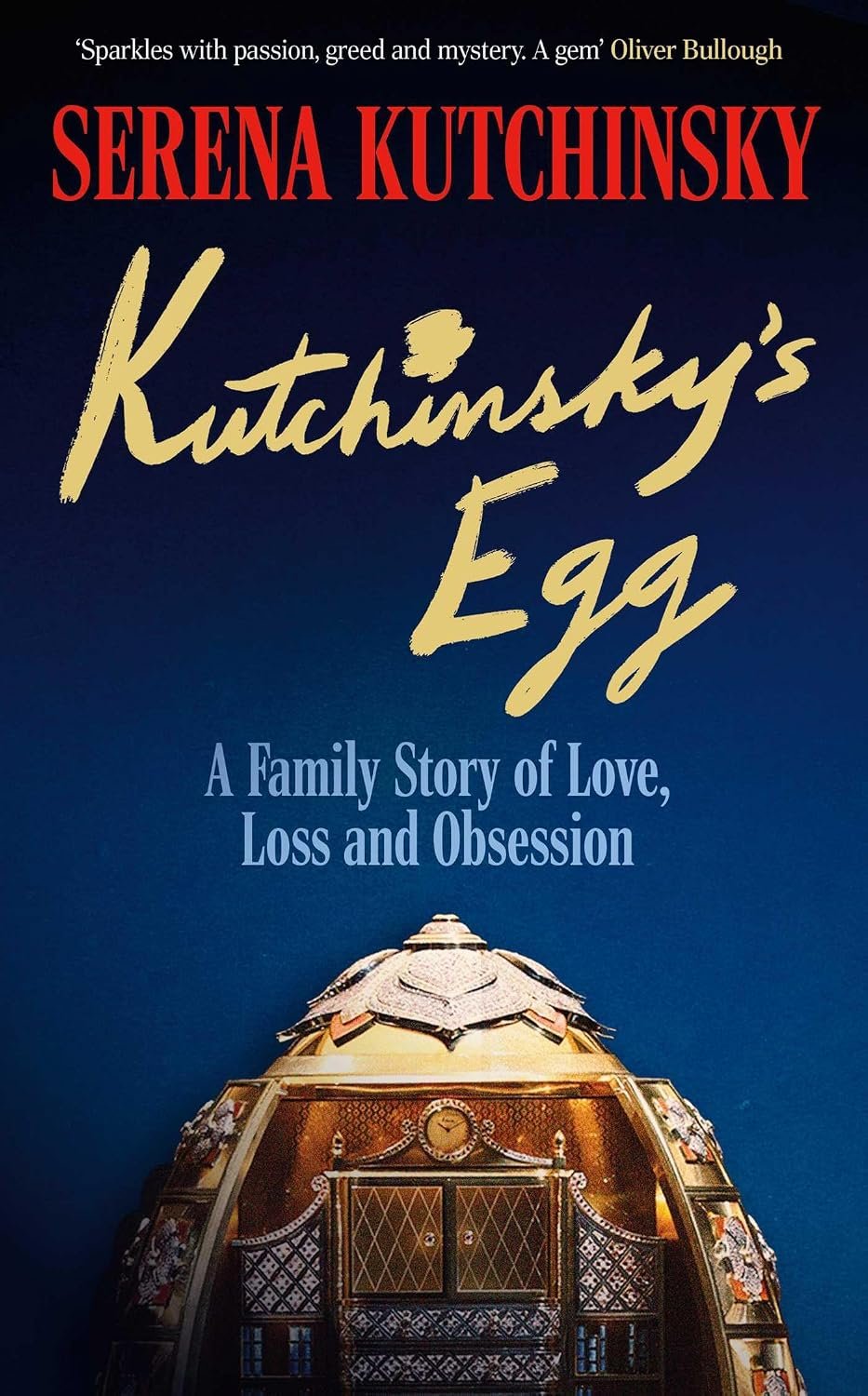
Serena Kutchinsky’s Kutchinsky’s Egg begins with an object that seems too extravagant to belong to ordinary life: her father Paul commissioned an enormous, jeweled egg in the ambition of rivaling…
Books worth discovering. Authors worth knowing.
Serena Kutchinsky’s Kutchinsky’s Egg begins with an object that seems too extravagant to belong to ordinary life: her father Paul commissioned an enormous, jeweled egg in the ambition of rivaling Fabergé. The project consumed vast resources and became entangled with the collapse of a family jewelry business and the disintegration of his marriage…
Considered reviews, grounded in the book’s documented promise.
Serena Kutchinsky’s Kutchinsky’s Egg begins with an object that seems too extravagant to belong to ordinary life: her father Paul commissioned an enormous, jeweled egg in the ambition of rivaling Fabergé. The project consumed vast resources and became entangled with the collapse of a family jewelry business and the disintegration of his marriage. Years later, the author sets out to learn what happened to the object and, through it, to the relationships and silences that shaped her childhood. The result, as described by the publisher and several professional reviewers, is an inquiry into the cost of confusing a beautiful creation with a guarantee of personal or dynastic greatness.
A jewel as an archive of consequences
The Argyle Library Egg was intended to demonstrate extraordinary technical and artistic ambition. Its reported physical details—gold, diamonds and an elaborate mechanical design—matter not as decoration but as evidence of how completely Paul tried to turn a fantasy of recognition into matter. The object became difficult to sell, and the enterprise collapsed under pressures that a single spectacular work could not resolve. That arc exposes an unsettling paradox: a monument created to preserve a family name can endanger the people living under that name. The author’s investigation makes an aesthetic object serve as a document of financial and emotional decisions. It is a powerful way to move beyond the familiar memoir structure of childhood, crisis and recovery.
The daughter who becomes an investigator
Serena’s choice to search for the vanished egg is psychologically complex because research cannot be entirely detached when the subject is one’s father. Archives and interviews may illuminate the record while also reopening the question of which family stories have been told for protection. A memoir that investigates its own makers must face the difficult distinction between understanding and forgiving. Sources including Kirkus describe the author’s lengthy inquiry and her willingness to uncover uncomfortable family relationships. The method offers readers the pleasures of a mystery, but the stakes are not the location of a treasure alone. They are the revision of an inherited account of who the father was and what his ambitions cost.
Immigration, craft and prestige
The Kutchinsky dynasty’s history is also a story of Jewish immigration and work in London’s jewelry trade. The family’s rise from precarious beginnings to a luxury house gives Paul’s later risk a wider historical meaning. Prestige can be pursued as proof that a family has arrived, and the desire to equal established European brands can carry memories of exclusion. The author’s sources reportedly reach back to the family’s arrival in London and the formation of its business. That background makes the financial disaster something more poignant than extravagance by a rich man. It asks how success inherited across generations can become a burden to the person expected to surpass it.
Obsession seen from more than one side
One of the book’s useful tensions, reflected in its critical reception, is whether the egg should be read as magnificent folly or as an understandable expression of Paul’s vulnerability. These explanations need not exclude each other. Creative risk often looks admirable until others bear the costs; destructive ambition can still produce an object of real beauty. A professional review should resist a verdict that renders Paul either a caricature of vanity or a misunderstood visionary. The strongest memoir lets affection and moral clarity coexist. Reviewers have generally admired the narrative force, though some questioned passages that imagine the inner lives of past figures. That distinction between documentary knowledge and inferred emotion is an important part of the book’s method.
The object and the family after it
The memoir’s lasting question may be less where the egg ended up than how a family comes to tell the truth about an object that has become a symbol of catastrophe. The investigation holds out a form of closure but also demonstrates how incomplete closure can remain. Unlike a detective puzzle, family history never restores every missing conversation. The egg offers an unforgettable image, yet the people who shaped and were shaped by it are the true subject. The author’s journalistic method makes the account accessible to readers of narrative nonfiction while encouraging more demanding reflection on the ethics of retrospective storytelling.
The price of the extraordinary
Luxury objects are often discussed in the vocabulary of taste, rarity and craftsmanship, which can make their economic circumstances seem invisible. In this memoir, the extravagant object returns the reader to those circumstances with force. The egg needed money, labor, expertise, buyers and a family business willing to assume an enormous risk. Once those elements are brought back into view, aesthetic extravagance becomes a question of responsibility. The object may be beautiful and ruinous at once. Serena’s investigation therefore offers a way of reading material culture through the people who paid for its creation. The family’s relationship to the egg is not a footnote to its design; it is part of the object’s history.
A memoir that refuses an uncomplicated inheritance
A daughter can love a father while refusing to carry forward his preferred version of the past. That is the quiet courage at the center of a genuinely investigative family memoir. The author’s public interviews and reviews describe years spent tracing the egg and examining stories that family members had reasons to protect. The reader is not required to share every interpretation in order to value the decision to ask difficult questions. Some reviewers have questioned imaginative reconstructions of private thought, and that reservation is worth retaining because memoir’s power depends on trust. Yet even the dispute clarifies what is at stake: the book tries to make room for both emotional inheritance and a more exacting account of what happened.
Who will value this book
This is one of the better-documented books in the batch, with an official publisher synopsis and independent professional reviews. It will particularly interest readers of investigative memoir, family business history, British Jewish cultural history and the psychology of ambition. The present piece synthesizes public bibliographic and critical evidence, rather than claiming an independently conducted full reading.
Scope of this assessment
This is a research-based editorial review drawn from identified bibliographic, author and publisher sources. It considers the work’s documented premise and the critical questions it invites, without claiming a complete firsthand reading. No unverified scene, character action or ending is asserted.
About the book.
An evidence-bounded critical introduction to investigative family memoir. Published descriptions support the stated premise; interpretations are identified as editorial analysis, not confirmed plot details.
This is an unsponsored, research-based editorial review, not a claim to firsthand reading of the complete book. The Sheet uses a subtitle phrasing different from the US publisher edition. Retain the exact official title from the Sheet until cross-edition verification.
Found a book worth opening?
Books worth discovering. Authors worth knowing.
Return to the Journal →