
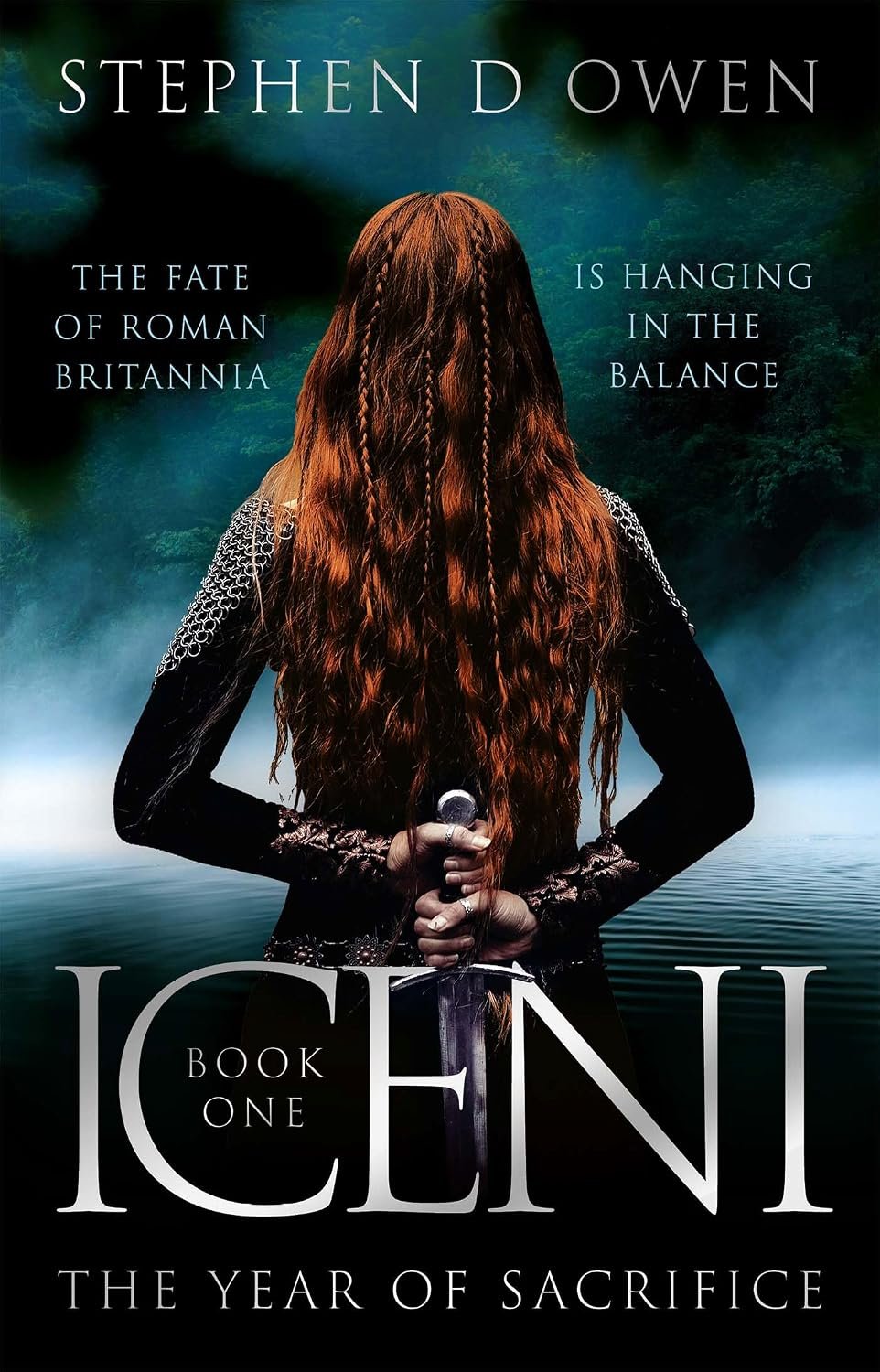
Iceni: The Year of Sacrifice
Stephen D. Owen’s Iceni: The Year of Sacrifice begins from a political wound that history has not stopped debating: the uneasy relationship between the Iceni and imperial Rome in the years…
Books worth discovering. Authors worth knowing.
Stephen D. Owen’s Iceni: The Year of Sacrifice begins from a political wound that history has not stopped debating: the uneasy relationship between the Iceni and imperial Rome in the years surrounding Boudica’s revolt. Owen has discussed his fictional characterization of Catus Decianus, the Roman procurator whose exploitation of the tribe appears in…
Considered reviews, grounded in the book’s documented promise.
Stephen D. Owen’s Iceni: The Year of Sacrifice begins from a political wound that history has not stopped debating: the uneasy relationship between the Iceni and imperial Rome in the years surrounding Boudica’s revolt. Owen has discussed his fictional characterization of Catus Decianus, the Roman procurator whose exploitation of the tribe appears in ancient accounts. The book promises a story in which a client kingdom’s apparent security becomes increasingly vulnerable to the ambitions of an occupying power. What gives this material its force is not only the promise of military uprising but the question of how people recognize the exact moment when accommodation becomes submission.
History written from unequal archives
The sources most commonly cited for Boudica’s revolt are Roman, including Tacitus and Cassius Dio. They are indispensable, but their authors wrote from the imperial world whose decisions they described. A novelist approaching the Iceni must therefore navigate evidence that is powerful and incomplete, separating documented political structures from invented private motive. Owen’s interview openly distinguishes his elaboration of Decianus from the descriptions in the Roman historians. That transparency is an advantage: it reminds readers that historical fiction offers an interpretation, not an untouched recovery of the past. A rigorous appraisal should test whether the novel uses that freedom to illuminate uncertainty or closes it too neatly.
The administrator as a source of violence
The figure of a fiscal officer is dramatically useful because conquest often proceeds through taxes, claims and humiliating procedures before it becomes open warfare. The antagonist need not always be a sword-bearing general. Owen describes Decianus as arrogant, exploitative and little concerned with the Iceni’s status. His account suggests that bureaucratic authority can be emotionally brutal while presenting itself as ordinary administration. In historical fiction, the political stakes become convincing when abstract imperial power is seen in transactions that alter people’s lives. The interview indicates the intended conflict but cannot establish how individual scenes render it.
Boudica beyond a national emblem
Boudica is frequently invoked as a symbol of resistance, a figure pressed into modern arguments about freedom and identity. Fiction can restore some of the person’s difficulty by depicting what a leader owes to followers whose lives will be endangered by rebellion. The coming confrontation between the Iceni and Rome is known in outline, but the characters within a novel still need decisions that feel contingent. The art lies in allowing duty, grief, anger and strategic calculation to coexist. Owen’s projected trilogy broadens the frame across the revolt; this first volume should be judged on whether it provides a compelling foundation rather than simply postponing all the momentous events to later books.
Prophecy and political decision
The author has signaled an interest in sacrifice and prophecy across the trilogy. Such material can illuminate how ancient communities interpret catastrophe and obligation, but a careless novel may use supernatural foreshadowing to remove the force of individual choice. The most rewarding historical fiction lets belief influence action without reducing historical complexity to fate. What matters is how people decide under pressure when their categories of knowledge differ from those of modern readers. The setting provides rich opportunity, yet the interview does not justify invented descriptions of ceremonies or characters absent from the accessible record.
The first book’s burden
A trilogy opener has two obligations: make an immediate experience satisfying and create consequences that justify returning. Knowing the broad historical outcome does not eliminate suspense, because historical novels can ask what people understood as events developed. The Year of Sacrifice may appeal to readers interested in the social causes of revolt as much as battle scenes. A complete judgment must wait on dialogue, research accuracy and the handling of historical voices; this introduction rests on the author’s clearly identified statements and the title’s historical frame.
The stakes of calling a kingdom a client
The language of “client state” can make imperial domination seem like an administrative relationship between consenting equals. Roman Britain provides a setting in which that language deserves scrutiny. A smaller polity might retain certain rulers or customs while losing practical control over taxation, security and succession. Once the balance shifts, a nominal ally can discover that its rights survive only at the pleasure of the stronger partner. Owen’s attention to the procurator Decianus invites the reader to examine how that transformation happens through official decisions, not just battles. The drama becomes more penetrating when imperial arrogance is treated as a system with institutional incentives rather than the character flaw of a single bad man.
The distance between ancient testimony and modern desire
Many modern audiences approach Boudica with a ready-made image of defiant national freedom. Ancient writers had different concerns and their evidence leaves many personal details inaccessible. A novelist must create scenes in that space of uncertainty, but the work is stronger when it acknowledges that people of another period understood kinship, religion and political legitimacy differently. Historical fiction can bring a lost world close without pretending it was the present in costume. The author’s discussion of sources shows awareness of this interpretive challenge. Readers should ask how his characters balance duties to family and tribe against the consequences of resistance. That is a more rewarding question than whether the novel simply reproduces an inspiring legend.
A political struggle without simple innocence
The friction between client kingship and imperial authority is interesting partly because compromise may have seemed rational before it became intolerable. Historical fiction can allow characters to be mistaken without making them foolish. The consequences of their limited information are often more tragic and more credible than retrospective moral certainty.
Who will value this book
Readers of Roman-British historical fiction and politically engaged narratives of resistance will find a well-defined historical backdrop. MAB-1847 in the queue lists the same work with a different storefront URL; that later listing should not produce a second review. The present appraisal does not assert comprehensive textual or historical-factual verification.
Scope of this assessment
This is a research-based editorial review drawn from identified bibliographic, author and publisher sources. It considers the work’s documented premise and the critical questions it invites, without claiming a complete firsthand reading. No unverified scene, character action or ending is asserted.
About the book.
An evidence-bounded critical introduction to historical fiction set in Roman Britain. Published descriptions support the stated premise; interpretations are identified as editorial analysis, not confirmed plot details.
This is an unsponsored, research-based editorial review, not a claim to firsthand reading of the complete book. Full queue match MAB-1847: same author and title, identical ASIN B0DQ5QV8WS across different storefronts. Treat later row as same underlying work.
Found a book worth opening?
Books worth discovering. Authors worth knowing.
Return to the Journal →