
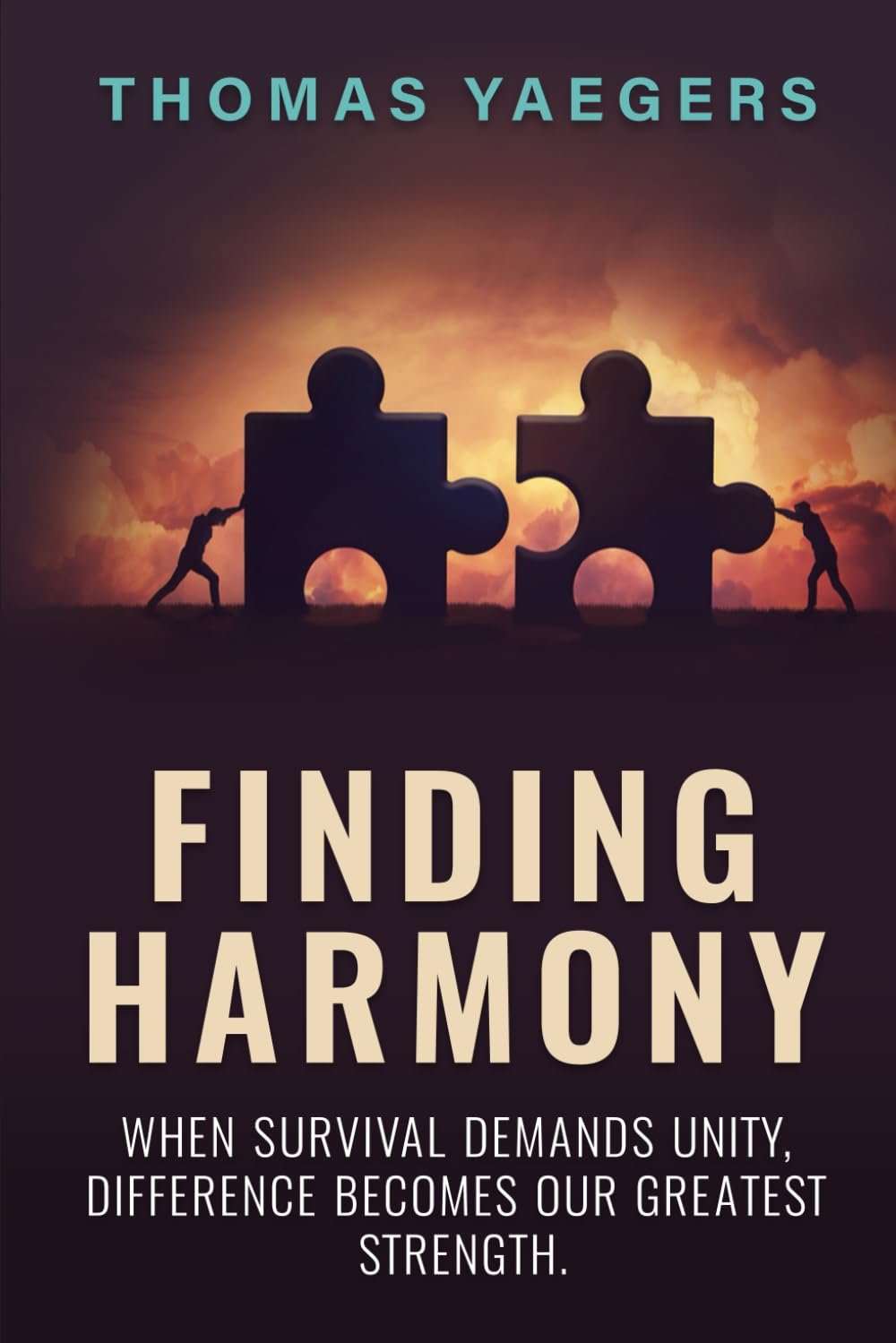
Finding Harmony
Finding Harmony refuses the premise that social differences must end in permanent estrangement. Thomas Yaegers's described novel gathers characters from distinct backgrounds, including Jamal…
Books worth discovering. Authors worth knowing.
Finding Harmony refuses the premise that social differences must end in permanent estrangement. Thomas Yaegers's described novel gathers characters from distinct backgrounds, including Jamal, Lillian, Ben and Gabriela, who have experienced poverty, racial injustice, family or identity conflict, and migration in different ways. The book frames their…
Considered reviews, grounded in the book’s documented promise.
Finding Harmony refuses the premise that social differences must end in permanent estrangement. Thomas Yaegers's described novel gathers characters from distinct backgrounds, including Jamal, Lillian, Ben and Gabriela, who have experienced poverty, racial injustice, family or identity conflict, and migration in different ways. The book frames their lives around security, dignity, opportunity and the possibility of collective flourishing. The literary question is whether a shared future can emerge from genuine human difference rather than from a speech about what everyone ought to believe. Good intentions provide the destination; the difficult artistic work is furnishing a credible journey.
Four histories, not four labels
The character descriptions are unusually specific about identity and background: a young man raised in a poor Black neighborhood in the Northeast, a woman shaped by Jim Crow's legacy, a gay man from a conservative Midwestern family, and a Central American immigrant. Such an ensemble can expose how different institutions produce related vulnerabilities. It also risks reducing the people to representatives of sociological categories. The strongest possible version of this book will allow each person unanticipated desires and contradictions, including those that resist the author's preferred lesson. A character is never only evidence for a thesis.
The politics of common ground
Public calls for unity frequently evade unequal power. A novel promising collaboration must not treat every disagreement as equally accidental or every grievance as a failure of listening. Historical deprivation and prejudice do not dissolve because people discover that they all want safety. Yaegers's stated aim of collective prosperity is appealing precisely because it invites harder questions about resources and obligations. The challenge is to show what people relinquish, repair or risk for the common project, not merely what inspiring words they exchange around it.
Imagination as a civic instrument
Political fiction can perform a valuable experiment: it invites a reader to imagine the conditions under which different choices would become plausible. Its alternative society should not resemble a frictionless proposal document. Trust changes through repeated acts and disappointments; institutions improve through conflict, trial and accountability. A novelistic blueprint earns emotional force when its protagonists encounter obstacles that cannot be argued away in one chapter. The descriptions suggest a conscious invitation to rebuild rather than a satirical demolition of the present. That positive ambition is worth examining without suspending critical judgment.
The demand for ordinary scenes
The novel appears intended to bridge ideological divisions, a difficult purpose for fiction because exemplary characters can become mouthpieces. Some readers may welcome a direct statement of values; others need conversations in which nobody is simply correct. Specific homes, work, neighborhoods and family histories could give the argument texture. Whether the published novel achieves that realism remains beyond the accessible overview. A critic should judge its dramatic embodiment of solidarity rather than measure how often it repeats the word harmony.
Hope without compulsory optimism
Hope becomes serious when it can acknowledge events that will not be neatly repaired. The backgrounds described for Lillian and Gabriela in particular imply personal experiences that cannot be translated into generic uplifting messages without loss. Yaegers's undertaking will matter most if the community's future remains responsive to those particulars. There is a real difference between imagining universal agreement and imagining institutions capable of surviving disagreement. The latter would be the more courageous kind of harmony.
Social justice does not remove personal mystery
It is tempting to describe characters through the political categories they inhabit, especially in a novel whose ambition is constructive social change. Yet even people who broadly agree on justice need different kinds of love, security and recognition. One might want to repair a family; another might want an unfamiliar place to feel less hostile; another may mistrust public causes because earlier promises failed. A novel that allows such private contradictions to remain can create a more persuasive vision of common ground. The best social fiction does not ask readers to discard identities, nor does it make identity the only source of meaning. Its people remain too complicated to be fully administered by the ideas the book wishes to advance.
The hard work of listening
Listening is not an ending. It is a method for discovering conflicts that require practical decisions, some of them unpopular. If two groups disagree about land, wages or institutional authority, mutual understanding may reveal the conflict's stakes more accurately without ending it. A truly imaginative social novel would confront such trade-offs and allow solidarity to emerge through accountable action. Yaegers's prospectus invokes shared prosperity, an appealing phrase that demands a concrete account of who benefits and who contributes. This is a useful pressure to bring to the text. A promise of harmony becomes literary rather than rhetorical only when its characters endure the discomfort of choosing.
The audience beyond the already persuaded
A book that openly advocates cooperation risks preaching to people who already agree with it. Fiction has a greater opportunity: it can let a reader spend time with a person whose position they initially find strange, without forcing an instant ideological conversion. Particular desires and moments of humor can do this more effectively than arguments alone. The cultural ambition of Finding Harmony is laudable, but aesthetic success remains a separate question. Does the narrative allow a character to act badly without being rejected as unrepresentative? Does it admit that generosity can require boundaries? These are the tests that determine whether the book will travel beyond its most sympathetic audience.
The possibility of a future worth writing
Utopian imagination has been treated as naïve in cultures more comfortable with catastrophe. There is nevertheless a place for fiction that asks what people could build after recognizing common needs. Its credibility rests in the obstacles. A story where every misunderstanding quickly disappears may confirm the reader's cynicism; a story where cooperation survives recurring failures can change the range of possible expectation. Yaegers's declared aim belongs to that second and more difficult tradition. The public summary establishes the hope, but not yet the strength of the dramatic pressure exerted upon it.
Who will value this book
This book may interest readers of socially engaged ensemble fiction, political idealism and narratives about building community across difference. Those seeking tight genre suspense may find its announced philosophical mission more prominent than mystery or action. The critical assessment rests on its publicly available synopsis and does not claim a full-text reading.
Scope of this assessment
This is a research-based editorial review drawn from identified bibliographic, author and publisher sources. It considers the work’s documented premise and the critical questions it invites, without claiming a complete firsthand reading. No unverified scene, character action or ending is asserted.
About the book.
An evidence-bounded critical introduction to social-issue ensemble novel and utopian political fiction. Published descriptions support the stated premise; interpretations are identified as editorial analysis, not confirmed plot details.
This review concerns a book marked sponsored in the current MarketAnyBook queue. Sponsorship is disclosed, and all observations remain research-based.
Found a book worth opening?
Books worth discovering. Authors worth knowing.
Return to the Journal →