
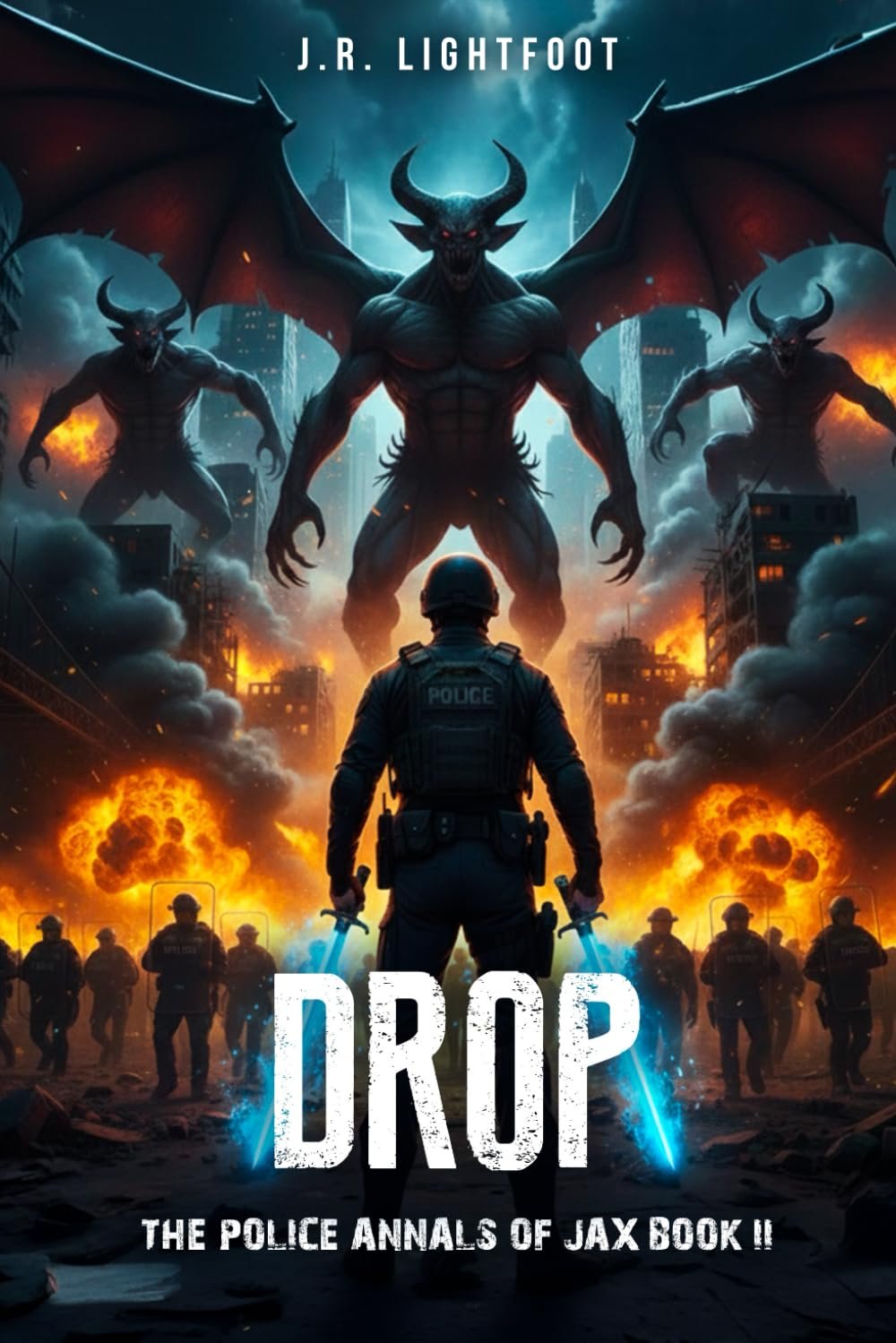
DROP: The Police Annals of Jax Book II
DROP returns Detective Jax Ferris to Fort Worth carrying grief, a badge and a set of mystic gauntlets. In this second Police Annals of Jax installment, a joint FBI task force pursues witches…
Books worth discovering. Authors worth knowing.
DROP returns Detective Jax Ferris to Fort Worth carrying grief, a badge and a set of mystic gauntlets. In this second Police Annals of Jax installment, a joint FBI task force pursues witches, berserkers and other supernatural threats; the announced central conflict concerns a berserker kingpin embedded in the city's nightlife. The premise has an…
Considered reviews, grounded in the book’s documented promise.
DROP returns Detective Jax Ferris to Fort Worth carrying grief, a badge and a set of mystic gauntlets. In this second Police Annals of Jax installment, a joint FBI task force pursues witches, berserkers and other supernatural threats; the announced central conflict concerns a berserker kingpin embedded in the city's nightlife. The premise has an almost deliberately unstable moral center. A detective can claim to enforce the law, but when vengeance becomes the motive and the quarry is defined as a monster, what restraint remains? This is where Lightfoot's combination of crime drama and supernatural action acquires real critical interest.
Revenge in a procedural uniform
Traditional detectives have to work against their own certainty; evidence, procedure and legal consequence constrain a theory of guilt. Jax's losses threaten to collapse that discipline into personal combat. His connection to the FBI offers institutional legitimacy while the gauntlets advertise a more extravagant mode of force. A novel that understands this tension can ask whether a grieving officer remains capable of distinguishing justice from revenge. The threat is not merely the berserker. It is a hero whose authority may make his anger unusually difficult to question.
A city where genre boundaries fail
Fort Worth's clubs give the supernatural threat a recognizably contemporary setting. The hybrid genre works best when the magic makes an established city stranger without erasing its particular character. A detective's surveillance, informants and command structure do not disappear because mythical enemies exist; they become tools that may be insufficient or compromised. The most interesting tension is between what can be documented and what can only be believed. A reader attracted to both noir and fantasy will want the novel's rules to support rather than undermine the investigative stakes.
A villain as more than a destination
The publisher description emphasizes a final encounter with a powerful criminal figure. Such publicity promises intensity but offers little about the adversary's social world or motives. If the kingpin is nothing more than an obstacle to execute, the police-procedural element may function as costume. If the creature's power reveals who benefits from criminal violence, the novel can become more searching. Lightfoot's setup admits both possibilities; the available description cannot resolve which is realized.
Violence and moral vocabulary
Genre fiction may relish the directness of a hero facing a monstrous foe. Yet the more interesting question comes after the foe is named. Who authorizes the confrontation? What happens when tactical necessity overrides law? Jax's sense of duty may be tested not by insufficient toughness but by his willingness to pause. The emotional value of his mentors' deaths depends on allowing grief to alter perception, not simply providing an excuse for spectacular punishment.
The obligations of a second installment
A returning character should carry consequences that deepen rather than merely explain his behavior. A second volume can reward familiarity with the world while presenting a coherent fresh case. The public synopsis establishes the through-line of loss and retaliation, but not the balance between investigation and supernatural combat. This distinction matters for reader expectations. The book promises high-velocity confrontation; its lasting quality would depend on how much human reasoning survives the velocity.
The badge as a contested symbol
Police and paranormal stories share an interest in defining threats, yet their concepts of legitimate force are quite different. Police work is theoretically bounded by law and accountability; supernatural quests often imagine a chosen warrior whose personal conviction authorizes decisive violence. Jax occupies the uneasy intersection. If Lightfoot keeps the distinction visible, the genre blend could acquire a moral bite rarely found in straightforward monster hunting. A task force dealing with creatures unknown to ordinary institutions must ask how evidence can be presented and who decides what danger warrants action. The gauntlets make him powerful, but power is not a sufficient theory of justice.
Why Fort Worth matters
A real-city setting changes the reader's expectations. Fort Worth is not a blank gothic stage; it has histories, working neighborhoods and institutions that would shape how extraordinary violence is experienced. A fantasy detective's movement through clubs and investigative offices can make the city legible as a social environment rather than merely scenery. Whether the novel achieves that specificity is not confirmed by the brief synopsis. The opportunity, however, is clear. A recognizable urban setting can keep the bizarre grounded if the author notices ordinary people whose lives continue around the detective's crusade.
Grief and the temptation of certainty
The deaths of Jax's mentors and friends supply a ready-made motive to pursue the next enemy with fury. Grief, however, is often more unpredictable than that. It can narrow perception, create unfounded pattern and make a person long for one name to blame. The detective novel traditionally treats certainty as something earned through patient doubt. Jax would become more interesting if the second book forced him to recognize how vengeance can distort the very skills that made him competent. The clash between a disciplined investigator and a warrior with powers may be the story's most productive internal conflict.
The series' changing emotional register
A sequel promises both familiar pleasures and a visible alteration in the central character. The word DROP suggests abruptness, perhaps the threat of a fall, although the title itself provides no verified explanation. Readers can reasonably expect the earlier losses to carry forward. A critical reading of the series should determine whether new violence deepens the first book's consequences or simply increases the number of enemies. The public synopsis makes a potent case for a darker second installment, but only the complete novel can establish the emotional cost of its action.
The credibility of an impossible case
The hybrid detective story needs a particular kind of fairness. Readers cannot solve a supernatural crime if the author invents a fresh power whenever the investigation becomes difficult. The fictional rules need to be clear enough for clues and mistakes to mean something. Jax's extraordinary equipment may give him an advantage, but it should not remove the value of observation, persistence and doubt. Otherwise there is no practical difference between a police investigation and a succession of battles. What makes the premise worth examining is the pressure exerted on a professional method by a world that repeatedly violates its assumptions. The distinction between knowledge and force could give the sequel a lasting identity.
Who will value this book
Best considered by readers of gritty urban fantasy, action-heavy detective stories and morally compromised protagonists. The reported violence and revenge themes make it unsuitable as a conventional cozy mystery. Assessments here refer to the documented premise, not to an independent examination of the complete prose or ending.
Scope of this assessment
This is a research-based editorial review drawn from identified bibliographic, author and publisher sources. It considers the work’s documented premise and the critical questions it invites, without claiming a complete firsthand reading. No unverified scene, character action or ending is asserted.
About the book.
An evidence-bounded critical introduction to police procedural fused with dark urban fantasy. Published descriptions support the stated premise; interpretations are identified as editorial analysis, not confirmed plot details.
This is an unsponsored, research-based editorial review, not a claim to firsthand reading of the complete book.
Found a book worth opening?
Books worth discovering. Authors worth knowing.
Return to the Journal →