
The House as Witness
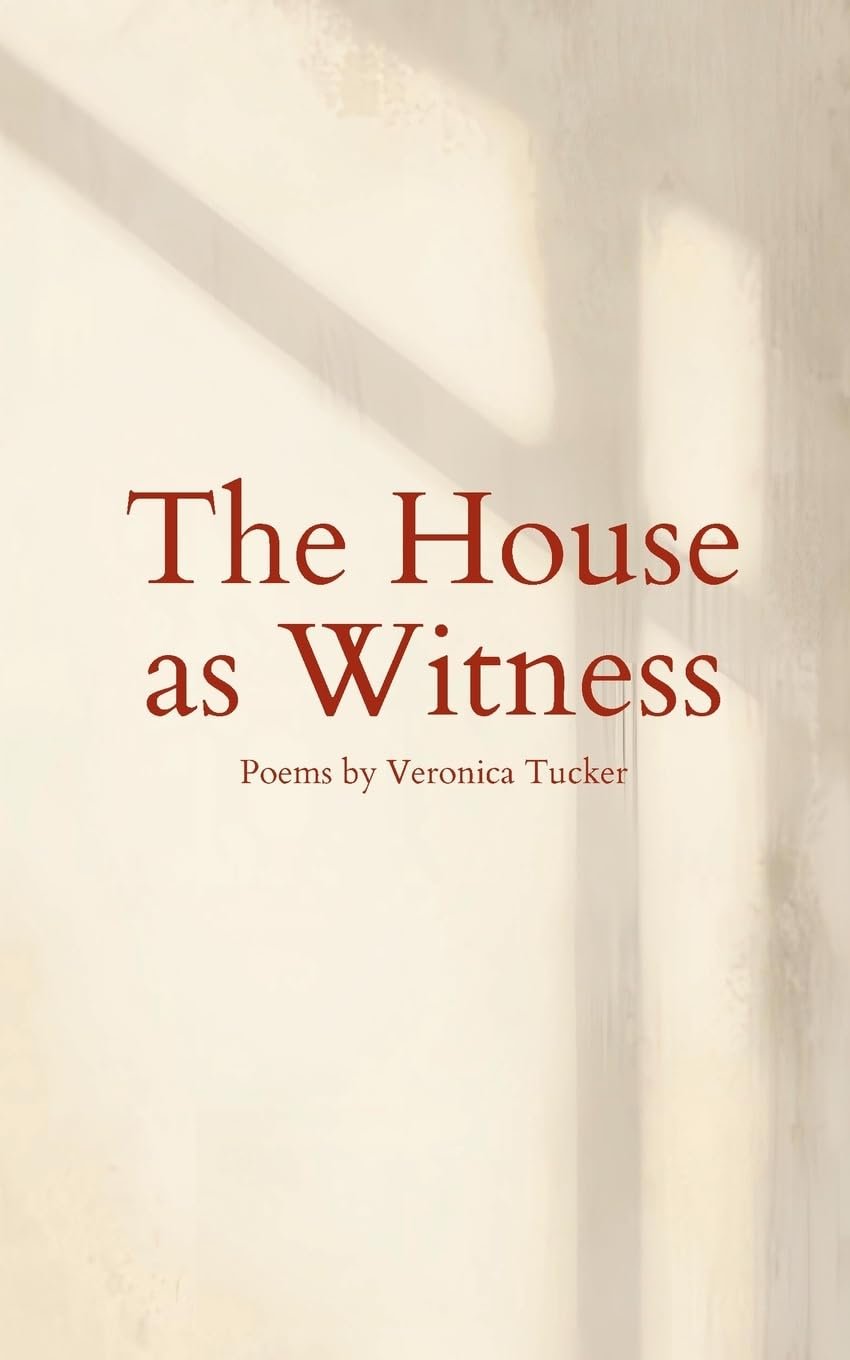
A house remembers in ways that people cannot. It keeps a child's footsteps beside the silence left by an older relative; it accommodates care, quarrel, illness and the slow transformation of rooms…
Books worth discovering. Authors worth knowing.
A house remembers in ways that people cannot. It keeps a child's footsteps beside the silence left by an older relative; it accommodates care, quarrel, illness and the slow transformation of rooms into recollection. Veronica Tucker's The House as Witness uses that metaphor to organize a poetry chapbook about domestic life, inheritance and the forms of…
Considered reviews, grounded in the book’s documented promise.
A house remembers in ways that people cannot. It keeps a child's footsteps beside the silence left by an older relative; it accommodates care, quarrel, illness and the slow transformation of rooms into recollection. Veronica Tucker's The House as Witness uses that metaphor to organize a poetry chapbook about domestic life, inheritance and the forms of love that do not announce themselves as grand events. Published descriptions trace its poems through construction, childhood, illness and family memory. The critical appeal is the discipline of the ordinary: a home becomes a lens through which impermanence can be seen without necessarily being solved.
Architecture as a form of memory
The book's title offers a distinctive point of view. A witness observes, but a house cannot testify or correct the people who inhabit it. Poetry can exploit precisely that uncertainty. Familiar spaces gather meaning from repeated acts, and their surfaces outlast versions of a family that no longer exist. The structural metaphor of rooms, walls and passages can give shape to feelings that are difficult to narrate chronologically. Yet it also risks sentimentality if the home becomes an unquestioned symbol of safety. Homes preserve painful histories as well as tenderness.
The labor of care
Publisher material connects the poems with caregiving and inherited responsibility. Those concerns reward small observation because care is usually enacted through ordinary repetitions: someone makes tea, waits, tidies, remembers an appointment, or notices that another person is no longer able to do a familiar task. To call these actions love is not to make them simple. A convincing poem can recognize devotion and exhaustion simultaneously. The collection's announced subjects suggest room for precisely such ambivalence, though judging its individual imagery and lineation requires the actual poems.
The ethics of a quiet voice
A family poem may be tender while still protecting the complexity of people represented in it. Memory rearranges experience, especially when loss becomes its organizing force. A poet's responsibility is not to record an impossibly complete history, but to discover language adequate to what cannot be preserved. The concept of a house as witness can counter the speaker's limited perspective by implying that other lives unfolded within the same walls. Whether Tucker actively uses that plurality remains unknown from promotional descriptions; it is one of the strongest questions to take into a close reading.
Illness and the ordinary sublime
Tucker's author biography identifies work in emergency and addiction medicine, but it would be misleading to assume a specific poem derives from a clinical encounter without textual confirmation. What is documented is an artistic interest in care, medicine and family life. The pairing may lend precision to the collection's attention to fragility. The sublime need not arrive as an extraordinary revelation. In a chapbook of this kind, the angle of afternoon light or an unnoticed change in household rhythm may carry the weight of an entire relationship.
What brevity asks of the reader
A chapbook has less space than a full-length collection, which can give each recurring image greater responsibility. Repetition might become a deliberate musical structure or feel too insistent; a short book is especially exposed to both possibilities. The public synopsis makes a persuasive case for the collection's emotional architecture, not its exact poetic achievement. A reviewer must hear its rhythms, breaks and silences on the page before declaring the poems masterful.
The importance of leaving the door open
The work is most appealing as an invitation to reflect on one's own remembered rooms. Its subtitle-free title offers no program of advice or therapy. Instead, it asks readers to notice that homes can hold a life in fragments, sometimes long after its occupants leave. The metaphor works because its limits remain visible: no building can remember for us, and the act of remembrance is inevitably selective. A strong collection should make that impossibility moving rather than merely decorative.
The familiar room as unreliable archive
Every family imagines that its home preserves an accurate record. Yet a house contains only traces: marks on a wall, a stain, a repaired step, a doorway worn smooth by repeated passage. People supply the interpretations. Tucker's metaphor is therefore poignant precisely because the witness cannot speak. The poet must choose which signs to notice while admitting that many experiences left no visible trace. A collection that respects that incompleteness may feel more truthful than one that imagines the house knows everything. The literary pleasure comes from the uneasy partnership between physical continuity and changing human memory.
Caregiving without the grand gesture
A household's moral center may shift around illness or aging without an event that announces the change. One person stops driving; another begins taking a parent to appointments; a room takes on a new function. The publisher's description refers to caregiving, not a particular family episode, so those examples are context rather than claims about the poems. They illustrate why the subject lends itself to poetry. A lyric can attend to the quiet recalibration of responsibility, recording feelings that are too mixed for a conventional inspirational narrative. Care may involve love, resentment, pride and fatigue in the same breath.
The writer's professional double life
The author's work in medicine and her poetry share an interest in witnessing vulnerable bodies, but they are not interchangeable forms of knowledge. Clinical experience can teach precision and humility; poetry asks what happens when precision cannot adequately describe a feeling. Tucker's public profile identifies this intersection as a continuing concern. A critic should nevertheless resist assuming that a physician-poet necessarily writes with diagnostic authority about her own family. The poems deserve to be evaluated for voice, image and construction rather than made into illustrations of the author's occupation.
A short book's long echo
Because a chapbook is brief, it can be carried through one sitting. That does not make it minor. A recurring room or sound might return with altered meaning across several poems, creating an emotional argument more subtle than a continuous story. The critic's task is to listen for those changes, including moments when the collection interrupts its own tenderness. The described themes of inheritance and loss are compelling, but no amount of sympathy for them can replace evidence of how the verse moves. The present review records the book's promise, not a fabricated close reading.
Who will value this book
Readers drawn to contemporary lyric poetry, domestic memory, caregiving and grief may find a carefully focused subject here. The collection is short and meditative, not a conventional narrative memoir. The present assessment is based on the publisher's description and author's stated interests, and does not pretend to quote or scan poems not examined.
Scope of this assessment
This is a research-based editorial review drawn from identified bibliographic, author and publisher sources. It considers the work’s documented premise and the critical questions it invites, without claiming a complete firsthand reading. No unverified scene, character action or ending is asserted.
About the book.
An evidence-bounded critical introduction to family-memory poetry chapbook. Published descriptions support the stated premise; interpretations are identified as editorial analysis, not confirmed plot details.
This is an unsponsored, research-based editorial review, not a claim to firsthand reading of the complete book.
Found a book worth opening?
Books worth discovering. Authors worth knowing.
Return to the Journal →