
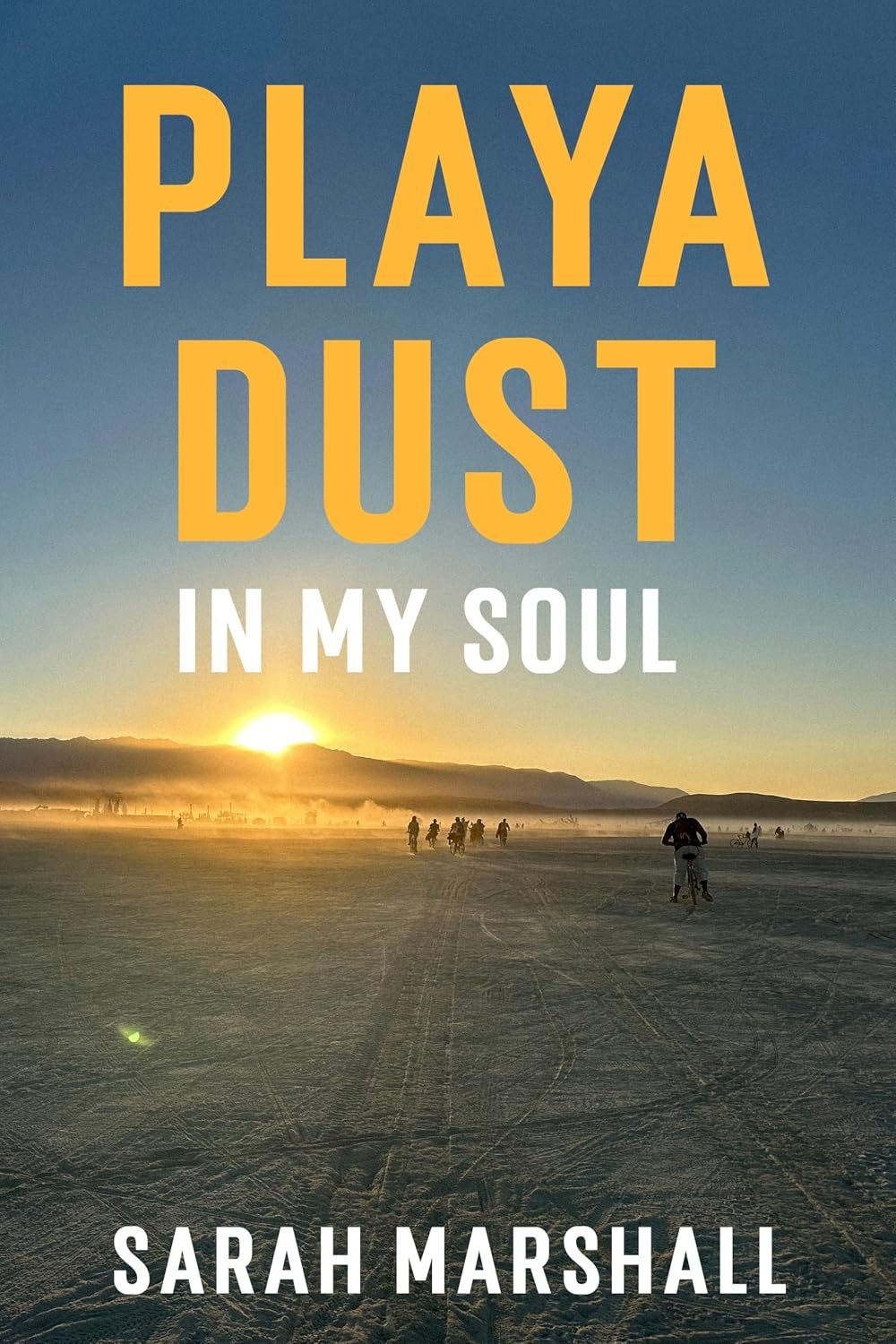
Playa Dust In My Soul
The desert in Sarah Marshall's Playa Dust in My Soul is not a decorative setting for self-discovery. The publisher's account places two men at Burning Man amid the physical labor of creating a…
Books worth discovering. Authors worth knowing.
The desert in Sarah Marshall's Playa Dust in My Soul is not a decorative setting for self-discovery. The publisher's account places two men at Burning Man amid the physical labor of creating a temporary city. Ruben arrives newly exonerated after imprisonment, seeking a foothold in a world that has denied him one. Harley is an older sculptor trying to…
Considered reviews, grounded in the book’s documented promise.
The desert in Sarah Marshall's Playa Dust in My Soul is not a decorative setting for self-discovery. The publisher's account places two men at Burning Man amid the physical labor of creating a temporary city. Ruben arrives newly exonerated after imprisonment, seeking a foothold in a world that has denied him one. Harley is an older sculptor trying to raise a colossal metal stallion while contending with the history he carries. The novel's provocative proposition is that what people build together may outlast the structures they are obliged to dismantle.
The work underneath the spectacle
Burning Man is often represented through costumes, spectacle and the visual drama of the desert. Marshall's synopsis turns instead to the Department of Public Works, whose demanding routine makes a temporary gathering possible. That decision gives belonging a material dimension: it can be earned through shared exhaustion, obligation and a willingness to contribute. In such a context, a newcomer is not merely welcomed by an abstract ideal. He has to negotiate the ordinary friction of working alongside strangers. The desert becomes a place where romantic rhetoric about freedom encounters tasks that must actually be finished.
An exoneration is not an ending
Ruben's release from prison changes his legal status but cannot return the intervening years. The public description emphasizes his arrival on the playa after exoneration. A responsible literary appraisal must resist treating that fact as a shortcut to perfect redemption. Freedom comes with practical questions about trust, employment, identity and whether other people can see a person without rehearsing his worst experiences. The narrative's available premise suggests a delicate opportunity: to give Ruben desires and capacities beyond being someone wronged by an institution. The published materials do not justify inventing the grounds of the conviction or the exact circumstances of his release.
A metal stallion as confession
Harley's sculpture is described as part myth and part confession. A horse made from metal suggests movement and captivity at once: an animal associated with freedom translated into a heavy object that cannot move without human effort. That contradiction makes the installation a potentially rich artistic center for a novel about people who cannot simply ride away from their pasts. Its size and difficult construction also make the work dependent on help, an uncomfortable prospect for a creator determined to manage alone. What this symbolism accomplishes on the page depends on the scenes and language, but the premise gives the image genuine thematic weight.
The risk of easy transformation
Temporary communities are attractive settings for fiction because they allow people to present different versions of themselves. They can also produce artificial resolutions: one extraordinary week appears to repair a lifetime of pain. The stronger novel would recognize how brief encounters alter possibilities without erasing damage. Marshall's description pointedly says the book is less about the festival than about what the experience does to people. That distinction is promising. A reader should look for the moments when transformation is fragile, compromised or difficult to carry into ordinary life.
Time, demolition and memory
A city constructed with the knowledge that it will disappear creates unusual pressure on each act of making. Much conventional fiction imagines growth as accumulation—more security, more possessions, a more permanent home. The playa reverses that logic. The sculpture must matter even though its physical future is uncertain, and a friendship can count even if the men eventually separate. A novel built around such a calendar can examine what permanence means when the evidence of labor is temporary. Memory becomes less a passive record than a form of responsibility toward what another person helped create.
Two kinds of solitude
Ruben and Harley are presented as different generations facing different forms of estrangement. Their partnership is intriguing because it need not depend upon instant emotional similarity. One may have the perspective of somebody excluded by the state; the other, that of a maker whose life has narrowed around an unfinished creation. Cooperation may begin as need before it becomes recognition. That is the sort of relational change literary fiction can render with more complexity than an inspirational slogan. The synopsis establishes the encounter but not its dramatic precision, which remains a matter for full-text review.
The double meaning of a temporary home
In a work camp on a desert plain, belonging can seem paradoxically more concrete than in a permanent city. People may know one another first through shared tasks and only later through biographies. Ruben has good reason to distrust identities assigned by institutions; the new community offers the possibility of being encountered through what he does today. But a temporary home may also sharpen the fear of being left without a place when the season ends. That uncertainty could give Marshall's setting unusually poignant force. A reader should notice whether the relationships forged at work survive the conditions that made them possible.
Craft as a conversation without confession
Harley and Ruben need not tell each other everything before they can collaborate. Metal must be cut, lifted and joined; physical work gives them a common subject that does not demand immediate emotional disclosure. Art can thus become a nonverbal method of approaching experiences too painful to narrate. The motif is promising because it respects the tempo of trust. A sensational version of the plot would force each confession to arrive on schedule, as if suffering were fuel for the sculpture. A subtler novel would allow the work itself to change what can be said.
The freedom to remain unfinished
The language of redemption sometimes implies that a damaged person must eventually become exemplary to deserve acceptance. Marshall's premise can resist this by showing two people engaged in useful work while still uncertain about their futures. Ruben's legal exoneration, in particular, should not force him to perform gratitude for a world that failed him. Harley's artwork may never answer the questions he brought to it. Their partnership can matter without any total conversion into peace. This would make the novel's interest in belonging more credible than a simple story about a festival that cures loneliness.
Who will value this book
Readers drawn to novels about art, wrongful confinement, collaborative work and unconventional communities will find an unusually tangible premise here. It promises the emotional seriousness of a story about repair without guaranteeing a simple cure. The existing synopsis supports a strong thematic introduction, but the degree of narrative subtlety, dialogue and psychological development still calls for direct reading.
Scope of this assessment
This is a research-based editorial review drawn from identified bibliographic, author and publisher sources. It considers the work’s documented premise and the critical questions it invites, without claiming a complete firsthand reading. No unverified scene, character action or ending is asserted.
About the book.
An evidence-bounded critical introduction to contemporary literary fiction of art, community and second chances. Published descriptions support the stated premise; interpretations are identified as editorial analysis, not confirmed plot details.
This review concerns a book marked sponsored in the current MarketAnyBook queue. Sponsorship is disclosed, and all observations remain research-based.
Found a book worth opening?
Books worth discovering. Authors worth knowing.
Return to the Journal →