
Biological War
A nonfiction scenario of an engineered pathogen, told against the history of biological-weapons programs.
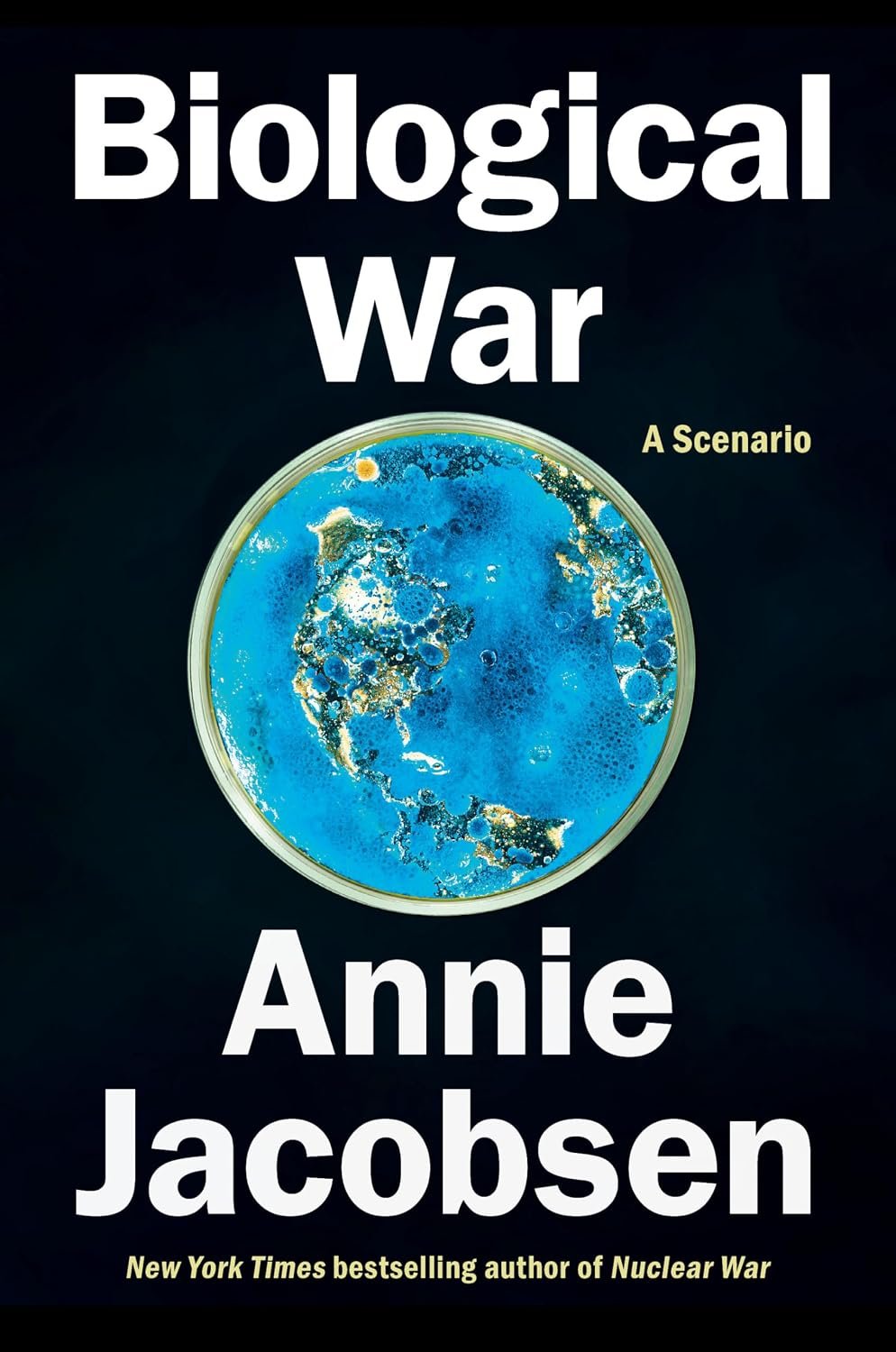
Annie Jacobsen’s scenario book on a biological catastrophe.
Biological War: A Scenario is Annie Jacobsen’s nonfiction book about what a large biological attack, or the accidental release of an engineered pathogen, could do. Dutton published it on July 28, 2026. The book uses a fictional near-future catastrophe to walk through governments, health systems, armed forces, and civilians. Around that scenario it places historical programs, interviews, and the new tools of genetic engineering, synthetic biology, and artificial intelligence.
A scenario with a history under it
The outbreak the book stages
The scenario begins with a release after an incident at a Russian biological research facility. The agent is described as engineered to be unusually transmissible and lethal. Governments cannot tell, at first, whether the outbreak is natural, accidental, or an attack. That uncertainty is the engine. Attribution is not a detail. It is the question that decides quarantine, blame, and response.
The narrative moves by hours, then days, then weeks. Public-health authorities try to identify the pathogen and build countermeasures. Political and military leaders face the same clock. Jacobsen’s method, as described in the public synopsis, is to make the fictional hour carry the real institutional problem. Who speaks. Who closes a city. Who is believed.
This feature does not treat the scenario as a prediction. The book calls it a scenario. The value is the sequence: release, confusion, response, and the point where a health emergency becomes a national-security emergency.
The history the scenario stands on
Before the fiction, the book discusses the Soviet Union’s secret biological-weapons program, including Biopreparat and research at the Vector Institute. The Soviet Union had signed the 1972 Biological Weapons Convention and, the book argues from that history, kept a clandestine program anyway. That fact is the reason the scenario is set where it is. A treaty is not a laboratory.
Jacobsen is an investigative journalist. The book combines the scenario with interviews with scientists and national-security officials. A reader is not being asked to accept a novel’s villain. The reader is being asked to watch a constructed outbreak next to a documented program. The two parts need each other. Without the history, the scenario is a thriller. Without the scenario, the history is an archive.
Dutton’s July 28, 2026 date places the book in a year when synthetic biology is no longer a specialist rumor. The public synopsis names genetic engineering and artificial intelligence as part of the discussion. Those are the tools the scenario worries about. This feature does not invent a casualty figure or a named patient.
Who it is for
The book is for a reader who wants a security book that moves like a timeline. It is not a lab manual and not a novel, though it borrows a novel’s clock. It is a poor fit for someone looking for a single policy answer. The synopsis describes consequences and responses, not a closing recommendation this feature can honestly summarize.
The scenario form has a limit. It can show a path. It cannot prove the path will happen. Jacobsen’s title admits that. A Scenario is the honest half of the title. Biological War is the subject. Together they tell you the genre.
I have not read the week-by-week account. The verified offer is the facility incident, the attribution problem, and the Soviet program underneath the fiction.
The limit of a scenario
A scenario book has to choose a clock. Jacobsen chooses hours, then days, then weeks, which keeps the reader inside the lag between an infection and a decision. That lag is the subject. A health officer needs a sample. A minister needs a sentence. A general needs a map. The book, as described, follows those needs as they collide. The collision is more useful than a single villain.
The historical chapters do a second job. They remind the reader that a signed convention did not close the Soviet program. A present-day scenario that starts at a research facility is borrowing that lesson. Treaties, labs, and publicity are different rooms. The book puts the fictional release in one room and the documented program in another so the reader can see the door between them.
None of this is a claim that the named facility will fail, or that a named pathogen exists in the form the scenario needs. The book is explicit that the catastrophe is constructed. What it takes from the record is the existence of past programs, the interviews, and the speed of new biological tools. That is a fair use of a scenario. It is not a forecast with a date.
More Journal stories are on the Journal, and other book articles are collected in Book Reviews.
About the book.
Dutton published Biological War: A Scenario on July 28, 2026. Jacobsen stages an engineered pathogen after an incident at a Russian research facility and sets that scenario against historical biological-weapons programs, including the Soviet Biopreparat effort.
A short note
I like that the book admits it is a scenario. The part worth opening is the first confusion: an outbreak that might be an accident, a leak, or an attack, and a government that has to act before it knows which. Jacobsen fits the book because the work is already about systems under a clock. I have not read the later weeks. The attribution problem is the part I would hand someone first.
This is a sponsored MarketAnyBook book feature. It is a promotional editorial based on the listing and verified public information, not a full-book review. Book links may be sponsored or affiliate links.
Found a book worth opening?
Books worth discovering. Authors worth knowing.
Return to the Journal →