
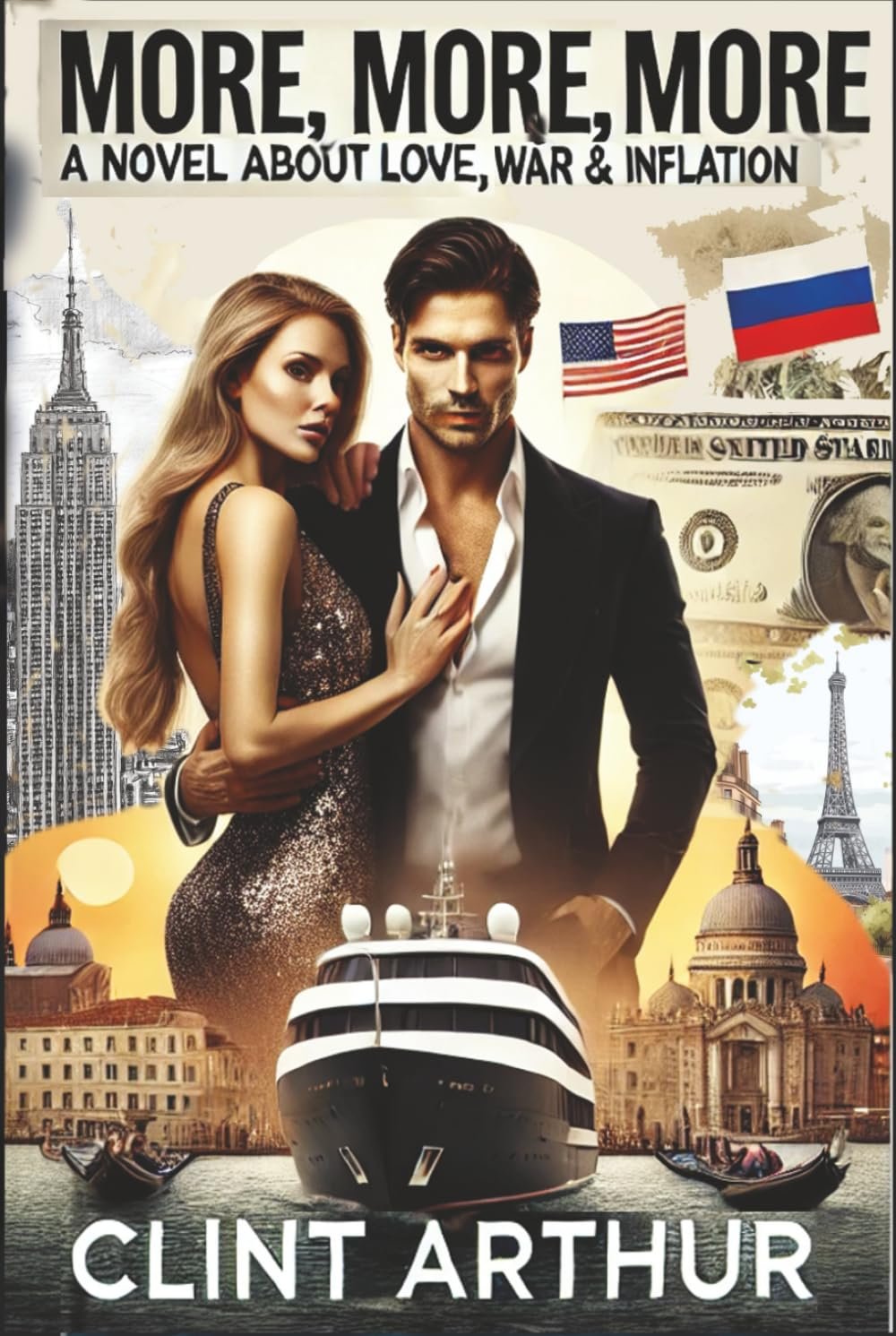
More, More, More: A Novel about Love, War & Inflation
Spy Jack Powers navigates ambition, romance and an imagined Cold War campaign that weaponizes economic disruption.
Books worth discovering. Authors worth knowing.
Spy Jack Powers navigates ambition, romance and an imagined Cold War campaign that weaponizes economic disruption.
Jack Powers is recruited to pursue an imagined strategy against the Soviet economy while navigating global intrigue and a dangerous relationship.
A spy story where inflation becomes a weapon
Clint Arthur’s *More, More, More* builds an international thriller from an unconventional premise: what if an intelligence operation sought to weaken a rival power not by conventional attack, but by undermining its economy? Public descriptions identify Jack Powers as a Naval Intelligence officer and covert CIA attaché caught in a Cold War scheme aimed at the Soviet Union. The story combines that assignment with wealth, espionage and a relationship with the formidable Svetlana. Arthur has explained in an interview that the idea was inspired by an account heard on a conspiracy-themed podcast. That origin is important. It identifies the book’s concept as imaginative fiction, not as historical evidence that a particular covert operation actually happened. The title’s repetition suggests appetite that cannot be satisfied: more money, more influence, more romance, more leverage. The official pitch describes a story that travels from New York and Philadelphia into major European cities, where finance and national ambition meet private desire. Its locations offer glamour, but the central conflict is not merely the contrast between humble beginnings and luxurious surroundings. Jack has to decide what sort of person he becomes while pursuing high-stakes objectives. A reader can enjoy the international settings while also watching how ambition changes the meanings attached to success and loyalty.
Jack Powers and the story of becoming someone
Arthur describes Jack as a young patriot and street urchin drawn into a plot with world-changing ambitions. That background gives the narrative a personal trajectory distinct from its macroeconomic intrigue. Intelligence adventures often begin with an established professional who already possesses access, training and authority. This one makes the protagonist’s climb part of its appeal. A person who has known scarcity may see wealth and recognition not only as rewards but as proof of escape. The larger the assignment becomes, the harder it may be to separate loyalty to a mission from the desire to prove personal worth. The book’s economics are dramatic machinery. Inflation is a real phenomenon with complex causes and consequences; a thriller can simplify those mechanisms to generate narrative urgency. Readers should not mistake an entertaining plot for a lesson in verified Cold War policy or for professional economic advice. The intriguing fictional question is how an institution might imagine deploying money as force and what such a strategy would do to the people asked to execute it. That opens territory not often foregrounded in action thrillers: the damage a policy can inflict without a conventional battlefield and the ambiguity of winning a conflict through financial disruption.
The global stage and its private costs
The author’s interview names international cities he knows personally and says some destinations and venues in the novel draw on places he has visited. That may lend a distinctive geographical enthusiasm to the fiction, though it does not establish the accuracy of every depicted transaction or meeting. The settings range through recognizable centers of finance, culture and travel. Such breadth gives the story room to juxtapose elite spaces with the protagonist’s earlier circumstances. The glitter of a major European city may represent opportunity in one scene and entrapment in another; the reader’s question is what Jack risks while moving through environments designed to impress. The presence of Svetlana, promoted as a figure whose loyalty may be unclear, turns the spy plot into a relational puzzle. In espionage, affection and suspicion are difficult to separate because revealing the truth can endanger both the operation and the person trusted. The public synopsis calls the romance dangerous, but it does not justify asserting exactly which betrayals take place. What can be said is that the described relationship forces Jack to confront competing allegiances. Readers who favor romantic tension inside an external action plot may find that overlap especially appealing, while those seeking a romance free from manipulation should note the book’s thriller framing.
The fiction of a war without gunfire
A central imaginative provocation is the idea of “winning” a war through an economic instrument. This should prompt moral curiosity rather than factual certainty. Even if a strategist avoided visible military confrontation, economic collapse would affect ordinary people who neither designed the policy nor chose the conflict. That tension can complicate a conventional story of national triumph. The larger the gap between an operator’s goal and civilian lives, the harder the reader may find it to treat cleverness as a sufficient ethical defense. These are questions the premise makes available for discussion; they are not claims about the novel’s exact speeches or conclusions. The subtitle adds love and inflation to war, producing three types of pressure on its protagonist. War demands allegiance, love demands vulnerability, and monetary power demands decisions about value. Each exposes a different weakness in a person who may be hungry for recognition. The fictional scope encourages a broad reading of success: does Jack simply pursue more, or can he identify what is worth refusing? The publisher description does not tell us how he answers. That uncertainty is an appropriate part of a feature about a thriller; revealing an invented outcome would do readers no service.
Where the Jack Powers adventures begin
The title is associated with the *Jack Powers Adventures* series, making it the starting point for a projected larger world. Arthur has discussed possible further stories in an interview, but creative plans are not guaranteed publication schedules. It is useful to approach this installment on its own terms and treat the series name as an invitation rather than a promise about sequels. The first book sets up the blend of political theater, international mobility and personal ambition that could sustain more adventures. The challenge for an opening novel of this kind is making those ambitions meaningful to readers who have little interest in the intricacies of monetary policy. Readers can also separate the book’s self-mythologizing energy from the author’s documented claims. Arthur says early portions were informed by autobiographical experience and later portions draw on travel, yet the work remains a novel. That combination may explain its interest in ambition and self-invention without converting events into biographical fact. The most useful editorial perspective is to take the stated fictional premises seriously while withholding judgment on their historical accuracy. A thriller can explore a possibility dramatically without establishing that the possibility ever occurred.
Who should follow Jack Powers
Fans of globe-spanning espionage, morally charged wealth dramas and high-stakes romantic uncertainty may find *More, More, More* worth exploring. It should particularly interest readers who like speculative alternatives to battlefield-centered spy fiction and protagonists shaped by their own ambition. Those expecting documented Cold War history, a technically rigorous economics textbook or a transparent moral universe will want to adjust expectations. This is a novel about a financial strategy imagined as a weapon, not evidence for one. Its strongest invitation is to consider what the pursuit of power costs a person who has spent a lifetime dreaming of more.
About Clint Arthur
Clint Arthur has spoken publicly about the inspiration for the novel and his interest in economic questions, noting his Wharton studies and familiarity with several settings. His remarks distinguish the imaginative plot from verified historical events. The interview and audiobook listings support the core premise, author identity and series association used in this feature.
About the book.
Historical spy thriller / international romantic intrigue. Jack Powers is recruited to pursue an imagined strategy against the Soviet economy while navigating global intrigue and a dangerous relationship. Research-based editorial feature, not a firsthand review.
Sponsored book feature. Research-based commentary using verifiable published sources, not a claim of a complete firsthand reading. Cover placeholders await the owner’s Python automation.
Found a book worth opening?
Books worth discovering. Authors worth knowing.
Return to the Journal →