
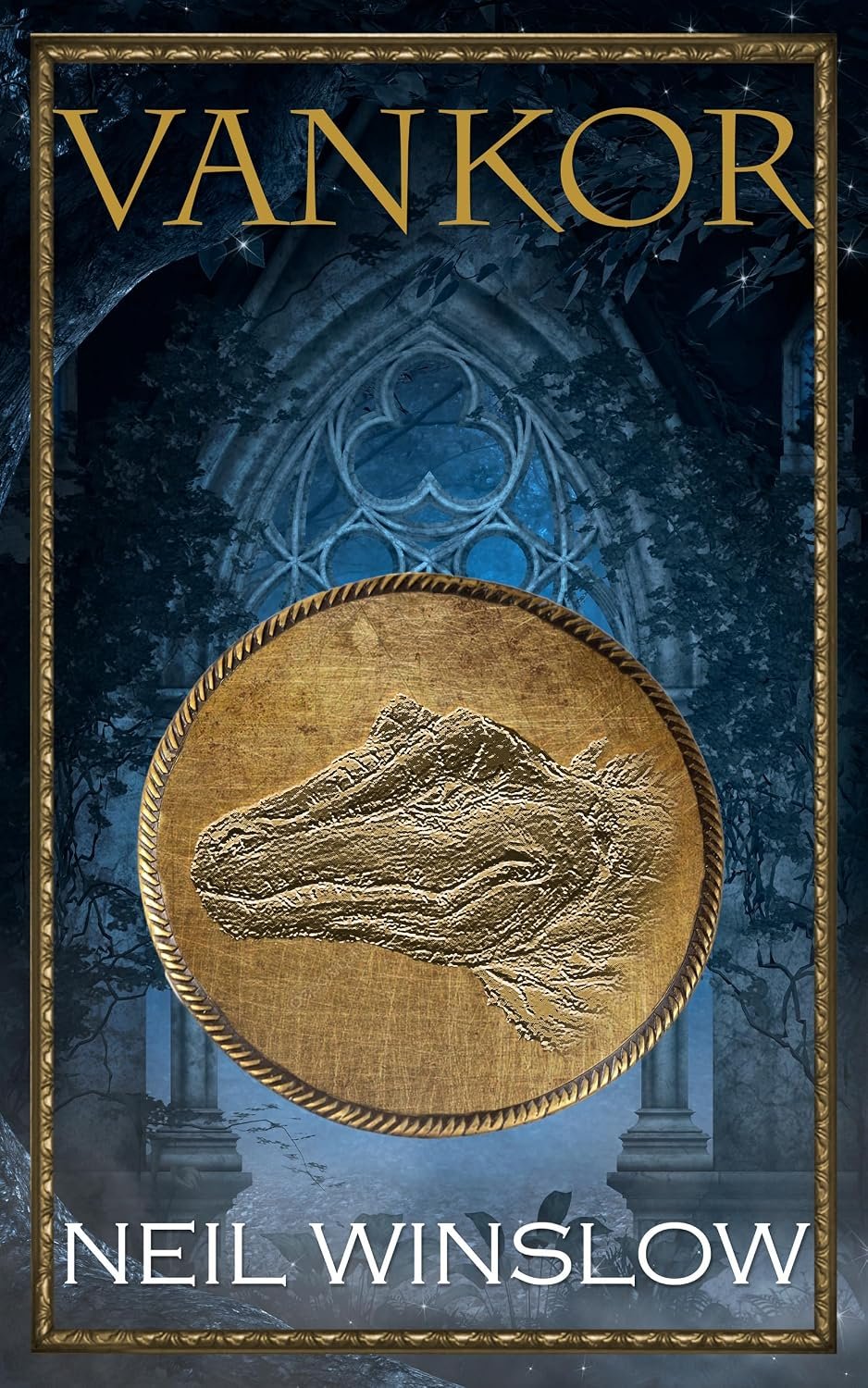
Vankor
In a world divided by violence, a Journeyman’s choice to protect an orphaned lizard child challenges inherited hatred.
Books worth discovering. Authors worth knowing.
In a world divided by violence, a Journeyman’s choice to protect an orphaned lizard child challenges inherited hatred.
Teleth Lysander rescues a Semuyan infant after a massacre in a world where fragile treaties barely restrain historic hostilities.
An unlikely act of mercy amid inherited hatred
Neil Winslow’s fantasy *Vankor* begins with a devastating conflict between humans and a lizardlike people called the Semuyan. In the world of Enkratis, a fragile treaty has followed years of war, but its existence has not erased distrust. A violent encounter leads to the slaughter of a Semuyan settlement. Journeyman Teleth Lysander is sent to investigate and discovers a surviving infant. Instead of treating the child as an enemy, he decides to care for him and gives him the name Vankor. The premise, confirmed by a detailed Kirkus assessment and bookseller description, asks how responsibility begins when established loyalties say compassion should be withheld. That initial choice reframes an epic conflict on an intimate scale. Treaties and assemblies may declare peace, but an adult carrying an infant must make decisions every day that cannot be outsourced to a political statement. Who offers shelter? Who can be trusted? What happens when strangers perceive the child only as a member of a feared group? Teleth’s decision to protect Vankor therefore changes how readers may understand the surrounding conflict. Peace is no longer only a negotiated condition between populations; it is a sequence of ordinary acts in which someone refuses to accept that identity alone justifies cruelty.
The fragility of a negotiated peace
The official descriptions of Enkratis establish long hostility between nearby settlements and a treaty that is barely a year old. Such a context makes even a limited incident capable of accelerating into disaster. Fear becomes a political force, and leaders may interpret ambiguous events in ways that confirm what they already believe. The massacre that sends Teleth into the field reveals how quickly a peace built on exhaustion rather than trust can fail. The story’s central problem is therefore not simply the existence of monsters or a hostile species; it is the reluctance of people to acknowledge the humanity—or personhood—of someone they were taught to fear. Kirkus reports that the novel also introduces a powerful figure known as an Anakite and suggests the possibility that a third party has inflamed the conflict. Those are source-grounded elements, not an explanation of the mystery’s resolution. Their presence broadens the narrative beyond a simple lesson in kindness. If violence is being manipulated, readers have to consider the incentives behind it and the difference between what a community believes happened and what evidence might establish. The fantasy framework allows these questions to be heightened without flattening them into a one-to-one allegory of any single modern conflict.
A guardian whose loyalty has to be chosen
Teleth is described as an experienced Journeyman rather than an impulsive outsider. He has seen enough to recognize that a massacre demands investigation, but his most consequential discovery is small and vulnerable. The bookseller’s account emphasizes the child’s initial hostility and the cautious relationship that follows. It is tempting to turn this into a predictable sentimental bond, but the premise supports a more interesting tension. Kindness offered across entrenched boundaries can attract danger to giver and recipient alike. Affection does not automatically stop suspicion from the wider community or erase the child’s traumatic beginnings. The name Vankor is translated in the public description as “fearsome champion,” an arresting choice for an infant who survives because another person intervenes. It suggests potential rather than a verified destiny. A good way to approach the book is to ask whether courage must look like force. The massacre demonstrates power exercised destructively; Teleth’s care represents another kind of strength. The novel appears interested in the consequences of that contrast over time. This feature does not invent the child’s later abilities, choices or ultimate role, and it makes no claims about particular scenes not established in the sources.
The ethical center of a secondary world
Fantasy often gives writers room to dramatize prejudice through peoples who differ markedly in appearance, customs or mythology. There is a risk in treating fictional species as a simple substitute for real human communities. Winslow’s setup is more useful when considered as an invitation to ask how violence is justified and how individuals might refuse inherited categories. Review coverage notes concerns with tolerance, religious hypocrisy and the meanings attached to tragedy. The novel’s worldbuilding matters because institutions and beliefs help explain why Teleth’s apparently personal decision becomes politically significant. Readers can also consider the weight placed on a surviving child. Narrative symbolism may make Vankor seem to embody a future peace, yet a child should not have to earn protection by becoming a heroic exception. That distinction can deepen the story’s ethical appeal. Compassion toward one individual is meaningful even when it fails to repair an entire world. The available reviews position the book as intellectually ambitious and unusually interested in moral consequence; they do not give license to assert that its argument is flawless or that it endorses a simple answer to every conflict.
What readers can expect from the adventure
The public material confirms journeys through Enkratis, fraught relations between settlements and larger political institutions responding to violence. That makes *Vankor* suitable for fantasy readers who enjoy travel, invented societies and the testing of beliefs under pressure. The premise is less about accumulating magical powers than about what happens when a man accepts responsibility for someone his own people may regard as an enemy. The contrast between sweeping historical hatred and the care of one child provides narrative momentum without requiring a catalog of unverified battles or magical devices. Its darker elements deserve acknowledgement. The story begins with mass death and includes hostility toward an infant survivor. Readers expecting a cozy tale of interspecies friendship may encounter more violence and moral unease than that shorthand suggests. Conversely, those interested in philosophical fantasy may appreciate that the first ethical act is neither victory nor revenge but attention to someone helpless. That is a theme established by the documented setup, not a claim to know precisely how every plot thread concludes. The book’s question is whether compassion can withstand a world organized around mistrust.
The question an imagined world asks of its readers
Because the conflict takes place between humans and the Semuyan, it would be easy to assume the central question is which side should win. Teleth’s discovery redirects attention to whether winning is even an adequate moral aim when innocents are caught between communities. The child’s survival creates a continuing responsibility after the initial violence is over. A treaty can be signed by leaders, but a child needs the ordinary security of a meal, a safe place to sleep and someone who will not abandon him. Those needs make the world’s political divisions immediately concrete. The book’s speculative frame thus invites an unusually grounded form of ethical reflection.
Who should pick up Vankor
Readers who want a secondary-world fantasy involving prejudice, political tension, hard-won trust and a meaningful guardian-child bond are the most likely audience. It is also a potential fit for book clubs willing to discuss how collective narratives of enemies are formed and challenged. It is less appropriate for readers looking for unbroken comic adventure or for a comforting absence of violence. The benefit of beginning with the official premise is that readers can approach the novel alert to both its imagined world and its human-scale center: an experienced traveler making an unpopular act of care amid the ruins of a war.
About Neil Winslow
Neil Winslow is credited as the author of *Vankor*. Kirkus assessed an earlier publication of the novel, while later bookseller entries document another edition. This article does not assume the ISBN or formatting is identical between those editions. The author credit and central narrative situation are supported by external bibliographic and review sources.
About the book.
Philosophical epic fantasy / interspecies guardian story. Teleth Lysander rescues a Semuyan infant after a massacre in a world where fragile treaties barely restrain historic hostilities. Research-based editorial feature, not a firsthand review.
Independent editorial book feature. Research-based commentary using verifiable published sources, not a claim of a complete firsthand reading. Cover placeholders await the owner’s Python automation.
Found a book worth opening?
Books worth discovering. Authors worth knowing.
Return to the Journal →