
Helio Apotheosis: Part 1: The Scorched Third
A man awakens without memory in a scorched world and begins a perilous search for identity and purpose.
Books worth discovering. Authors worth knowing.
A man awakens without memory in a scorched world and begins a perilous search for identity and purpose.
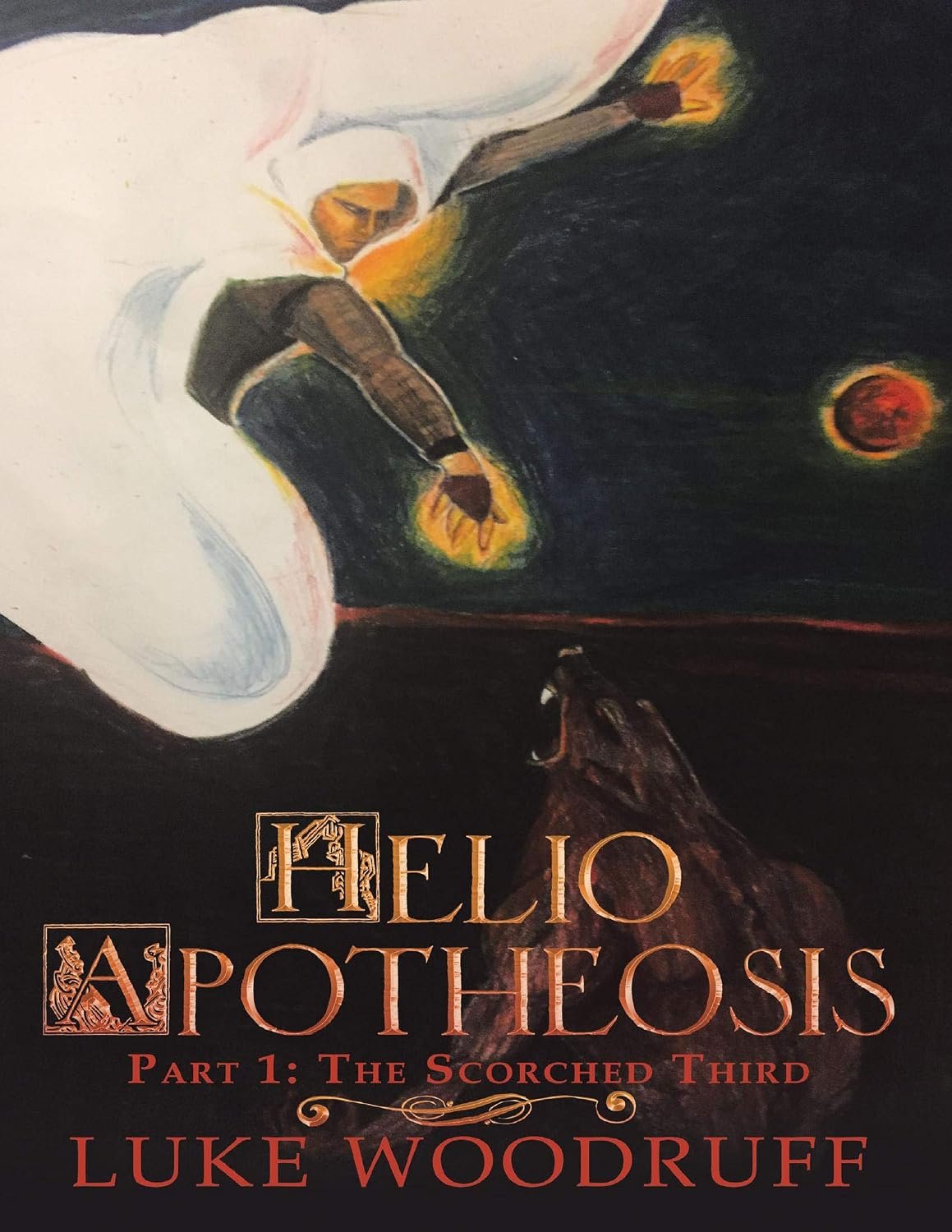
Luke Woodruff’s Helio Apotheosis: Part 1: The Scorched Third begins, according to its published synopsis, with a man waking in dust beneath a brown sky.
An unfamiliar sky and an unanswered name
Luke Woodruff’s Helio Apotheosis: Part 1: The Scorched Third begins, according to its published synopsis, with a man waking in dust beneath a brown sky. The land around him is desiccated. He does not recognize his surroundings or remember how he arrived there. This is an immediate problem of orientation, but the questions quickly extend beyond geography. The story promises a struggle for understanding in a world where external enemies and internal weaknesses are both consequential. Readers who enjoy beginning a speculative novel at the same disadvantage as its protagonist may appreciate that setup. There is no inherited map, familiar village, or trusted explanatory voice in the premise. The opening image communicates isolation before the narrative has supplied any history. The protagonist must discover not only where he is but how to interpret a setting that appears already damaged. The title suggests transformation, while ‘The Scorched Third’ sounds like a region marked by catastrophe. That is an interpretive connection, not a verified description of its full world-building system. What is confirmed is a journey begun in mystery and framed by the search for meaning.
Survival, memory, and the search for perspective
Amnesia can seem like an easy storytelling device unless it changes the character’s decisions. Woodruff’s official description makes lost memory foundational: the central figure lacks details of his own past and must learn what circumstances produced his present danger. Such a story can ask readers to distinguish identity from remembered biography. If a person cannot recall yesterday, which instincts and choices still reveal who that person is? The source material promises tests of character and the realization that opponents exist both inside and outside the self. That dual challenge separates this premise from a straightforward march across hostile territory. Physical survival matters, yet the more difficult task may be deciding how to act before a coherent explanation becomes available. A reader can watch how the character responds to uncertainty rather than simply tallying discoveries. The dust-filled world also offers an atmospheric metaphor for obscured knowledge: sight exists but visibility remains poor. It would overstate the verified synopsis to assign precise political factions, relationships, or battles to the opening. The reliable emphasis is on disorientation giving way to gradual moral and spiritual comprehension.
Faith as part of the novel’s architecture
The book’s publisher description explicitly invokes the protagonist’s angel and God, and independent reader discussion places biblical and fantastical elements within the adventure. This is relevant when selecting the book. Spiritual reference is not only a background ornament; it shapes the questions the narrative asks about help, agency, evil, and redemption. A faith-inflected fantasy can appeal to readers interested in how a character negotiates responsibility while believing that moral order extends beyond material events. That does not require a feature to certify any supernatural claim as fact. The book is fiction, and its religious framework belongs to its invented story. There is room for readers of different commitments to approach the premise, but expectations should be accurate. Someone wanting science fiction with an exclusively technological explanation may find the spiritual dimension central rather than incidental. Equally, readers expecting a devotional guide should anticipate a narrative with action and peril, not a practical spiritual curriculum. The productive question is how the promised faith framework influences a person’s choices when the origin of danger remains uncertain.
An adventure with two kinds of opposition
The text’s description says that enemies will test the hero both externally and internally. Those categories create contrasting kinds of suspense. External opposition can threaten safety, block travel, or force a tactical choice. Internal opposition may take the form of fear, pride, doubt, or an impulse to surrender. The exact configuration in Woodruff’s novel cannot be asserted without the complete text, but these are useful lenses for reading what the synopsis explicitly promises. If a character survives an encounter while betraying their values, has that encounter really been a victory? If they make a difficult ethical decision but remain materially endangered, what counts as progress? The publisher places victories and defeats alongside endings and beginnings, suggesting a journey where action and interpretation are intertwined. The landscape of scorched earth can sharpen these questions because a devastated setting restricts comforting alternatives. The story’s tension may come from needing to choose without perfect information and then living with the consequences. That is a more compelling proposition than a summary of invented action sequences would be.
Why the first installment matters
The subtitle identifies this book as Part 1, and bibliographic catalogs place it in a speculative-fiction context. A reader should therefore approach the volume as the opening of a larger narrative rather than demand closure for every premise introduced. Early installments often establish stakes, moral vocabulary, and the uncertainties that later volumes will explore. The synopsis offers an unusually explicit promise of revelation: the central figure seeks an explanation for the mystery enveloping his beginning. It does not disclose how much of that explanation this particular volume supplies. Rather than pretending to know its final turns, it is more responsible to describe the reading contract. The audience is being invited to enter a damaged world with the protagonist, accumulate clues, and see whether physical encounters alter his self-understanding. Some readers find that sustained mystery energizing; others prefer a standalone adventure that ties every thread immediately. Knowing this difference helps choose deliberately. The distinctive flavor here is the collision of a harsh landscape, lost memory, and a vocabulary of divine assistance.
How to read its genre blend
Helio Apotheosis can be described through several overlapping terms: speculative adventure, fantasy-inflected fiction, and spiritual or Christian-themed storytelling. Independent bibliographic sources and reader accounts support that broad characterization, though labels are never a substitute for the actual book. The useful test is what the blend asks of the reader. Does the unfamiliar physical environment generate curiosity? Does the central character have meaningful decisions to make despite his limited knowledge? Do spiritual elements function as part of the story’s imaginative logic rather than as claims readers must accept outside fiction? Each reader may value those components differently. The novel should not be presented as verified scientific forecasting or a literal guide to angels and demons. Nor should a research-based feature quote dialogue or describe a precise scene not established by the descriptions. Its evident strength as a premise lies in the tension between a person who knows almost nothing and a world apparently governed by forces larger than any one person.
Who should read The Scorched Third
Choose this opening installment if you enjoy entering a strange world with very little explanation, watching a protagonist reconstruct their identity, and encountering questions of faith inside an action-driven adventure. Readers interested in lost-memory plots, allegorical struggle, and the moral meaning of survival have several accessible points of entry. Those looking for a purely secular hard-science scenario or a contemporary realist novel should note the clear spiritual and fantastical orientation. Because this is a first part, it is also well suited to readers comfortable with an unfolding series. Approach it as the beginning of a search rather than a collection of already solved mysteries, and let the contrast between outward danger and inward choice guide your attention.
About the author
Luke Woodruff is the author credited on the relevant book listings for Helio Apotheosis: Part 1: The Scorched Third. Catalogs identify editions published through Lulu, while a separate retailer lists an ebook edition. Exact pagination varies by format and source, so this feature avoids presenting a single universal count. The book’s documented focus on mystery, faith, and moral testing is sufficient to introduce Woodruff’s narrative interests without inventing personal history or literary awards.
About the book.
Speculative adventure; faith-inflected fantasy fiction. A man awakens without memory in a scorched world and begins a perilous search for identity and purpose.
Editorial book feature, not paid sponsorship. Original research-based commentary, not firsthand complete-book reading. The owner’s Python automation will resolve the cover placeholder.
Found a book worth opening?
Books worth discovering. Authors worth knowing.
Return to the Journal →