
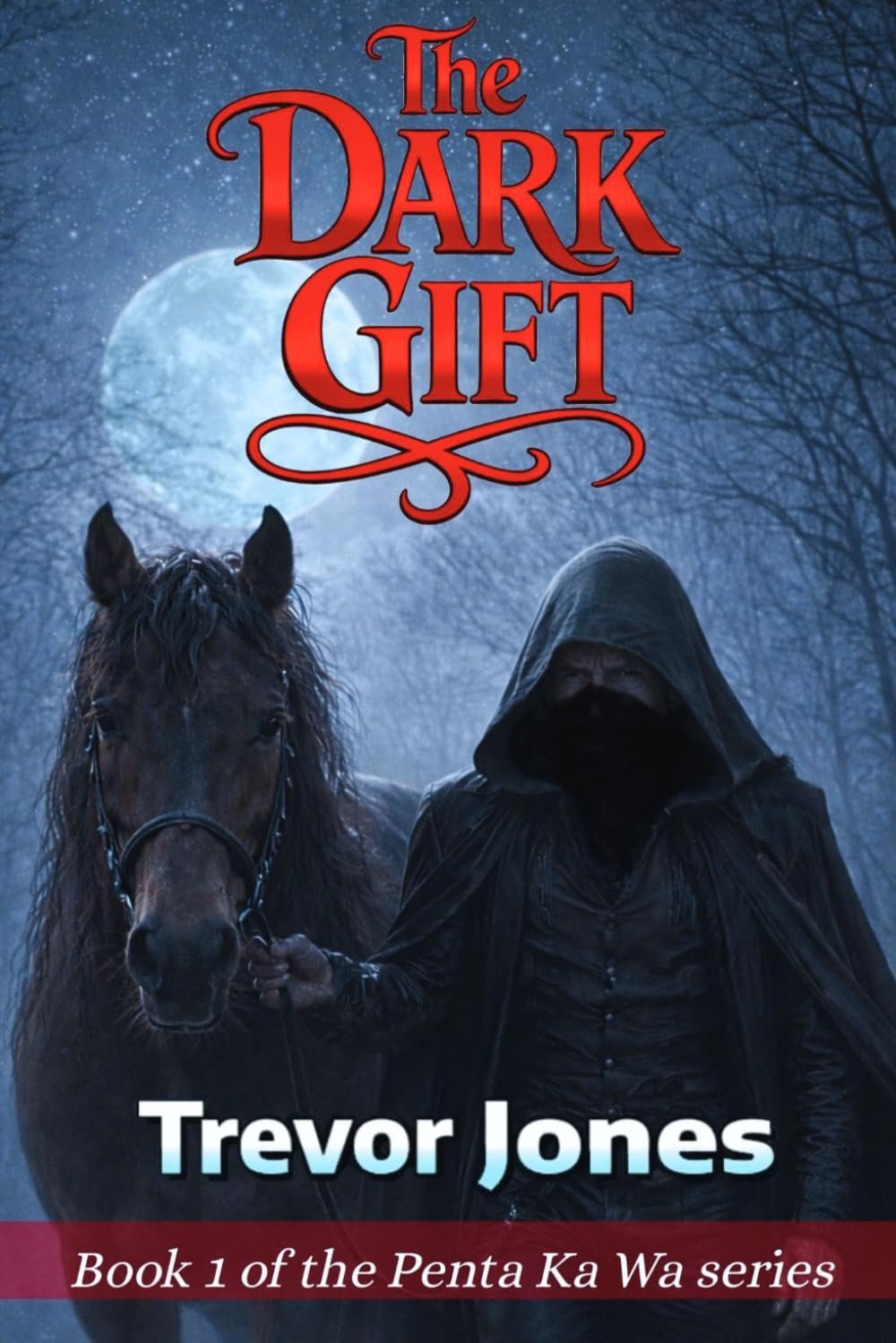
Penta Ka Wa: The Dark Gift
A legendary retired Horseman loses his peaceful life and must resist the darkness of a supernatural transformation.
Books worth discovering. Authors worth knowing.
A legendary retired Horseman loses his peaceful life and must resist the darkness of a supernatural transformation.
Trevor Jones begins Penta Ka Wa: The Dark Gift with an inversion of the usual fantasy hero’s journey.
A Hero Forced to Become His Nightmare
Trevor Jones begins Penta Ka Wa: The Dark Gift with an inversion of the usual fantasy hero’s journey. Penta is not a young adventurer looking for his first battle. He is a celebrated Horseman who has reached the years when he longs to leave warfare behind and grow old peacefully with his wife. The public description establishes that sudden violence destroys that future and transforms him into a vampire against his will. This is an unusually rich starting point because Penta has already formed a moral identity before the supernatural ordeal begins. His problem is not how to become powerful enough to confront an enemy; it is how to remain himself when power arrives as a curse. Readers who prefer mature protagonists and morally conflicted fantasy may find the premise especially compelling. A life built around service and courage is interrupted by a kind of survival Penta would never have chosen.
Kinthur Is More Than a Backdrop
The story unfolds in Kinthur, a fantasy world that Jones has developed for decades. On his author website, he describes a setting with a lengthy imagined history, distinct deities, and multiple races and magical traditions. The scale of that work gives Penta’s journey an environment capable of pushing him in many directions. Elves, monsters, supernatural powers, and human ambitions can all become part of a world where the boundaries between good and evil are contested. Yet the presence of familiar fantasy species is not the most distinctive thing about this opening volume. What matters is how the larger world responds to a respected former warrior whose very existence has become troubling. Kinthur offers room to explore that problem across countries and cultures while keeping the story anchored in a single man’s loss. The author’s published description confirms the broad setting and central conflict, not every encounter that might occur along the road.
An Unwanted Hunger
Becoming a vampire gives Penta abilities that can serve him, but it also introduces a hunger that threatens his values. That conflict is at the center of the book’s premise. A battle-hardened warrior knows how to resist outward enemies; resisting an appetite embedded in his own condition is different. A supernatural curse can serve as a vivid fictional image for losing control over the assumptions that once made life understandable. Readers do not need to flatten the vampire element into a lesson about real illness or moral weakness to appreciate its dramatic force. The fantasy situation is distinctive on its own terms. If Penta uses frightening powers to defend others, how does he judge the means? If he refuses those powers, can he survive long enough to act on his principles? These are questions invited by the publisher-facing summary rather than spoilers about his decisions.
Grief Behind the Adventure
Penta’s transformation follows the loss of his wife and the peaceful retirement they hoped to share. The violence makes grief a motive as well as a wound. This emotional foundation prevents the book from being merely a catalogue of dark creatures and sword fights. The loss of a long-established relationship may also complicate the fantasy convention of a hero who can leave home easily because he has so little to lose. Penta’s deepest commitments already lie behind him; his travels take place in the shadow of a life he wanted to keep. A thoughtful reading can notice the difference between revenge and justice without assuming the novel delivers a simple verdict. Grief may sharpen a wish to punish, but it can also make the memory of loved ones an ethical anchor. The external adventures matter because they test what he wishes to preserve.
From Tabletop History to Fiction
Jones has explained that the Kinthur world grew out of tabletop role-playing, and that Penta began as a character whose oral history expanded until it demanded a written form. This history is useful context, not a reason to assume the finished novel follows game mechanics. Role-playing settings often accumulate deep lore because different characters explore different parts of the same imagined world. Turning that material into a novel requires organizing it around emotional and narrative purpose. Penta’s unusual age and unwanted transformation provide precisely such a center. Readers who enjoy extensive world-building may appreciate a setting with a long creative history. Those who are wary of fantasy fiction that resembles a game transcript should judge the book by its character dilemma rather than by its origins. An independent review has noted the author’s success in making the unlikely vampire protagonist work within this kind of fantasy setting.
The Question of Moral Power
Traditional fantasy often rewards a character who grows stronger. The Dark Gift complicates that expectation because increased power arrives through a violation of Penta’s wishes. Strength can be useful, yet its source changes the way others regard him and how he regards himself. In such a premise, heroism has less to do with possessing the right abilities than with choosing how to use abilities one never requested. Penta’s past as a Horseman makes that conflict sharper. He may remember codes of conduct that do not apply neatly to his new existence. A reader can expect tension between the discipline of the former warrior and the appetite of the vampire, but should not assume an easy reconciliation. What is most promising about the setup is that ethical judgment becomes an ongoing practice rather than an inherited title or reputation.
An Epic Story With Human Stakes
The official and bookseller descriptions emphasize a landscape filled with magic, heroes, and creatures associated with darkness and light. Such breadth can deliver spectacle, but Penta’s origin creates a way to measure whether the spectacle matters. Encounters can reveal how much he has changed and how determined he remains to protect something of his former self. The book is the first entry in a continuing Penta Ka Wa sequence, and later installments deepen the setting’s history. Prospective readers should therefore approach it as the beginning of a larger arc rather than a stand-alone experiment in vampire fiction. Readers seeking a compact supernatural thriller may find the expansive fantasy world an important consideration. Those drawn to long-form character transformation and established magical societies will have a different reason to start here.
There is a particularly poignant contrast between retirement and immortality. Penta has reached a point when the ordinary finitude of life feels like something to welcome: he wants time at home with the person he loves. Vampirism forces an existence potentially defined by survival without the life he hoped to inhabit. Fantasy often treats longevity as a prize, yet this premise asks whether endless years would mean anything to someone deprived of the relationships that gave those years meaning. The question does not require detailed knowledge of the novel’s later mythology. It arises directly from the facts of Penta’s retirement, bereavement, and involuntary transformation. That tension creates room for the action to carry an unexpected melancholy even at moments when the hero demonstrates formidable powers.
Why This Dark Gift Stands Apart
The strongest hook in Penta Ka Wa: The Dark Gift is the contradiction at its center. A man respected for what he has done in life becomes a being many people would consider monstrous, then has to decide what his previous life means under new conditions. That premise can support adventure, grief, horror, and reflection without requiring any fabricated side plot. Trevor Jones’s own accounts of the setting establish that the story belongs to a wider imaginative enterprise, while external descriptions confirm the retired Horseman, violent loss, and unwilling transformation. An introduction to the novel can confidently foreground those details and leave individual reversals for readers to discover. Penta’s journey poses a compelling fantasy question: if fate removes the form of life in which one’s virtues were learned, can those virtues survive in a radically different body?
About the book.
Epic dark fantasy; unwilling vampire protagonist. A legendary retired Horseman loses his peaceful life and must resist the darkness of a supernatural transformation.
Sponsored book feature. Independent research-based commentary based on publicly available book details; not a claim of first-hand full-text review. The designated cover placeholder will be resolved by the owner’s publishing automation.
Found a book worth opening?
Books worth discovering. Authors worth knowing.
Return to the Journal →