
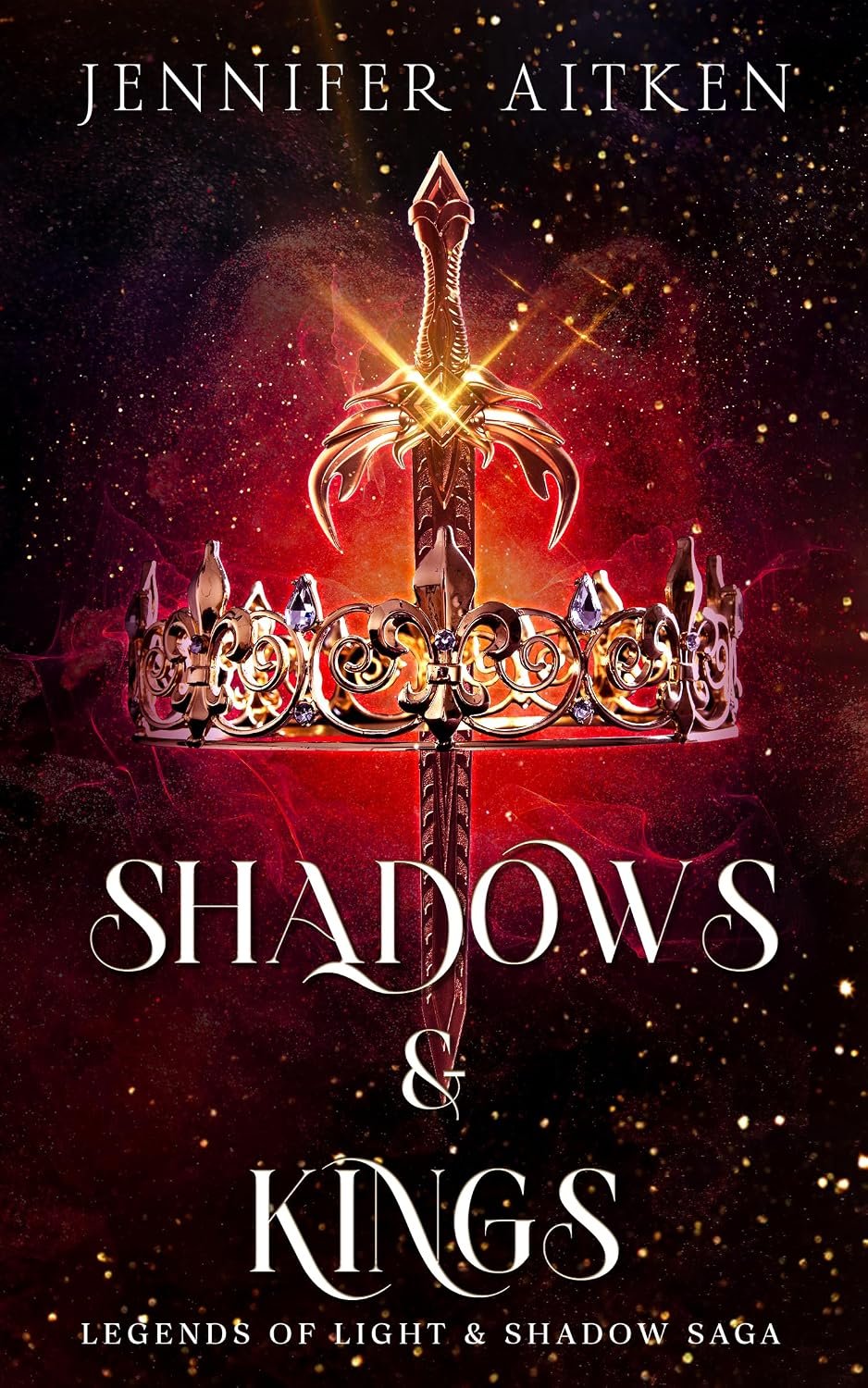
Shadows & Kings
Lucius survives the battle against Tartarus only to discover that shadow power has followed him, threatening the humanity he hopes to keep.
Books worth discovering. Authors worth knowing.
Lucius survives the battle against Tartarus only to discover that shadow power has followed him, threatening the humanity he hopes to keep.
J.
Power After the Victory
Fantasy victories usually arrive with a moment of release. The enemy has fallen, the threat has passed, and the heroes can finally stand on ground that feels safe. Jennifer Aitken’s *Shadows & Kings*, the third book in her *Legends of Light & Shadows Saga*, begins from a more unsettling possibility. The publisher description says Lucius has already defeated Tartarus, yet some of the defeated enemy’s shadow energy has attached itself to him. Survival is not the end of the crisis. Lucius must learn to control a force that could kill him, even as he is called to confront another threat. The aftermath of an apparent triumph becomes the opening of a deeper struggle.
The central magical proposition is striking: Lucius is expected to wield both Light and Shadow. Such opposites are familiar fantasy symbols, often arranged as moral absolutes. Aitken makes the combination dangerous rather than simply glamorous. A person who carries two immense energies must decide how to contain them, how to use them and what they might do to his identity. The promotional language raises the possibility that he will lose the last piece of his humanity in becoming the figure the universe requires. That is a dilemma that cannot be resolved merely by increasing magical strength. It asks whether power can become destructive even when the person wielding it hopes to do good.
The Shadow That Will Not Leave
The aftermath of Tartarus’s defeat turns a common fantasy convention inside out. When evil is overcome, its influence does not necessarily evaporate. Consequences can remain in a victor’s body, relationships or sense of self. Lucius’s shadow energy makes that idea literal. The publisher description explicitly says the force has attached itself to him and must be controlled before it destroys him. Readers can understand the problem without needing a technical diagram of the fictional magic system. The thing he fought has become part of the person who fought it. Every future choice may be complicated by what was supposed to have been left behind.
This does not require the reader to interpret Light as always harmless or Shadow as always equivalent to wickedness. The premise is more interesting if both are treated as consequential forms of energy whose use depends on control and intention. The possibility that a hero must work with something associated with an enemy creates tension between purity and responsibility. Rejecting the darkness outright might be impossible; embracing it carelessly could be fatal. The story is advertised as a struggle to master the contradiction rather than a celebration of possessing unlimited power.
Chaos Is Not What It Once Was
A second threat enters the publisher’s description through a being called Chaos and a shadow army. Lucius previously helped bring these forces out of the shadow realm, only to discover that the Chaos they knew has been altered by an invading shadow demon. This introduces a painful dimension to the conflict. Lucius is not merely facing a new villain who arrives from nowhere. A former action, apparently taken for one purpose, has produced a dangerous consequence. The need to fight becomes entangled with responsibility for the circumstances that made the fight necessary. The hero must confront not only another powerful opponent but also the limits of his earlier judgment.
The name Chaos is a strong piece of fantasy symbolism, but the confirmed details give the figure a more particular dramatic function. An ally or familiar force may become unrecognizable when infected or transformed. That possibility unsettles trust. How does someone know whether the person before them can be saved, resisted or understood? How much of the old identity remains? The published synopsis does not provide a final answer and does not justify inventing one. It supplies a dilemma about a changing relationship and a threat to the wider universe, enough to suggest why the third installment is not simply repeating the earlier battle.
The Cost of Being Needed
Lucius is repeatedly described in the official material as someone the universe needs him to become. This can sound heroic, but it also places a heavy burden on individual choice. A person told that everyone depends on his transformation may have little room to ask what the transformation will cost him personally. Aitken’s setup seems especially conscious of that price. If the last shred of Lucius’s humanity is in jeopardy, the question is not only whether he can win. It is whether the universe’s survival can be reconciled with his own. Readers interested in morally complicated heroes may find this more engaging than an uncomplicated ascent to invincibility.
The conflict also opens a question about support. Grand fantasy narratives often center a chosen individual while treating everyone else as an audience. Yet no person, however powerful, is immune to the need for trust or assistance. An author interview about the book points to Elowen helping Lucius carry a burden of Universal energies, reinforcing the human significance of relationships amid cosmic scale. That is sourced context rather than a claim that every scene has been examined firsthand. It suggests that the saga’s enormous stakes can still turn on whether someone recognizes another person’s need and chooses to share it.
What a Third Book Can Do
The book is listed as the third volume in *Legends of Light & Shadows*. That matters for reading expectations. Some of the characters’ relationships and the significance of Tartarus’s defeat are rooted in earlier installments. A returning reader may experience the new crisis as the consequence of choices accumulated across the saga. A newcomer can still understand the main dilemma from the synopsis but should know that the story enters a continuing world rather than introducing every element for the first time. The attraction of a saga lies in how consequences acquire weight across books. Victories become history; history shapes the next decision.
Aitken’s own website identifies the saga as a young-adult fantasy project, while major digital bookstores present detailed summaries of this installment. Those sources consistently establish Lucius, Light and Shadow, Tartarus, Chaos and the threat of universal domination. Page counts differ among formats and sellers, so a single number would add little to a feature. More valuable is the continuity of the narrative promises across official descriptions. It is an action-oriented cosmic fantasy, but one organized around what power does to the person asked to carry it.
What Remains of the Hero
There is a compelling emotional paradox in the title *Shadows & Kings*. Royalty and immense forces may suggest command, but the protagonist is described as fighting to control something inside himself. External authority offers little comfort if self-command is slipping. In that sense the conflict is both outward and inward. Lucius must oppose Chaos, but he must also become someone capable of surviving his own abilities. The story’s appeal grows from that double demand: extraordinary power is meaningful only when the bearer can keep choosing how it is used.
An editorial introduction can accurately describe these premises without treating the public marketing text as evidence of a flawless resolution or claiming a full critical reading. The questions worth carrying into the book are already clear. What is left of a hero after he has saved everyone once? Does responsibility excuse every sacrifice demanded of him? Can an identity survive the need to contain opposing forces? *Shadows & Kings* is positioned as the saga’s exploration of these costs. For readers drawn to sweeping fantasy with consequences that persist after victory, its central struggle offers a strong reason to return to Lucius’s universe.
About the book.
After Tartarus is defeated, Lucius carries shadow energy that could destroy him. He must master both Light and Shadow while Chaos and an infected shadow army threaten the universe.
Editorial book feature, not paid sponsorship. Independent research-based commentary using publicly available descriptions and author material, not a claim of first-hand full-text review. The cover placeholder will be resolved by the owner’s publishing automation.
Found a book worth opening?
Books worth discovering. Authors worth knowing.
Return to the Journal →