
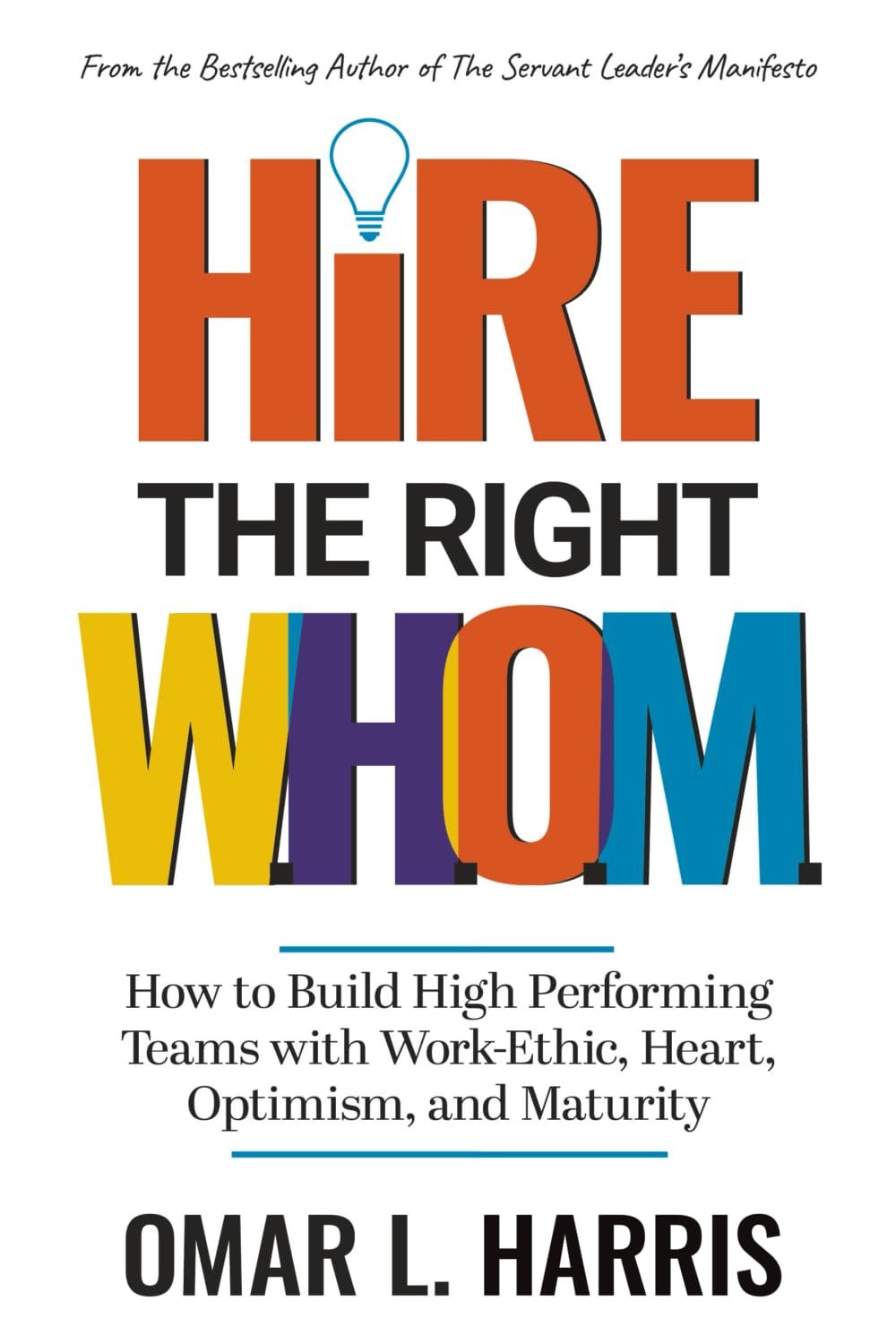
Hire the Right W.H.O.M.
Omar L. Harris asks employers to look beyond credentials and hire for work ethic, heart, optimism and maturity.
Books worth discovering. Authors worth knowing.
Omar L. Harris asks employers to look beyond credentials and hire for work ethic, heart, optimism and maturity.
O.
A Hiring Question Bigger Than a Résumé
The résumé can tell a manager where someone worked, which certificates they earned and how they describe their achievements. It rarely reveals how that person responds when a project goes badly, shares credit when a colleague succeeds or handles a decision that requires admitting a mistake. Omar L. Harris starts from this gap in Hire the Right W.H.O.M., a leadership book that argues for looking at dimensions of character as deliberately as conventional qualifications. The title’s unusual acronym is the argument in miniature: Work-Ethic, Heart, Optimism and Maturity. In Harris’s framework, these qualities help teams ask not merely whether an applicant can perform a task but how they will behave while performing it with other people.
This is not a reason to disregard technical competence, experience or employment law. It is a proposal about what conventional hiring procedures tend to under-examine. Harris’s own commentary criticizes what he calls résumé roulette, in which a seemingly reassuring career history gets mistaken for a prediction of future conduct. A genuine recruitment process cannot diagnose character from a charismatic interview or a gut feeling. Its useful challenge is to turn vague opinions about a person’s attitude into observable questions that can be evaluated fairly. The book’s promise lives in that distinction between a grand slogan about culture and the practical work of making a decision that other people will live with.
Four Letters With Different Responsibilities
Work-Ethic, the first dimension, concerns follow-through and consistency rather than an endless willingness to work late. Someone can be industrious without being sustainable, and an organization can undermine its own employees by rewarding exhaustion. As a lens for selection, work ethic is best considered through reliable evidence: what commitments were made, which obstacles arose and how the work was completed. Heart shifts attention from output alone toward values, courage and genuine concern for colleagues. It asks whether a capable employee leaves the room more trusting or less trusting, an important question when performance reviews privilege individual results above the experience of an entire team.
Optimism, as Harris describes it, is connected to adaptability and resilience rather than cheerful denial. A candidate who says a problem is real and then proposes an informed next step may show more useful optimism than someone who insists every difficulty will somehow vanish. Maturity brings self-awareness, judgment and diplomacy into view. It is visible when a person can accept feedback, distinguish a conflict from a personal attack and choose restraint even when they have authority. Each trait has weaknesses if reduced to an easy personality score. Together, however, they provide a language for discussing qualities that managers often notice only after the hiring decision has already become expensive.
The Problem With Hiring for Polish
Recruiting interviews can be theater. A confident applicant is not necessarily competent, a quiet applicant is not necessarily indifferent, and familiarity with a company’s mannerisms is not necessarily evidence of ethical alignment. Employers who hire for a narrow sense of cultural fit may end up hiring people who resemble themselves. Harris’s model is most useful when its categories are interpreted as behaviors rather than tastes. A manager might ask candidates to describe an instance in which they corrected their own mistake, advocated for a colleague or revised a plan after criticism. The answer would still need careful evaluation, but it would prompt a better conversation than asking someone to declare themselves a team player.
The challenge becomes sharper for workplaces that claim to want innovation. A team of agreeable people can be pleasant and unproductive if everyone is afraid to disagree. Heart should not be confused with avoiding conflict, and maturity should not mean unquestioning obedience. A mature colleague can challenge an unrealistic deadline while caring about the people responsible for delivering it. An optimistic teammate can surface bad news early because they believe it is possible to respond. Even the framework’s vocabulary creates useful tension: strengths matter most when they remain compatible with honest disagreement, transparent feedback and respect for people whose styles differ.
Character as a Team-Level Concern
Harris draws from executive experience across international settings, according to his author biography, and repeatedly returns to the consequences of misalignment between personal behavior and shared goals. The book’s argument therefore reaches beyond the first interview. Onboarding, delegation and performance management all reveal whether an organization’s stated standards are real. A company cannot credibly ask for maturity while rewarding public blame, or praise heart while tolerating leaders who humiliate junior staff. Hiring is the point where a new working relationship begins, not a substitute for the policies and example that sustain it.
Imagine a talented new employee entering a team in which every disagreement becomes a competition. Even a person with extraordinary patience may eventually adopt the surrounding behavior. The W.H.O.M. questions can be directed inward as well as outward: does the management team model the behaviors it says it values? Do rewards favor thoughtful work and mutual support, or merely visible heroics? Harris frames character as something that compounds across careers. That is an editorially interesting idea because culture is never the property of a single impressive hire. It is the cumulative result of decisions repeated by colleagues, supervisors and institutions.
What a Reader Can Put to Work
The framework may appeal to founders making their first critical hires, experienced managers rebuilding trust, and job seekers who want to articulate what they bring beyond job titles. Readers can construct practical reflection questions from the four dimensions without assuming the book offers a scientifically validated assessment for every setting. For example: what evidence supports a claim of reliability? When has a candidate balanced another person’s welfare with a difficult obligation? How did they approach a setback they could not control? What did they learn after discovering that their initial judgment was wrong? These questions invite examples instead of self-advertisements.
Fairness remains essential. Evaluations of optimism and maturity can be culturally influenced, and a candidate’s disability, accent or speaking style should never be treated as a proxy for capability or values. The book’s most responsible application would use consistent, job-relevant criteria, multiple sources of evidence and space for reasonable accommodations. Character-based hiring should make decisions more thoughtful, not less accountable. That safeguard also protects the employer: when a manager cannot explain why a person was judged to have more heart than another, the apparent rigor of an acronym may conceal an ordinary preference.
An Invitation to Rethink Talent
Hire the Right W.H.O.M. gives familiar concerns about workplace culture a memorable structure. Harris’s four terms are simple enough to travel through a conversation, but they ask complicated things of a manager who takes them seriously. Work-Ethic without compassion becomes a demand for constant sacrifice. Heart without discernment can make difficult decisions impossible. Optimism without evidence becomes wishful thinking. Maturity without courage risks becoming silence. The potential value lies in considering all four qualities together and checking each against the realities of the role, the team and the workplace.
The book is especially timely in a professional world where career histories are highly polished and recruiting technology makes applicants easier to filter than to understand. Its claim should not be mistaken for a guarantee that the perfect hire can be identified every time. The more modest—and more useful—lesson is that skill and character belong in the same discussion. A good team needs people who can do the work, learn when the work changes and treat one another as partners rather than expendable resources. Harris asks readers to make those expectations visible before the employment contract is signed, and then to live by them afterward.
About the book.
Harris presents the W.H.O.M. model—Work-Ethic, Heart, Optimism and Maturity—as four character-based dimensions for evaluating prospective teammates alongside skills and experience.
Sponsored book feature. Independent research-based commentary using publicly available descriptions and author material, not a claim of first-hand full-text review. The cover placeholder will be resolved by the owner’s publishing automation.
Found a book worth opening?
Books worth discovering. Authors worth knowing.
Return to the Journal →