
Two Euro Candles
A lyrical memoir looks at trauma, faith and authenticity through vignettes rather than a tidy promise of transformation.
Books worth discovering. Authors worth knowing.
A lyrical memoir looks at trauma, faith and authenticity through vignettes rather than a tidy promise of transformation.
M.
A Memoir Built From Quiet Scenes
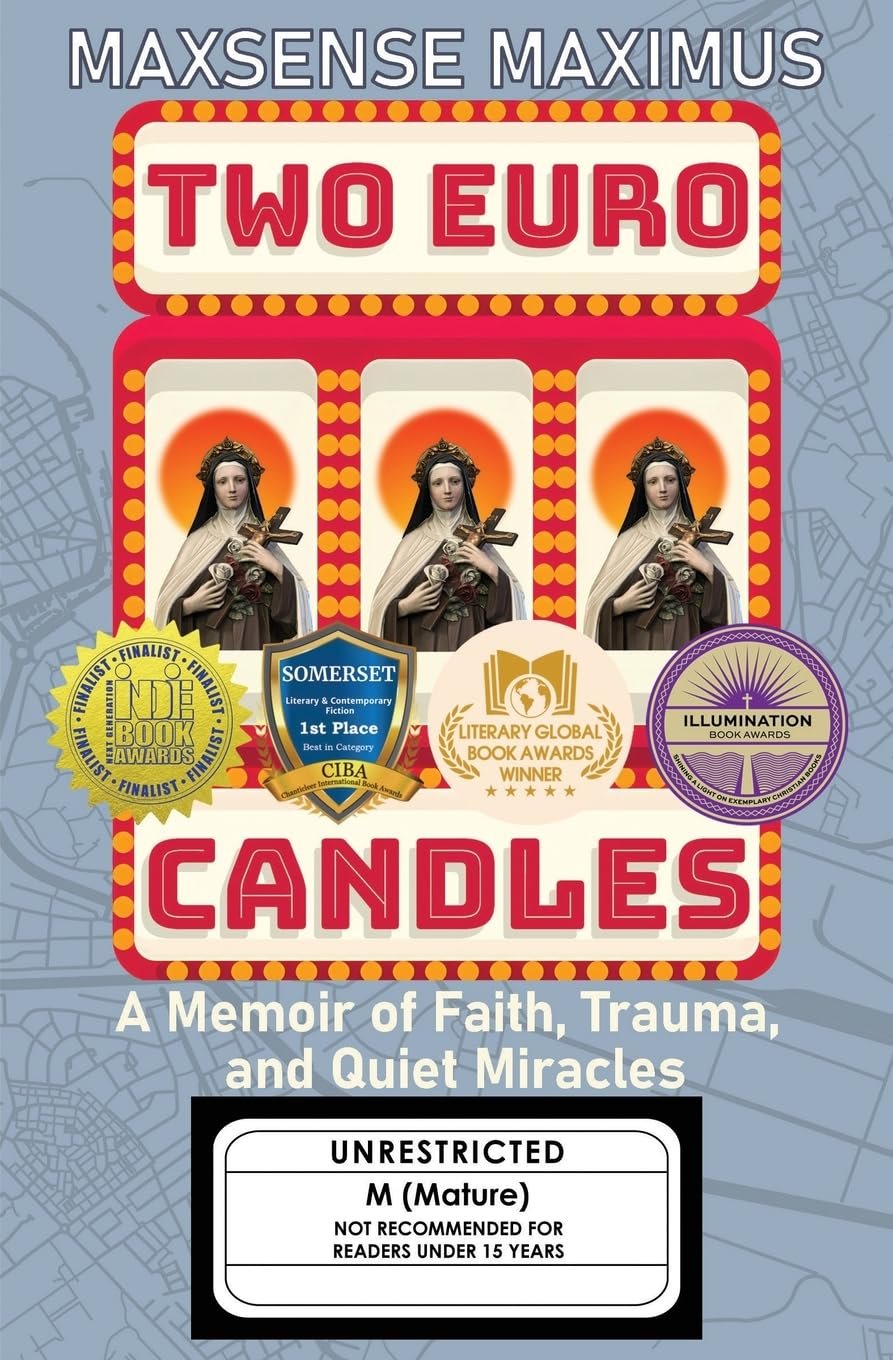
The title Two Euro Candles invites curiosity about something small: an inexpensive object, perhaps an everyday gesture whose significance becomes larger than its price. Maxsense Maximus’s memoir is described in an Australian government classification record as a 360-page literary account of trauma, faith and existential authenticity told through lyrical vignettes. That verified description is more useful than guessing exactly where the candles appear or what they symbolize in a scene. It establishes that the book’s interest lies in accumulated moments and the search for meaning rather than in a conventional promise of dramatic, uninterrupted triumph.
Memoir is often marketed through a clear trajectory from crisis to resolution, but experience seldom organizes itself so neatly. Vignettes can approach a difficult subject from different angles, offering brief encounters, memories or reflections rather than a strict chronological chain. A book built in that manner may invite the reader to assemble emotional connections across scenes. The word quiet in the subtitle, A Memoir of Faith, Trauma and Quiet Miracles, suggests attention to changes that are easy to miss when a life is measured only by spectacular turning points. It does not certify a supernatural event as fact; it is part of the memoir’s own language for experience.
What the Public Record Establishes
The Australian Classification database lists this work as an original English-language publication from 2025, published by Euraus Publishing, with Maxsense Maximus credited as author. It identifies the book as literary memoir, gives a 360-page extent and notes mature-content guidance, not recommending it to readers under fifteen. A verified record of this kind provides a firm bibliographic foundation. It does not offer a complete scene-by-scene synopsis, author biography or an independent assessment of the book’s literary success. The appropriate feature therefore explores the stated form and concerns while being clear about those limits.
The classification entry’s attention to trauma matters for reader expectations. Memoirs that revisit distressing experiences can be meaningful but emotionally demanding. Someone approaching the book in a vulnerable period may wish to review its content information before reading. Maturity guidance is not a verdict that a work is harmful or unsuitable for all younger readers; it identifies material requiring discretion. Nor should the label be used to advertise trauma as spectacle. The central ethical obligation is to treat the subject as human experience rather than a device for producing heightened curiosity.
Why the Vignette Form Fits Memory
Memory does not always arrive in a straight line. A particular sound, object or place can revive one event while leaving adjacent years indistinct. The vignette offers a literary method for acknowledging that unevenness. Instead of forcing every memory into a continuous report, a writer can linger on a short scene and let details carry emotional force. The Australian classification description specifically calls the book lyrical, indicating that the shaping of sentences matters alongside what is recounted. Such prose asks readers to attend to rhythm, image and silence, not only to the factual chronology of events.
The form also creates room for ambiguity. A memoirist may remember how a moment felt without claiming perfect access to every participant’s motives. That does not make memoir untruthful; it highlights the difference between personal testimony and an exhaustive external record. Readers can listen carefully while recognizing that every narrative selects and orders experience. When the subject is trauma, this selectivity may be especially significant. The writer can choose the pace and distance at which painful material enters the work, and the reader can respond without demanding that every unanswered question be resolved immediately.
Faith as a Language for Endurance
The subtitle places faith alongside trauma and quiet miracles. Faith in literary memoir can be a source of consolation, conflict, doubt or renewed attention to ordinary life. Public bibliographic material does not identify every belief or ritual discussed in this book, so it would be wrong to prescribe a particular religious interpretation to the author. The broader question raised by the premise is how spiritual vocabulary helps a person narrate experiences that resist simple explanation. Language about miracle may express gratitude, wonder or a personal account of extraordinary significance without functioning as a scientifically established claim.
Readers of different convictions may respond to that language in different ways. Some may recognize experiences of prayer, surrender or trust. Others may understand miracle metaphorically as a moment of unexpected assistance or survival. A respectful editorial feature leaves room for those responses while keeping the author’s testimony distinct from external verification. The emphasis on quiet events is especially suggestive: a small interaction or decision may matter deeply even when it would not attract public attention. The memoir appears interested in such meanings, and that interest can speak across differences in belief.
Trauma Without a Neat Ending
The temptation in marketing a recovery memoir is to promise that pain will be transformed into a simple lesson. Two Euro Candles does not need that burden. Its verified description concerns the exploration of trauma and authenticity; it does not guarantee a universal cure or a final victory over suffering. Authenticity can involve naming experiences that remain unresolved, resisting the pressure to make one’s life appealing to outsiders and choosing which parts of a story can be told responsibly. The lyric vignette may be suited to such work because it allows different degrees of closeness to memories.
Readers should also resist treating the memoir as a substitute for professional support. The value of literature lies in perspective, recognition and art, not in a medical assurance that another person’s account will work as treatment. A scene might evoke grief or release, and both responses may be legitimate. The book’s content advice is a reminder that encountering a difficult testimony is a personal decision. There can be courage in reading and courage in deciding that the moment is not right. Good memoir respects both writer and reader as people with boundaries.
The Small Object and the Big Question
The title’s reference to two inexpensive candles is memorable precisely because it resists grand language. One could imagine ordinary objects gaining weight through repeated use or association, although the exact role of these candles cannot be established from the public summary. That uncertainty should be preserved. It leaves the image open for the reader to discover within the memoir. More broadly, the title directs attention toward scale: experiences need not look impressive from the outside to be significant to the person living them.
The relationship between the everyday and the extraordinary is a long-standing subject of spiritual and literary writing. A quiet gesture may make another person’s suffering feel less solitary. An ordinary room may become the site of a decision whose consequences remain for years. Such possibilities are not asserted as verified incidents from this book; they are ways of understanding why a writer might pair modest imagery with the word miracles. The aesthetic choice encourages attention to what grand narratives often overlook, and it aligns with the described vignette structure.
Reading With Care and Curiosity
Two Euro Candles may appeal to readers who value reflective literary nonfiction, fragmented memoir forms and honest exploration of faith after hardship. Its 360-page length suggests a substantial work rather than a brief personal essay, while the classification description indicates a lyrical method. Those two facts together offer an interesting expectation: many pages of short-form encounters that accumulate into a larger meditation. Whether that accumulation succeeds stylistically requires direct reading, and this feature makes no claim to have assessed every chapter.
What can responsibly be said is that Maximus approaches material of real emotional weight through a form that appears to privilege detail and reflection. The memoir asks to be met without sensationalism or a demand for easy moral lessons. Its declared concerns—faith, trauma and existential authenticity—point toward the difficult work of making a life intelligible after disruption. The reader who follows that invitation may find a story less concerned with declaring that everything is repaired than with noticing the fragile, often quiet ways meaning persists.
About the book.
An Australian Classification record documents a 2025, 360-page literary memoir by Maxsense Maximus, exploring trauma, faith and existential authenticity in lyrical vignettes, with a mature-consumer advisory.
Sponsored book feature. Independent research-based commentary using publicly available descriptions and author material, not a claim of first-hand full-text review. The cover placeholder will be resolved by the owner’s publishing automation.
Found a book worth opening?
Books worth discovering. Authors worth knowing.
Return to the Journal →