
Mental Health, Poetry, and I
An intimate poetry collection invites discussion of how personal writing can give distress, relationships and recovery a language.
Books worth discovering. Authors worth knowing.
An intimate poetry collection invites discussion of how personal writing can give distress, relationships and recovery a language.
S.
When a Poem Becomes a Way to Speak
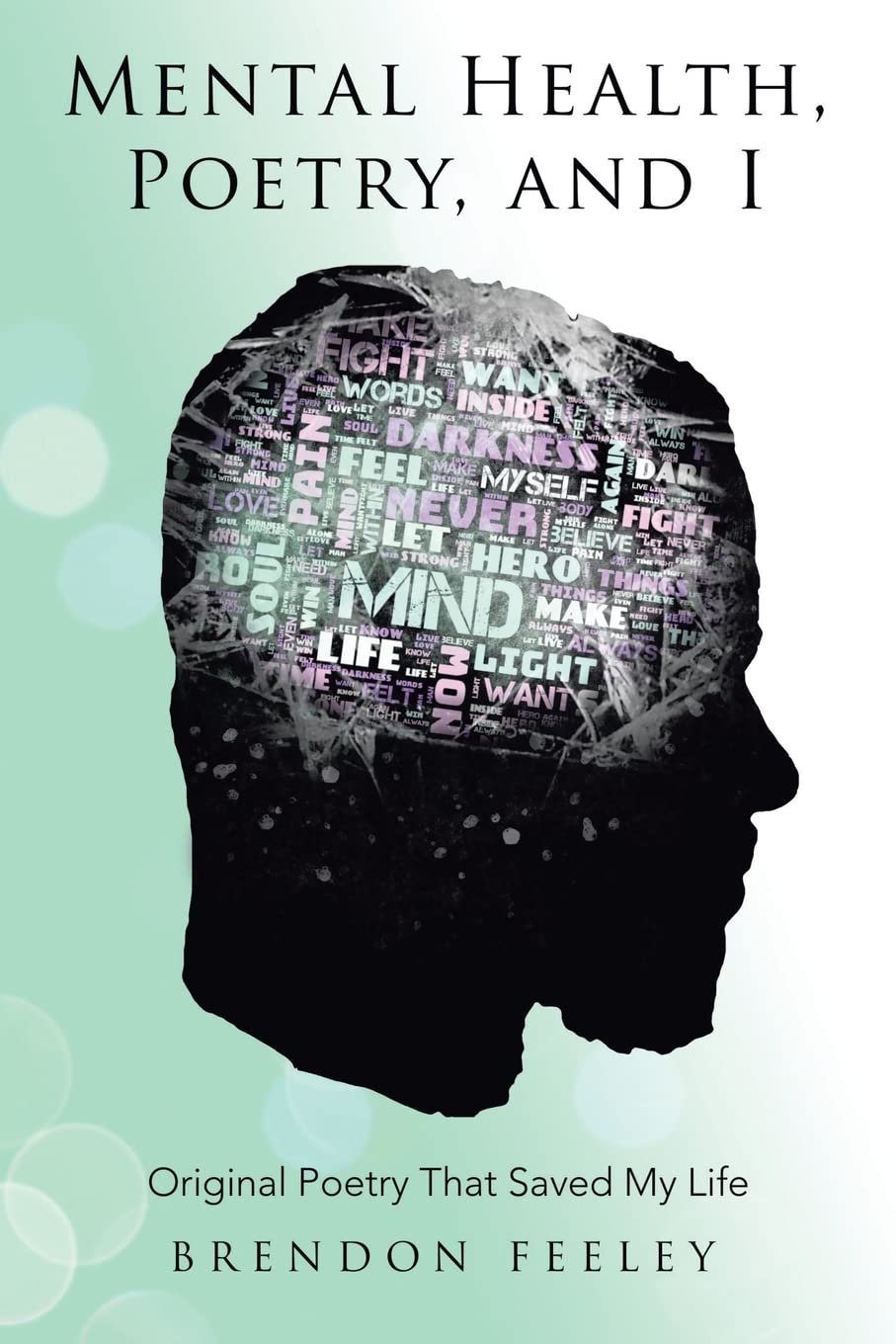
Brendon Feeley’s Mental Health, Poetry, and I: Original Poetry That Saved My Life makes an unusually personal declaration in its subtitle. The publisher’s public description identifies a collection of original poems offering insight into how mental health difficulties affect individuals and their relationships. That is the reliable starting point for discussing the book. The words saved my life describe the author’s framing of his experience; they are not a clinical claim that writing poetry can replace professional treatment for someone else. The difference matters when a deeply personal literary project addresses a vulnerable subject.
Poetry is one of the forms people turn toward when ordinary explanation feels inadequate. It can accommodate contradictory feelings without requiring an argument to be resolved by the end of a paragraph. A poem may describe a moment, revisit an encounter or give shape to an emotion whose cause remains unclear. Such possibilities explain the appeal of the genre for writers working through intense experience. They should not be mistaken for claims about the specific content of Feeley’s unverified individual poems. The available catalogues confirm the topic and form, not a complete table of contents or textual analysis of every verse.
The Personal Pronoun in the Title
The small word I at the end of Feeley’s title changes its meaning. The book does not present itself simply as a general poetry anthology about mental health, nor as an impersonal textbook. The title puts the speaker’s relationship with writing at the center. This is a useful clue to reading expectations. An anthology may seek breadth across many voices; a personal collection can invite readers to follow one person’s attempts to understand experiences over time. The publisher’s summary likewise places individuals and relationships, rather than abstract definitions, at the heart of its stated subject.
There is an ethical responsibility in introducing a book like this. The author’s title is not permission to invent diagnoses, describe private crises or claim that particular poems document specific events. It is possible to appreciate the stakes of a collection without claiming access to its most personal details. Readers may be interested because they have experienced emotional difficulty or loved someone who has. That identification deserves care. A literary feature should welcome recognition and reflection while resisting the temptation to make promises about what one book will accomplish for every reader.
Relationships Under Emotional Pressure
The short publisher description specifically mentions the effects of mental health difficulties on relationships. That phrase broadens the focus beyond private suffering. Emotional distress often changes communication, daily expectations and the way small events are interpreted. A person may struggle to explain what they need; someone close to them may misunderstand withdrawal as rejection or concern as intrusion. Poetry can give such relational tensions a concentrated form, sometimes allowing a difficult feeling to be held in language rather than converted immediately into a dispute. These are thematic possibilities, not descriptions of particular poems whose texts have not been verified.
For the prospective reader, the relevant question is how the collection treats the distance between internal experience and outward behavior. Personal poems can illuminate what a speaker felt unable to say in conversation. They can also remind readers that relationships are made of more than a single viewpoint. The public materials do not establish whether Feeley’s poems include dialogue, particular family relationships or named settings. A responsible introduction stays within that limit. The known promise is an insight into individuals and human connection, and that is already a meaningful reason to encounter the book.
Why Form Matters as Much as Subject
A poem is not simply prose shortened into lines. Rhythm, pauses, image and repetition can shape the reader’s attention. A repeated phrase may evoke a thought that will not leave; an abrupt line ending may produce a hesitation that a straightforward sentence does not. People writing from difficult experience sometimes find that indirect language allows them to approach feelings without naming everything at once. That is a general observation about poetry’s resources. It should not be presented as a stylistic analysis of Feeley’s work until the individual poems are available for examination.
The distinction between form and subject is particularly important for books marketed through personal testimony. A reader may be drawn to a topic and later discover that the artistry of the language is what makes the collection enduring. Conversely, an affecting life story does not by itself establish a poet’s meter, technique or formal innovation. This feature can introduce the likely emotional terrain while acknowledging that a first-hand review of craft would require direct reading. Such honesty is not a weakness. It gives the author credit for a complete literary work rather than allowing a promotional description to stand in for it.
A Collection in a Broader Conversation
The AuthorHouse UK edition is documented by publisher-facing sales materials, and a Publishers Weekly self-publishing roundup also identifies the book and its thematic emphasis. Those independent bibliographic confirmations are useful because they separate the existence of the collection from unsupported discussion of particular poems. The catalogues identify an original-poetry project released in 2022. Readers seeking the exact format, length or current availability should consult the linked retailer edition, since different product records can refer to different bindings.
The work enters a literary conversation in which personal writing can be both individual testimony and an invitation to empathy. The reader may bring their own memories, hopes or misunderstandings to the page. Yet empathy requires remembering that another person’s account is not a mirror made for us alone. Feeley’s phrasing centers a singular I. The best reading posture may therefore be to listen before translating every line into one’s own experience. A personal collection can create companionship without implying that two people have undergone precisely the same thing.
The Difference Between Comfort and Cure
The subtitle’s urgent language may be reassuring to someone who has found solace in writing. It may also be misunderstood if introduced without context. No poetry collection, however moving, is a substitute for individualized professional mental health support where that is needed. Reading can provide perspective, connection and language; it cannot offer a guaranteed clinical outcome. Respecting those boundaries protects the work from being asked to perform a task it does not claim to perform through verified evidence. The title describes the author’s perspective on his own creative life.
This is especially relevant to younger readers or anyone currently under strain. An emotionally serious book can stir memories as well as offer comfort. The publisher’s broad description does not state which subjects or distressing images particular poems may contain. Readers who need specific content information should consult a complete copy or reliable detailed preview. The feature’s role is to introduce the collection’s documented focus, not to reassure every reader that the material is necessarily gentle. Literary honesty includes acknowledging uncertainty about tone and the possible intensity of individual pieces.
What a Reader Can Listen For
Someone opening Mental Health, Poetry, and I might listen for the movement between isolation and connection, and for how an individual voice makes room for other people. They might notice whether a poem uses a concrete object to hold a memory, or shifts perspective from one emotional moment to another. These are suggestions for reading poetry generally, not a claim that Feeley employs any particular device. The collection’s promised focus on experience and relationships makes attentiveness to voice especially relevant. It invites a reader to encounter words as a way of witnessing rather than treating each poem as an instruction to follow.
Readers who are unfamiliar with poetry may benefit from moving slowly, returning to a line and recognizing that not every image needs an immediate interpretation. Personal verse does not always ask to be solved. It can ask to be heard. That is a respectful starting point for Feeley’s collection, given how little of the complete work is available in public descriptions. A feature that invents titles or dramatic events would obscure the actual poet. Staying with what is known preserves the space in which the reader can discover the words for themselves.
A Carefully Framed Invitation
The appeal of this book lies in the combination of a personal assertion and a broad human concern. Feeley presents original poetry in relation to the emotional difficulty of living and relating to others. That pairing may interest readers of confessional poetry, memoir-inflected verse and literature concerned with resilience. It may also serve readers who want language for talking more openly about distress, provided they understand that one person’s words will never describe everyone else’s journey. No single collection should carry that impossible expectation.
Mental Health, Poetry, and I deserves to be introduced as a real, documented book without the manufacture of scenes or poem titles that research cannot support. Its confirmed publication record and publisher summary establish enough for a thoughtful thematic spotlight, while a full literary review still requires access to the actual poems. The lasting question raised by its subtitle is why putting experience into language can matter so much to its writer. Readers willing to meet that question with patience may find in the collection an opportunity for attentive, compassionate reading rather than a promise of easy solutions.
About the book.
A collection of original poems by Brendon Feeley that the publisher describes as insight into the effects of mental health difficulties on people and their relationships; a 2022 AuthorHouse UK edition is catalogued.
Sponsored book feature. Research-based commentary from named public sources, not a first-hand complete-book review. The cover placeholder will be resolved by the owner’s publishing automation. Individual poem texts were not publicly verifiable; editorial approval required.
Found a book worth opening?
Books worth discovering. Authors worth knowing.
Return to the Journal →