
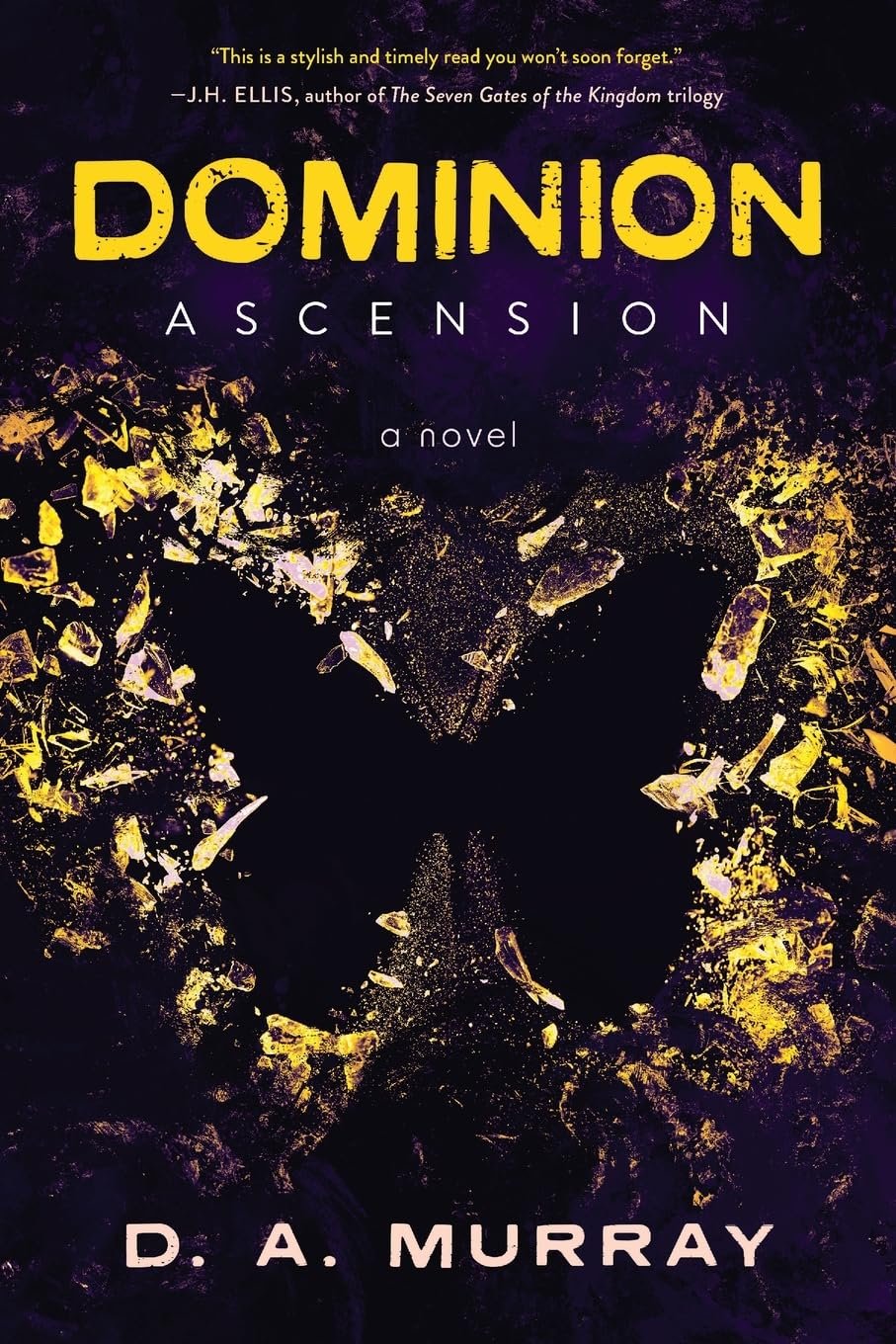
Dominion: Ascension
In a postwar matriarchy that ranks men by reproductive status, reporter Dani Matthews and Breeder Robbie seek an alternative beyond Dominion.
Books worth discovering. Authors worth knowing.
D. A. Murray imagines a society in which gender power has reversed but coercion and inequality have survived intact.
S.
The World After a War Against Bodies
D. A. Murray’s Dominion: Ascension imagines a future built from a global catastrophe and an extreme response to it. After a Great War involving chemical weapons, most men have suffered infertility or cognitive impairment. Women control Dominion’s political, commercial and cultural institutions. Boys undergo a test at twelve to determine their place in a rigid caste hierarchy, while a small group classified as Breeders lives under supervision in a place called the Colony. The system offers itself as order following devastation, but the public synopsis reveals a society in which order is purchased by restricting people’s autonomy. The premise challenges readers to look beyond which gender holds authority and toward the mechanisms through which authority is used.
A straightforward reversal of familiar hierarchies might be content to make men the oppressed group and women the rulers. Murray’s described ambition is sharper. She has said that a change in who holds power does not automatically remove corruption. Dominion’s rules reduce people to functions, build identity around biological classifications and justify control through the promise of stability. Readers are therefore invited to question the design of the entire society, not simply decide which group deserves to take charge. That makes the novel’s speculative background ethically provocative rather than a novelty of switched roles.
At Twelve, a Life Is Assigned
The Illegis examination described in publisher records is particularly unsettling. At an age when children in the reader’s world may just be beginning to imagine different futures, Dominion officially sorts its boys into categories. The test appears to remove uncertainty for those administering the system, but it also narrows individual possibility. That is the essence of bureaucratic dehumanization in dystopian fiction: what is convenient for a state becomes a boundary imposed on a person’s life. The novel’s structure makes that process literal and measurable.
The Breeder caste adds another level of control. Its members possess social importance because their reproductive capacity is scarce, yet the importance does not amount to freedom. They reside in a supervised Colony where reproduction and scientific advancement are tightly managed. This is a revealing distinction. People can be called valuable while being denied agency over their own bodies. Murray’s imagined institutions push that contradiction toward its extreme, asking readers to distinguish a system that praises a person’s utility from one that respects their personhood.
Dani Matthews Looks Behind the Ceremony
Dani Matthews enters the story as an investigative reporter whose family position gives her unusual proximity to power. She is the daughter of a high-ranking official, but proximity does not satisfy her curiosity about the society’s hidden architecture. According to the book’s published description, Dani is determined to investigate Dominion’s darker mechanisms. That role makes sense for a dystopian novel concerned with information. A government that depends on obedience also depends on shaping what people know, what they question and which stories count as legitimate public reality.
The figure of a reporter allows readers to experience the state through an inquiry rather than through a lecture. Dani’s professional interest invites questions about testimony, access, secrecy and the courage to publish inconvenient facts. Her privileged connection to authority may open doors that are closed to ordinary citizens, but it may also raise the personal cost of dissent. The synopsis establishes her determination; it does not reveal every piece of evidence she uncovers. That gradual discovery is part of the novel’s intended reading experience.
Robbie and the Memory of Another Life
At the national Ascension celebration, Dani reconnects with Robbie, her childhood best friend, who has been assigned to the Breeder caste. The reunion puts a familiar person inside a system of abstract categories. Robbie is not simply an example on a political chart; he is someone Dani knew before the state defined his adult role. That difference between remembered identity and imposed status offers the premise a strong emotional center. Whatever the rules say about his place in Dominion, their earlier relationship suggests a fuller human history.
As the two move toward an uncertain future together, the book combines its political investigation with a developing personal bond. The publisher’s synopsis identifies love as part of their story, but a feature need not turn that into promises about particular scenes or an uncomplicated happy ending. Romance in a restrictive society carries special ethical weight. The ability to choose a partner, share a home or plan a future is not just private sentiment when the state has reserved power over bodies and reproduction. Dani and Robbie’s connection therefore becomes a challenge to Dominion’s basic assumptions.
The Search for Haven
Haven is described as a refuge for escaped Breeders, and Dani and Robbie set out to find it. A named safe place is a powerful device in a dystopia. It gives resistance a destination, not simply an abstract wish. Yet the route from an authoritarian society to somewhere outside its control is rarely straightforward. The public account suggests a difficult journey and further trials called the Becoming. Those details establish danger without telling readers how the protagonists navigate every obstacle. The possibility that failure could mean death gives Haven both hope and a troubling uncertainty.
The title Ascension can also be read in relation to the state celebration that brings the protagonists together. A public ceremony may signal unity and progress to those organizing it, even as people subjected to the system experience the event differently. The coexistence of spectacle and hidden coercion is a hallmark of persuasive dystopian world-building. Readers learn not to accept official language at face value. A society’s vocabulary of harmony, security or advancement may conceal arrangements that serve a narrower class of beneficiaries.
Systems of Control, Not a Simple Gender Fable
Murray’s public statements frame Dominion as an examination of how power reproduces itself under changing rulers. That intention matters because the premise could easily be misunderstood as saying that one gender is inherently suited or unsuited to leadership. The stronger interpretation examines the combination of surveillance, coercion, biological classification and unchecked authority. The fictional system is unjust because it assigns rights according to manufactured social categories, not because power sits in a particular set of hands.
The author has a professional background in technology, and her launch materials discuss the role of data and engineered social compliance in the imagined world. Such details place the book within a tradition of speculative fiction that asks how tools promising efficiency can become instruments of exclusion. An algorithm cannot remove moral responsibility from those who choose its objectives. A test is not inherently fair because it produces a clear result. The book’s world invites readers to look at who defines success, who controls exceptions and who is unable to challenge a decision once made.
The Personal Story Within the Political Argument
World-building becomes compelling when large abstractions change particular lives. Dominion’s caste hierarchy matters to Robbie’s body and freedom; the regime’s secrecy matters to Dani’s investigation; the hope of Haven matters to their ability to imagine a future outside official rules. The characters give the reader a way to consider a political order from multiple angles: the child of authority, the person classified by it, and the relationship that crosses those positions. Their journey may include action and romance, but neither element operates in isolation from the institutions governing the world.
The novel also leaves room for discomfort. Readers may reject Dominion’s methods while recognizing familiar temptations behind them: the wish to eliminate uncertainty, assign people to functions and entrust complicated decisions to a system that claims to know best. Good dystopian fiction exaggerates such tendencies without requiring them to match current conditions exactly. Murray asks what happens when a society presents human difference as a problem to be managed rather than an aspect of personhood to be respected.
For Readers Willing to Question the Rules
Dominion: Ascension is likely to interest readers who enjoy speculative systems with detailed social rules, resistance narratives and romance that carries genuine political consequences. Its publisher synopsis identifies the essential framework: postwar transformation, gendered power, caste examinations, a controlled Colony, Dani’s investigation and Robbie’s escape toward Haven. It would be misleading to pretend that these facts reveal the novel’s complete philosophy or final outcome. What they do is establish a provocative setting in which loyalty, freedom and survival cannot be separated.
At the heart of Murray’s story is a question that outlasts any fictional regime: what makes a society legitimate when it is capable of organizing almost everything except consent? Dani and Robbie’s connection suggests that individual recognition can become a form of resistance. The novel asks readers to examine the structures surrounding them, not merely the faces at their summit. In a world obsessed with defining human worth through assigned roles, seeking Haven becomes an insistence that a person can be more than the state’s definition.
About the book.
After chemical warfare, most men are infertile or cognitively impaired. Dominion assigns boys to castes after an Illegis test at twelve; Breeders live in a controlled Colony. Dani Matthews, daughter of a high-ranking official, reconnects with childhood friend Robbie, a Breeder, and together they seek Haven.
Sponsored book feature. Research-based commentary from named public sources, not a first-hand complete-book review. The cover placeholder will be resolved by the owner’s publishing automation.
Found a book worth opening?
Books worth discovering. Authors worth knowing.
Return to the Journal →