
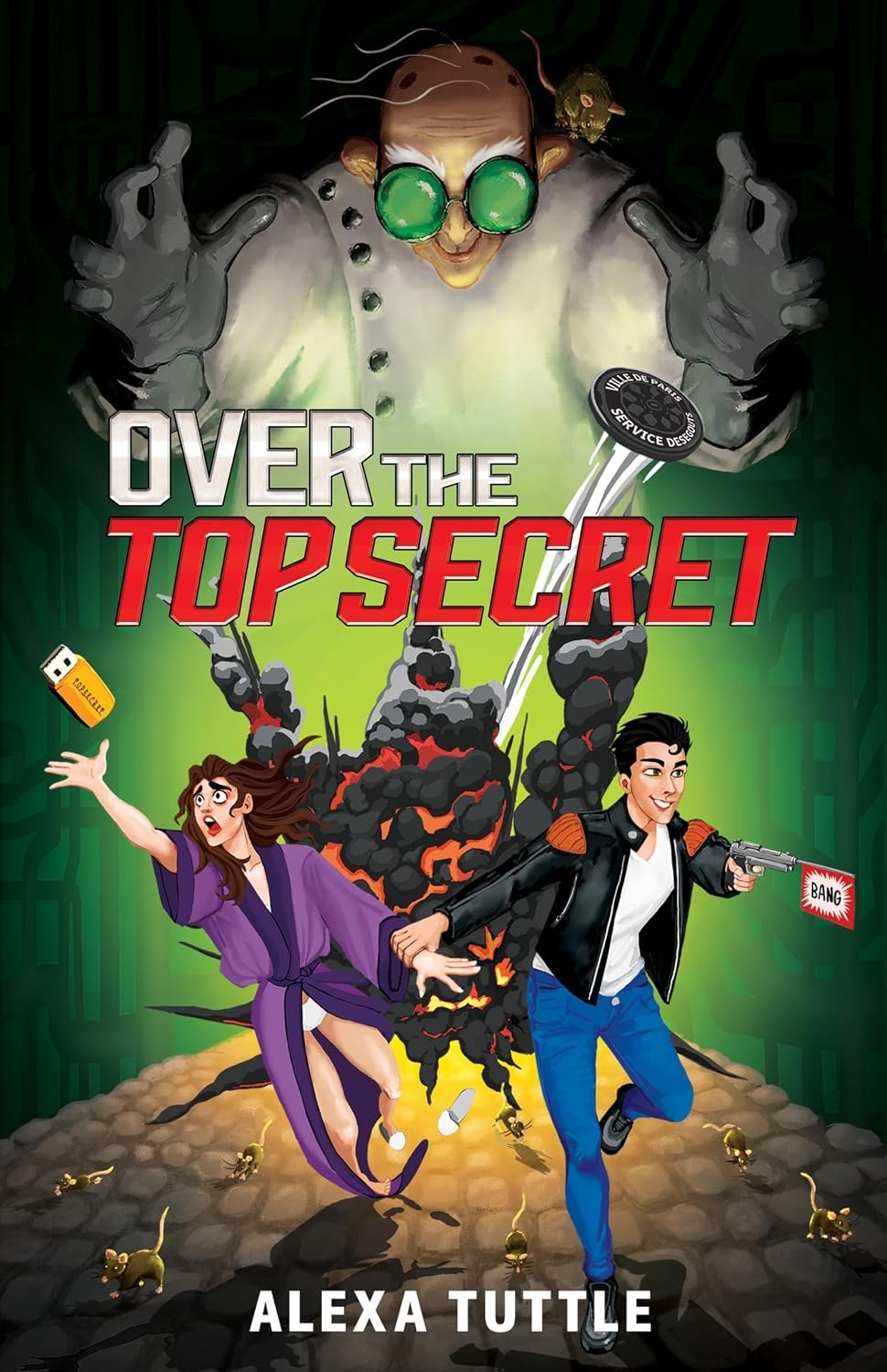
Over the Top Secret
College high achiever Julie Richardson accidentally triggers a government experiment and becomes an improbable secret agent.
Books worth discovering. Authors worth knowing.
Julie Richardson wanted academic success, not a gold thumb drive, Paris sewers and spies treating her brain like classified property.
S.
Julie Richardson Did Not Apply for This Assignment
Alexa Tuttle’s Over the Top Secret has the pace of an espionage thriller and the attitude of someone who refuses to take the machinery of espionage entirely seriously. Its heroine, Julie Richardson, is introduced as a high-achieving college student with ordinary academic worries. Then a disastrous encounter with a government experiment turns her into a valuable and vulnerable repository of classified information. Instead of worrying mainly about grades and graduation, she faces pursuers, dangerous authorities and a mission involving a golden thumb drive. Her predicament is absurd, but the consequences inside the story are anything but comfortable.
The title announces a parody before the first mission begins. Espionage stories traditionally celebrate gadgets, codes, disguises and protagonists who seem born to handle them. Julie has no such preparation. She is intelligent and capable, but being intelligent does not mean knowing how to escape a manhunt or navigate an organization’s competing agendas. The comedy comes partly from that mismatch. Readers are invited to recognize a familiar action-thriller structure while enjoying the irritation and confusion of a person who would rather be somewhere entirely different.
From GPA to Classified Data
One of the cleverest elements of the published synopsis is its use of academic ambition as a character baseline. Julie cares about performance, grades and a future she has planned carefully. The experiment overturns those metrics overnight. Her new circumstances cannot be solved by studying harder for a test. The world of secret intelligence rewards different forms of improvisation, skepticism and luck. That change gives a comedic adventure more than a string of jokes: it strips a character of the reliable system in which she once knew how to succeed.
The premise also plays with the idea of a person as an information source. Julie has become wanted not simply for what she has done but for what she now carries or represents. The official description makes clear that both villains and alleged allies are interested in her, and some of those supposed allies are willing to treat her as an experiment. This complicates the traditional distinction between good agents and bad agents. A person with information may be valuable while feeling powerless. Julie’s predicament turns the glamorous spy fantasy into a story about a woman who badly wants ownership of her own life.
Paris Sewers and the Art of Escalation
The book’s promotional description includes a vivid image: Julie racing through the sewers of Paris after a golden thumb drive while trying to stop a destructive scheme. The detail sounds deliberately cinematic. Paris provides a city associated with elegance and romance; the sewers offer precisely the opposite sensory environment. Putting an inexperienced operative underground is a convenient way to puncture the style of a glossy international mission. It is a setup that allows danger and ridicule to occupy the same frame.
Fast-moving comic adventure depends on escalation. A protagonist confronted with a problem can make a reasonable choice and still find everything getting worse. Julie’s earlier priorities seem increasingly remote as the action expands. The source material establishes the thumb drive and a mission, but not a trustworthy account of every maneuver or solution. Readers can enjoy the promise of outsize set pieces without being told how the sequence unfolds. The most interesting question is not whether Julie can become a conventional action hero; it is how she responds when none of her previous methods seems appropriate.
The Spy Who Is Not Quite a Comfort
Julie is accompanied by a highly attractive but self-absorbed spy, according to the public synopsis. The pairing works as a comic device because he seems to possess exactly the glamorous expertise she lacks—and precisely the personality traits likely to annoy her. In a straight thriller, an experienced agent may exist to reassure the protagonist and demonstrate competence. In a comedy, that same figure can become one more difficulty to manage. A person who knows how to use spy tools is not automatically good at listening to someone else’s fears or preferences.
Tuttle’s published prologue places Julie’s voice front and center as she fumbles through an attempt to record a mission account. The scene’s humor arises from self-consciousness and irritation, not from an effortless hero persona. It helps explain why the spy partnership can sustain tension even outside physical danger. Julie wants information and autonomy; the agent may prefer speed, authority or his own interpretation of events. The book’s genre suggests banter and friction, but this feature does not invent a romance arc beyond what the sources actually provide.
The Institution Behind the Acronym
T.O.P.S.E.C.R.E.T. is an intentionally ridiculous organization name, and the acronym is part of the joke. Spy fiction often uses official abbreviations to lend authority to institutions whose inner workings remain conveniently vague. Tuttle exaggerates that habit, inviting the reader to laugh at the performance of secrecy itself. The agency can still present a genuine danger within the fiction, particularly when bureaucratic actors treat Julie’s altered circumstances as something to exploit. The contrast between bureaucratic certainty and a baffled heroine offers an enduring source of comedy.
There is a wider satirical possibility here. Organizations that claim extraordinary knowledge may make poor moral decisions precisely because they believe their expertise excuses them from listening. Julie’s predicament suggests that experts and officials do not necessarily understand the person in front of them. The story does not have to become solemn to raise that question. Comic exaggeration can make institutional arrogance visible by pushing its habits just beyond plausibility. That is part of the pleasure of a spy parody with a protagonist who is clever but unwilling to defer automatically to the professionals.
The Serial Roots of a Fast Adventure
Tuttle published Over the Top Secret in serialized form through her newsletter, The Giggler. The author-hosted index lists a prologue, chapters and an epilogue with playfully titled installments. That history offers helpful context for the novel’s tone and rhythm: readers could encounter Julie’s mishaps in discrete comic-adventure episodes. It does not establish that every edition preserves precisely the same layout, but it confirms the author’s public involvement with the material. Her website also describes work in filmmaking, directing and writing across different formats.
That screen-oriented background fits the premise’s affection for visual set pieces, elaborate villains and action-comedy references. Tuttle reports recognition for the book in a comedy category at the Killer Nashville Silver Falchion Awards. Such awards are useful context, but the stronger evidence of the book’s character is the author’s own description and original published chapter. A sample allows readers to judge whether Julie’s irreverent voice suits them, which is more valuable than a feature promising everyone will laugh at every page.
For Readers Who Like Their Spies Unprepared
Over the Top Secret appears tailor-made for readers who enjoy frantic mysteries, mistaken authority and protagonists with enough intelligence to recognize how ridiculous their situation has become. It borrows action-thriller machinery but does not demand a solemn attitude toward it. The ordinary concern for a college future provides an emotional anchor: Julie has something specific she wants back. The government experiment, the international pursuit and the self-impressed spy keep making that apparently simple goal harder.
The result is a promising collision between scale and temperament. The mission is enormous; the heroine would prefer a smaller problem. The institutions are powerful; their claims of competence are questionable. The danger is genuine within the story; the presentation remains irreverent. Tuttle’s sources support that combination clearly, and they leave the best questions unanswered. Can Julie preserve her independence while everyone else claims to know what should happen to her? The answer should be discovered amid the book’s actual misadventures, not supplied by a premature recap.
About the book.
Julie accidentally activates an experiment, becoming a prized source of intelligence. Pursued by villains and dubious authorities, she is pushed into a mission with a handsome, self-regarding spy to retrieve a golden thumb drive and keep a dangerous scheme from succeeding.
Editorial book feature, not paid sponsorship. Research-based commentary from named public sources, not a first-hand complete-book review. The cover placeholder will be resolved by the owner’s publishing automation.
Found a book worth opening?
Books worth discovering. Authors worth knowing.
Return to the Journal →