
Universal War for All Creation
An illustrated work with a cosmic title invites questions about realities, conflict and creation; its interior remains unverified.
Books worth discovering. Authors worth knowing.
The title promises a scale of conflict stretching beyond one place or era, but a responsible introduction must also acknowledge what has not been independently described.
S.
A Title Built on an Extraordinary Scale
Universal War for All Creation: Phantoms…Alternate…Between arrives with an unusually expansive title and an unusually narrow public record. The source listing identifies Sasha V. Perera as author and Muhammad Waqas as illustrator, but it does not provide enough independently accessible narrative detail to identify protagonists, trace events or promise a particular ending. That distinction matters. A feature can invite curiosity about the imagery and questions suggested by a work’s presentation, but it should never pretend that speculation is a verified account of pages the writer has not seen.
The phrase “universal war” gives the imagination a scale beyond a familiar border dispute. It suggests the possibility of competing worlds, values or cosmic structures, while “all creation” expands that sense of consequence. These are readings of the title’s language, not confirmed story elements. They establish the kind of question a potential reader might bring to the listing: what happens when a conflict is described as affecting everything that exists? The answer could be literal, symbolic, philosophical or something else entirely. Without the text, the answer remains appropriately open.
Even the title’s punctuation creates an intriguing reading experience. The three words “Phantoms,” “Alternate,” and “Between,” interrupted by ellipses, feel like signposts separated by unspoken transitions. A phantom can be understood as an apparition, a memory or something whose presence is difficult to fix. An alternate points toward variation; between describes a threshold. None of those meanings proves that this particular book contains ghosts, parallel worlds or travel between dimensions. They simply show how much possibility can be packed into a few carefully chosen terms.
Reading the Promise Without Inventing the Plot
When a book has little accessible publicity, the temptation is to turn its title into a ready-made synopsis. That is especially hazardous with ambitious speculative vocabulary. It would be easy to invent a galactic empire, secret order or war between timelines. Yet no accessible corroborated description establishes such a cast or setting here. The responsible alternative is to discuss the reader’s expectations and the questions a fuller description would answer. Does the conflict exist within a constructed universe, within personal belief, or across multiple narrative layers? Each possibility suggests a different kind of experience; none should be advertised as fact.
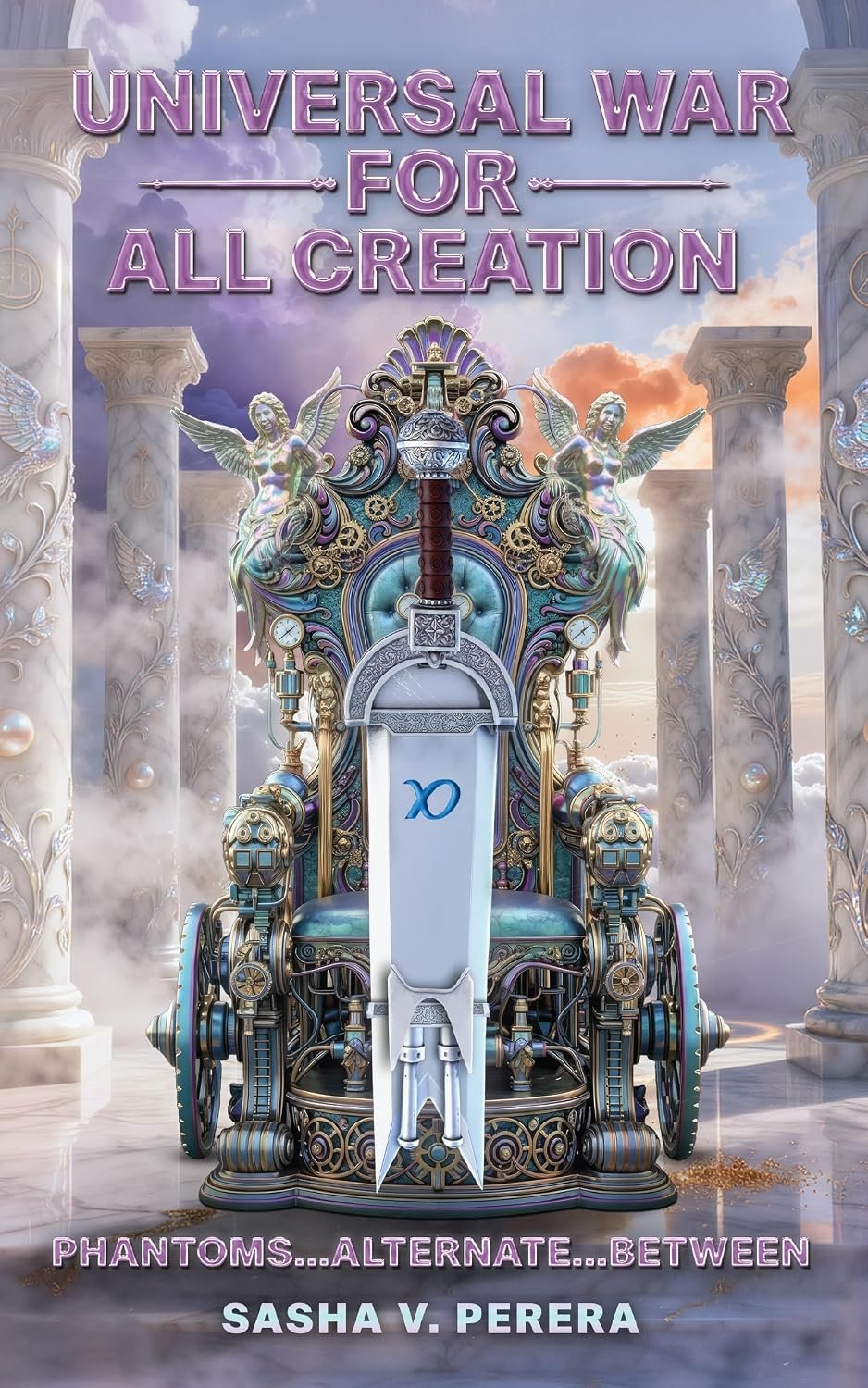
The book is credited as illustrated, an important distinction that changes how one might approach the edition. Illustration can do many kinds of work. It can depict characters, clarify an invented geography, establish mood, interrupt prose or offer a parallel visual interpretation. The listing identifies Muhammad Waqas in that role; it does not establish the number, medium, placement or content of the images. Readers who value illustrated storytelling may be interested, but should confirm the actual format and sample pages through the linked retailer before assuming this is a graphic novel or an image-heavy volume.
Titles with cosmic scope often create a productive tension between vastness and intimacy. In fiction generally, an enormous conflict has emotional force only when the reader can understand why it matters to someone. The same principle applies to a philosophical work: abstractions become compelling when linked to a recognizable problem. This is a critical lens a reader can bring to Universal War for All Creation, not a claim about its execution. A prospective reader might look for a sample that reveals whose viewpoint anchors the material, and whether the illustrations provide an additional center of attention.
What the Words Can Ask of a Reader
Consider the word “creation.” It is broad enough to describe a universe, an artistic act or a worldview. Joined to “war,” it invites an ethical question: what would be worth defending if the object at risk were not simply a territory but the possibility of making new things? This question is an editorial extrapolation. It might help explain why the title catches the eye of readers interested in speculative thought, but it cannot substitute for the author’s actual argument. The distinction between inviting a question and supplying an answer is central to trustworthy book journalism.
“Phantoms” is similarly resonant without being definitive. In the wider vocabulary of literature, phantoms frequently give shape to something unresolved: a fear, a legacy, a person absent from ordinary sight. In other contexts the word refers to apparitions as concrete imagined entities. The cover and product sample, rather than the name alone, would be the right evidence for deciding how it operates here. A responsible feature leaves room for readers to discover whether the author uses the term literally, metaphorically or in some unforeseen manner.
The word “alternate” perhaps raises the most practical question about narrative design. Alternation can occur through setting, perspective, chronology or visual form. Two points of view can make a conflict more complex; an illustrated sequence can interrupt a verbal narrative; a philosophical discussion can move between competing claims. This title does not tell us which, if any, of these methods Perera adopts. It suggests a field of possible reading experiences. That openness may be intriguing, but it also makes a verified sample more valuable than a confident invented pitch.
“Between” emphasizes the space that conventional categories miss. Borders between worlds, states of mind, communities or versions of a story have long served as fertile ground for writers. Here it is a word in an official title, and its interpretive appeal is worth noting without attaching fictional events to it. Readers might ask what is being separated, who is able to cross a threshold, and who must remain on one side. Those are helpful questions to take into a first chapter, not an account of what readers will necessarily find.
The Importance of Illustration and Edition Details
A named illustrator often signals deliberate creative collaboration, but the relationship between words and images can vary enormously. Illustrations may be integrated into the storytelling or appear as occasional decorative elements. They may have been commissioned specifically for the book or supplied in another way. The public metadata confirms Waqas’s credit and little beyond it. A book feature should give that work visible acknowledgement while avoiding unsupported claims about visual style. The detail is especially important to anyone purchasing an edition for its artistic presentation.
Edition verification also matters when a listing has a distinctive subtitle. Product pages sometimes shorten titles, reposition subtitles or display slightly different editions. For this feature, the queue’s full title and the exact linked book URL are retained in the detailed record, while the public headline uses the shorter principal title for clarity. That is an editorial formatting decision, not a change to the source’s attribution. The prospective buyer can compare the linked edition with whatever sample or cover images are available before making a choice.
There is a broader discovery problem here. Independent books often appear in retail catalogues before they develop an extensive trail of interviews, reviews, publisher descriptions or library records. Lack of a synopsis in accessible sources is not evidence that the work lacks substance. Nor is it permission to describe a substance that has not been confirmed. A small amount of precise bibliographic information can be more respectful to both creator and reader than a long collection of invented plot points dressed up as certainty.
A Considered Invitation to Explore
Readers most attracted to this listing may be those who enjoy bold titles, illustrated books and speculative possibilities whose exact shape is not immediately disclosed. The safest expectation is curiosity, rather than a promise of a familiar subgenre. Someone looking specifically for space opera, paranormal horror, theological allegory or alternate-history fiction should seek an official description or preview before assuming that any of those labels applies. The title’s imagination is evident; its precise narrative architecture remains unverified in the accessible record.
The distinction is worth preserving because it leaves the book free to speak in its own terms. Once a sample becomes available, the strongest follow-up questions will be concrete ones: who is speaking, what is at stake, how are the illustrations used, and how do the three elliptical terms relate to the main title? A reader can approach the edition with those questions without being promised invented answers. This is a spotlight on a discoverable book and its credited creators, not an assessment of an unseen complete text.
Universal War for All Creation offers an evocative invitation through its title and creative credits. For now, the most useful editorial service is transparent: name Sasha V. Perera and Muhammad Waqas accurately, preserve the linked edition, distinguish interpretation from evidence, and encourage confirmation of the actual contents. That restraint is not a lack of interest. It is the foundation for engaging seriously with work that has not yet left a sufficiently detailed public research trail.
About the book.
The queue identifies the English edition, full title, Sasha V. Perera as author and Muhammad Waqas as illustrator. No independently verifiable plot outline, cast, or genre-specific details were located; this feature is a limited-source thematic spotlight rather than a synopsis.
Editorial book feature, not paid sponsorship. Research-based commentary from named public sources, not a first-hand complete-book review. Limited-source spotlight; plot, genre and interior material were not independently verified. Editorial approval is required. The cover placeholder will be resolved by the owner’s publishing automation.
Found a book worth opening?
Books worth discovering. Authors worth knowing.
Return to the Journal →