
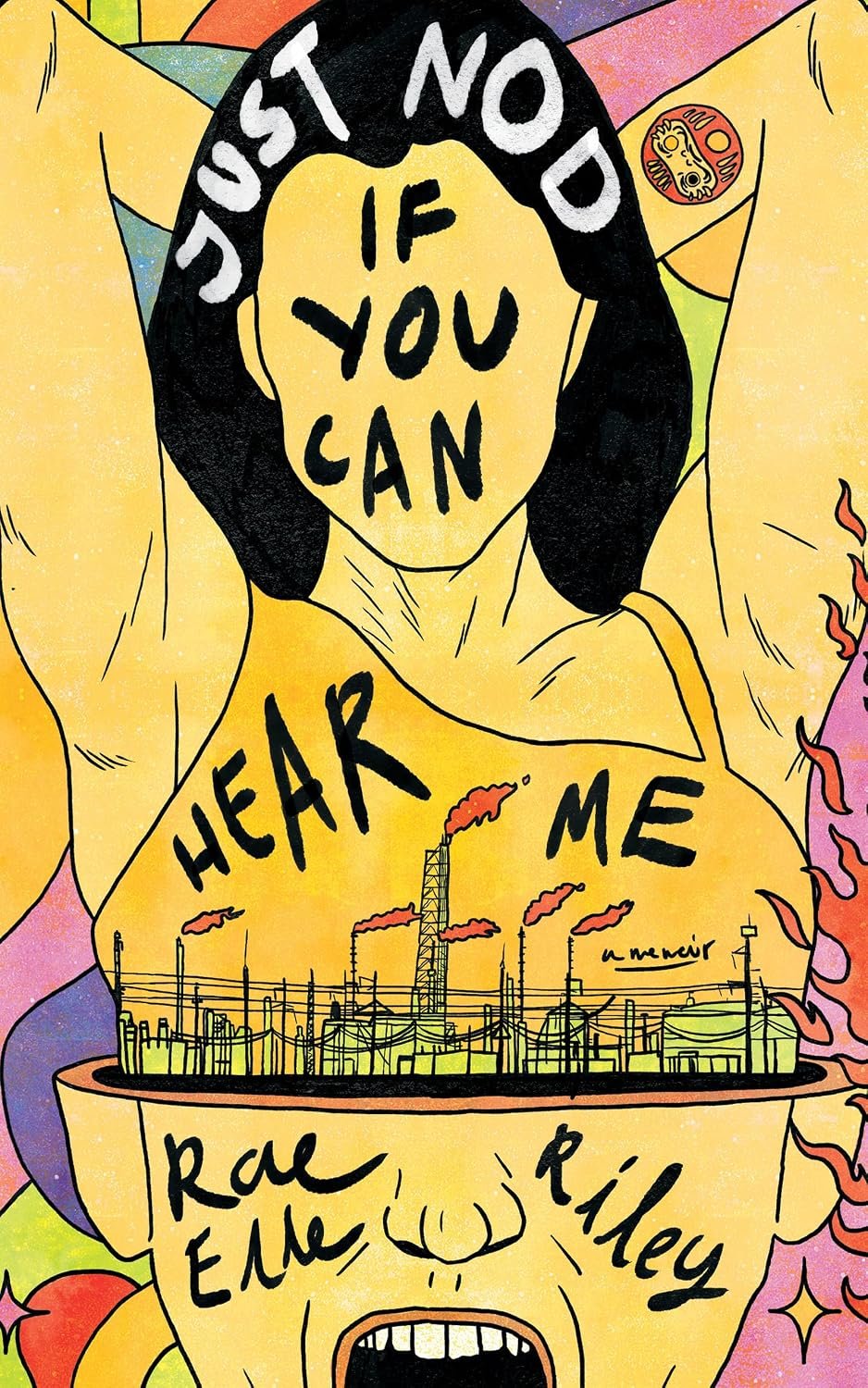
Just Nod If You Can Hear Me
A union steamfitter confronts addiction, trans identity and the cost of being recognized beyond an old public persona.
Books worth discovering. Authors worth knowing.
Rae Elle Riley begins with the hard surfaces of industrial work and a life known to others as Chuck Keiran, then turns toward what it takes to be seen as herself.
S.
The Person Beneath a Familiar Name
In Just Nod If You Can Hear Me, Rae Elle Riley places a difficult question at the center of her memoir: what happens when a name, a job and a reputation have become a protective shell that no longer fits the person living inside? The publisher’s description introduces Chuck Keiran, a union steamfitter shaped by demanding industrial work and personal anguish. It then discloses the central truth behind that public identity: Chuck is Rae, a transgender woman struggling to survive both her own destructive habits and the rejection she anticipates from a world that thought it knew her.
The title carries a plea for recognition without demanding a perfect response. A nod can mean that someone has heard, even when there is no immediate agreement or solution. Within the memoir’s documented context, that image resonates with the difficulty of asking others to recognize an identity they have not previously seen. It also shifts the focus from a single declaration to the sustained work of being understood. Identity is not simply announced once and then protected from all future conflict; it exists in workplaces, friendships, families and the memories other people hold.
Riley’s occupational background is unusually specific and important. Steamfitting is physically demanding industrial labor, and the published author biography identifies her as a veteran union tradesperson. The memoir’s language, according to that material, mixes blue-collar idiom with an expressive literary cadence. That combination resists the idea that working-class experience and elaborate prose belong in separate categories. An industrial setting can supply its own vocabulary of pressure, precision, danger and endurance, and a writer who has lived in that environment can draw on it without giving up tenderness or poetic intensity.
Survival Is Not the Same as Being Seen
The book’s description is candid about alcohol and drugs as part of Rae’s struggle. Those facts should not be turned into a simple redemption formula. Substance use, social stigma and questions of gender identity are different experiences, even when they intersect in an individual’s life. Riley’s memoir presents the burden of all three through a highly personal voice. A sensitive introduction should avoid suggesting that trans identity caused addiction, that sobriety alone resolves prejudice or that any one person’s course is a model for everyone else. The value of a memoir lies partly in its irreducible specificity.
A working-class antihero is an interesting frame for a life story because it acknowledges contradiction. An antihero can be wounded, difficult, resourceful, angry and sympathetic at once. The public synopsis does not advertise an idealized past; instead, it introduces someone who has survived by improvising under immense pressure. For a reader, that may be more revealing than a tidy before-and-after narrative. People do not always make wise choices when under strain, and the consequences of those choices can remain even after they begin to change.
There is also a painful difference between being accepted for a role and being accepted as a person. The earlier public persona was legible to coworkers and acquaintances within a familiar social world. Rae’s emergence challenges that established account. The publisher describes abuse and scorn from people who once loved Chuck and now resist the woman they are asked to recognize. This is not merely a story of internal courage. It asks what responsibility communities have when someone they know reveals a truth they did not expect, and how the person making that revelation can protect herself.
The Voice of a Worker and a Writer
Riley’s biography emphasizes a longstanding love of ambitious prose as well as technical work. The promised combination of gritty realism and musical language is worth approaching as a deliberate artistic tension. Industrial spaces are full of harsh sounds, machinery and exacting practical demands. Literary prose makes room for memory, private associations and questions that cannot be measured with tools. In a memoir, those registers can coexist because an individual life is never confined to the language of an occupation. A reader interested in voice may find the juxtaposition as compelling as the biographical subject.
Memoir depends on the relationship between remembered experience and the perspective of the person telling it now. The author knows something at the time of writing that the younger self did not know how to express. This allows a life story to move between urgency and reflection: a past moment can be narrated with its original fear while also being reconsidered through the clarity of hindsight. That framework is useful for understanding why a title that asks whether someone can hear also implies a second question: could the person herself hear the truth she was trying to articulate?
The publisher calls the work a memoir, so the central material is presented as autobiographical. This does not authorize readers to infer details of Riley’s private relationships, medical history or personal decisions that the available synopsis does not mention. Nor does it require a reader to treat the public author description as a complete account of the book’s tone. It is fair to notice the energy of the marketed language and its emphasis on literary style. It is not fair to invent dialogue, scenes from the worksite or a specific climactic encounter merely because they would suit that mood.
Community, Masculinity and the Cost of Change
The trades setting makes questions about gender roles particularly visible. An occupational culture can generate genuine solidarity among people who depend on one another for safety and competence, yet it can also maintain narrow assumptions about how a person should speak, move or identify. Both possibilities can coexist. The published synopsis emphasizes the social pressure Riley faces, but it does not establish every coworker’s reaction. A thoughtful reading should keep the focus on the conflict described without making categorical claims about an entire profession or union culture.
Memoirs of transition and recognition frequently challenge the expectation that their authors provide a neat educational lesson for outsiders. Riley’s story, as publicly described, seems less interested in offering an abstract explanation of gender than in conveying what it feels like to keep living when social acceptance is uncertain. That may ask more from readers than a clear moral statement. It requires attention to anger, exhaustion, awkwardness and imperfect coping alongside courage. Compassion need not mean pretending those difficult feelings are absent.
The imagery of being pushed down and standing up, present in publisher copy, conveys an active struggle against external and internal forces. Yet resilience should not become an excuse to demand endless endurance from people facing abuse. The more interesting question is what forms of support allow a person to live without constant defensive effort. A memoir can help readers notice the difference between praising someone’s survival and removing the conditions that make survival so costly. Riley’s personal testimony enters that wider conversation without becoming a universal prescription.
Who May Find This Memoir Meaningful
Readers drawn to blue-collar writing, LGBTQ+ memoir, difficult recovery narratives or highly expressive personal prose have several grounded reasons to consider Just Nod If You Can Hear Me. The publisher identifies the book’s themes clearly and gives prospective readers an indication of intensity. Those anticipating a light inspirational story should know that the disclosed subject matter includes addiction, rejection and abuse. These are not decorative obstacles. They are central features of the advertised life story and deserve careful treatment in any recommendation.
Another point of interest is the memoir’s refusal, at least in its public description, to split literary ambition from everyday work. The author writes from a world of tools, labor and endurance while pursuing a form that values rhythm and emotional exposure. Readers who appreciate memoirs with a forceful voice rather than a detached explanatory tone may find this combination particularly inviting. The important editorial qualification is that these expectations come from publisher and author biographies, not an independently verified reading of every chapter.
At its most direct, Riley’s book asks for the dignity of recognition. The person others have always named is not necessarily the whole person they have known. Through a specific working life and a history of survival, Just Nod If You Can Hear Me promises an account of that difficult distance. It is a memoir to approach with care for its subject, interest in its prose and an awareness that the right to be heard is different from the obligation to make other people comfortable.
About the book.
Publisher copy describes a steamfitter known as Chuck Keiran, whose outward persona concealed Rae, a transgender woman. The memoir describes pressure from alcohol, drugs, work culture, exclusion and her pursuit of an honest life.
Editorial book feature, not paid sponsorship. Research-based commentary from named public sources, not a first-hand complete-book review. The cover placeholder will be resolved by the owner’s publishing automation.
Found a book worth opening?
Books worth discovering. Authors worth knowing.
Return to the Journal →