
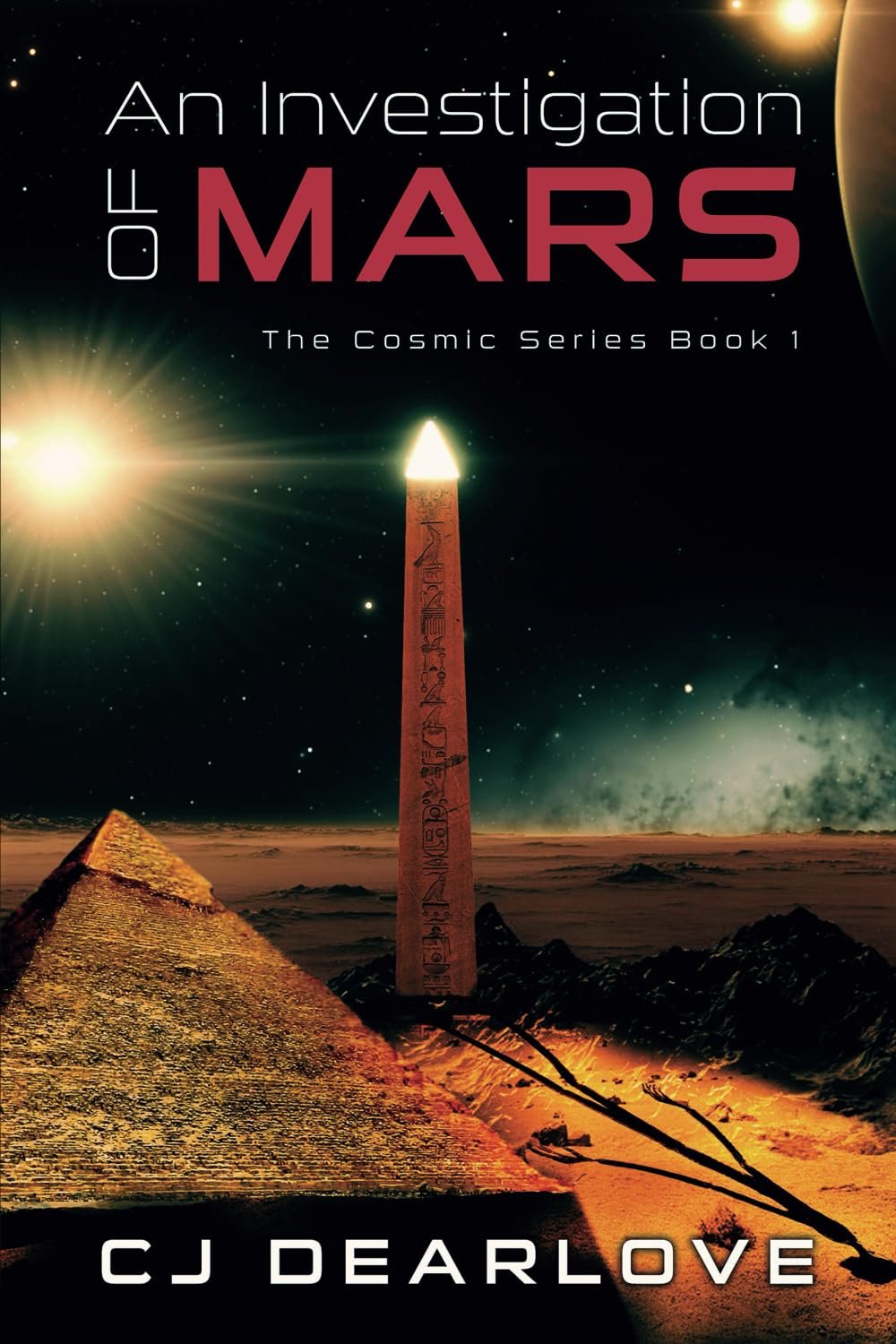
An Investigation of Mars
Tomi Newton enters a classified remote-viewing project and begins to question the boundaries of mind, history and reality.
Books worth discovering. Authors worth knowing.
A classified experiment becomes the beginning of Tomi Newton’s confrontation with realities she never expected to investigate.
S.
A Classified Door into an Unfamiliar World
CJ Dearlove begins An Investigation of Mars: A Cosmic Novel with a recognizable speculative-thriller proposition: ordinary reality may be much narrower than people think. Tomi Newton encounters a classified program examining the alleged ability to gather information without normal physical access to a place. The technique is called remote viewing, and within Dearlove’s fictional premise it becomes the threshold to a wider mystery. What begins as an experiment draws Tomi into questions about consciousness, extraterrestrial life and an unresolved personal history, including the absence of her grandmother.
The protagonist’s name and the book’s title suggest an adventure pointed outward, but the published synopsis makes its internal consequences equally important. Tomi’s changing understanding of the world threatens familiar relationships. New information does not simply make her more capable; it unsettles the beliefs through which she has organized her life. This is a strong foundation for speculative fiction. A story about discoveries that leave the discoverer unchanged may provide spectacle, but one that forces a person to reevaluate trust and belonging has room for more complicated stakes.
The author describes the novel as a blend of science-fiction suspense, paranormal ideas and philosophical inquiry. This description is a map of interests, not a license to treat the book’s speculative claims as science. Remote viewing has a history of investigation and controversy, but its presentation as an effective mechanism in a novel remains a fictional premise. Likewise, UFO accounts and reincarnation traditions may inspire narrative possibilities without establishing particular events as factual. Dearlove’s own reader’s guide explicitly calls the work fiction and distinguishes it from the materials that shaped it.
Tomi Newton and the Price of Curiosity
The public description shows Tomi becoming involved in an inquiry much larger than she anticipated. This changes the familiar investigator figure. Instead of merely collecting evidence from outside a phenomenon, she participates in the process of exploration herself. The boundary between observer and observed becomes unstable. A reader can therefore ask not only what Tomi learns but how her methods of knowing change. The mystery does not arrive in the form of an isolated object; it challenges the tools by which she decides whether an experience is real.
Her friends are involved in the discoveries, according to the author’s synopsis. That ensemble matters because a startling private claim behaves differently when several people try to understand it together. Groups can offer mutual support, but they can also amplify confusion and disagreement. The precise nature of those exchanges belongs to the novel and should not be invented here. What the premise establishes is that Tomi’s revelations occur within relationships rather than an empty laboratory, providing a way for cosmic possibilities to carry human consequences.
The missing grandmother is a particularly effective element in the advertised mystery. A family absence is intimate, concrete and emotionally legible, even when the setting becomes grand. The synopsis identifies that unresolved history as something haunting Tomi’s decisions; it does not disclose the answer. Readers can approach the book knowing that the search for cosmic meaning has a personal thread. The best mysteries allow such threads to exert pressure without turning every clue into a promise of a particular twist. Protecting that ambiguity makes room for discovery.
The Attraction of Unanswered Cosmic Questions
Mars occupies a special place in speculative imagination. It is a real neighboring planet and a symbolic frontier for stories about life beyond Earth. Naming it in a work about consciousness and hidden information creates a meeting point between measurable astronomy and far-reaching conjecture. Dearlove’s title does not mean the book offers a scientific investigation of Mars in the conventional sense. It is a cosmic novel, and the author’s description foregrounds Tomi’s encounters with extraordinary claims rather than a technical survey of planetary geology.
The author cites declassified documents, accounts from experiencers, spiritual traditions and theories as part of the inspiration. These sources vary widely in their evidentiary status. A declassified document demonstrates that an institution recorded or investigated a subject; it does not necessarily establish that every extraordinary interpretation in that record is true. Spiritual traditions carry their own cultural and experiential significance, while scientific claims require separate standards of testing. The novel can use all of them imaginatively, but a responsible book feature should not collapse their distinctions into one category labeled fact.
This tension can become a pleasure of reading rather than a problem to be solved by the reviewer. Fiction is a place to entertain “what if” questions provisionally. What if the mind could perceive beyond ordinary sensory limits? What if inherited stories of the cosmos reflected hidden connections? What if the strongest challenge to a person’s worldview came from a missing family member? The book’s public synopsis supplies those lines of inquiry without requiring the reader to accept any literal paranormal explanation outside the narrative.
How the Series Balances Scope and Continuity
An Investigation of Mars opens the Cosmic Series, according to the official author site. Series fiction must accomplish two things at once: give the first installment a meaningful shape and create a world with unfinished possibilities. The entry point appears to be Tomi’s introduction to the clandestine program. From there, the thematic canvas widens to mythology, consciousness and nonhuman possibilities. A prospective reader should therefore expect a beginning rather than a self-contained scientific essay. The narrative engine is mystery, carried forward by both personal stakes and cosmic curiosity.
Dearlove has also published a companion reader’s guide explaining inspirations by chapter, with a warning that it may contain spoilers. That is a useful resource for someone who wants to investigate the materials behind the fiction after reading. It can also illustrate how thoroughly a novelist has drawn from disparate traditions. The careful sequence is to experience the novel on its terms first, then use the guide to examine which outside references influenced individual scenes. Doing the reverse might reveal surprises or blur the distinction between fictional development and the author’s supporting notes.
The presence of an explanatory guide distinguishes this project from purely impressionistic space adventure. Readers are invited to continue exploring the references, yet the author marks a boundary between inspiration and verification. That is a productive model for responsible curiosity. A novel may ask enormous questions without providing settled empirical answers. Its artistic success, for each reader, will depend less on proving speculative ideas than on making Tomi’s experiences engaging and the emotional consequences intelligible.
A Story for the Cosmically Curious
Readers interested in secret-program thrillers, reality-bending science fiction, family mysteries or philosophical adventure have direct reasons to look at An Investigation of Mars. The official synopsis makes its combination explicit: clandestine research, unusual perceptual claims, UFO lore and Tomi’s missing grandmother all form part of the premise. Those looking for conventional hard science fiction grounded strictly in tested technology should approach it with the different expectations appropriate to paranormal speculation. Neither preference is superior; they simply ask for different narrative contracts.
What distinguishes this particular entry in its public presentation is the way cosmic questions turn inward. Tomi’s investigation asks what can be known, but it also asks what a person can endure when the foundation of familiar knowledge shifts. Relationships, identity and remembered family history become as important as the extraordinary phenomena. That emphasis offers a plausible emotional reason to follow the mystery even for readers skeptical of its paranormal ingredients.
The promise of An Investigation of Mars is not a factual disclosure about the hidden universe. It is a fictional invitation to test the edges of certainty alongside a protagonist whose personal world is changing. CJ Dearlove’s clearly stated genre and careful separation of inspiration from invention allow the book to be introduced on fair terms: a cosmic mystery with human stakes, speculative machinery and a question that remains compelling whether or not the reader shares the characters’ developing beliefs.
About the book.
Tomi encounters a clandestine program exploring remote viewing, and with friends discovers UFO mythology, ancient wisdom, reincarnation questions and details potentially linked to her missing grandmother. The author explicitly identifies the book as fiction.
Sponsored book feature. Research-based commentary from named public sources, not a first-hand complete-book review. The cover placeholder will be resolved by the owner’s publishing automation.
Found a book worth opening?
Books worth discovering. Authors worth knowing.
Return to the Journal →