
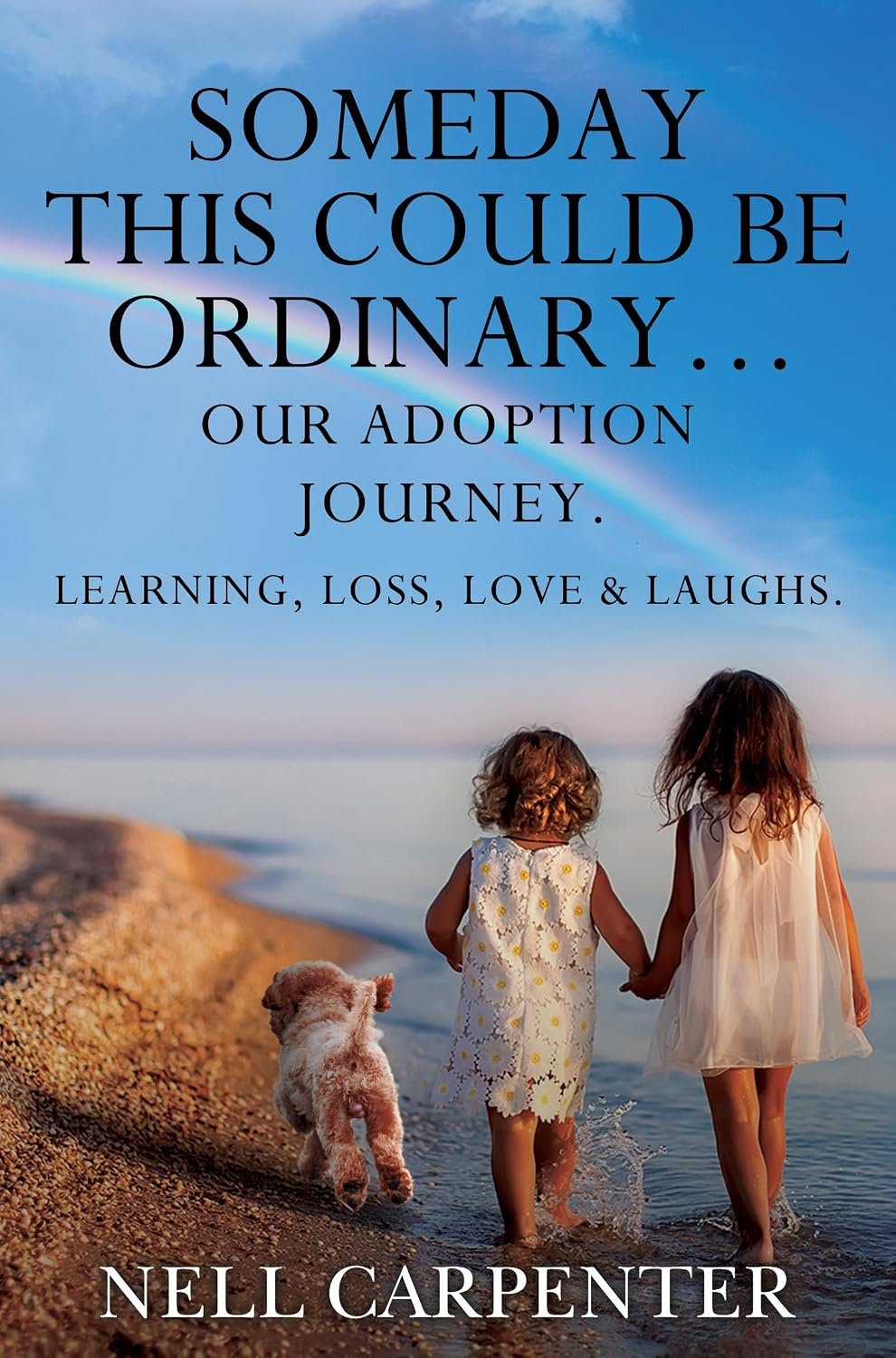
Someday this could be Ordinary…
An adoptive mother describes family formation without romanticizing the upheaval, grief, and hard-won attachments involved.
Books worth discovering. Authors worth knowing.
Nell Carpenter begins with the difficulty of becoming a family, not with a polished story of instant belonging.
S.
Becoming a Family Is Not a Single Moment
Nell Carpenter’s Someday this could be Ordinary… opens a window onto adoption without asking readers to mistake a new family photograph for the whole story. Carpenter describes welcoming two sisters, aged eight and three, whose early years had already involved disruption and distress. The emotional work of creating a shared home did not vanish when the children arrived. Instead, placement marked the beginning of a new process in which personalities, habits, anxieties and hopes needed room to coexist. Her published description stresses both the immense rewards and the difficulty of that transition.
The title holds its ambition in an ordinary word. For a family living through unfamiliar routines and strong emotions, ordinary may mean being able to wake without dread, make breakfast without conflict, or share a laugh that does not immediately become an argument. It is not a promise that every day will be easy. Carpenter’s account appears interested in the possibility of a stable home built slowly through imperfect repetition. The phrase someday allows for longing and patience, acknowledging that the desired normality cannot simply be declared into existence.
Adoption narratives are sometimes framed around the generosity of adults who offer a home. That emphasis risks obscuring what children have already experienced and the complexity of adapting to unfamiliar caregivers. Carpenter’s public remarks foreground the effort of forming attachments rather than presenting adoption as an uncomplicated act of rescue. Her candor may be important to prospective adopters and to general readers who want a more responsible account. The children at the center are not symbols of an adult’s virtue. They are people whose past experiences and present needs matter.
Two Sisters and Two Different Histories
A child of eight and a child of three may experience the same move very differently. They have different memories, developmental needs, vocabularies and expectations of the adults around them. Carpenter’s synopsis identifies the sisters’ ages and emphasizes that they came with established personalities shaped by instability. That description helps explain why a family cannot assume that two children arriving together will react as a single unit. Each relationship with a caregiver must be formed through particular interactions, not through a generic ideal of bonding.
The book’s public account does not give strangers permission to reconstruct the sisters’ private histories in detail. Discussing trauma responsibly means respecting that boundary. One can acknowledge that previous instability may influence trust, behavior and regulation without asserting precisely what each child experienced or how each responded in a particular scene. Carpenter’s strength, as described by readers and adoption-focused commentators, is in recognizing that adults also change when they are required to respond to needs they did not fully anticipate.
Sibling relationships add another dimension to the household. Two children who have relied on each other may bring patterns of comfort and conflict into a new family. An adoptive parent must learn how to support individual development while honoring bonds that predate placement. It is a complex balancing act, and the available descriptions suggest Carpenter is candid about the difficulty of merging lives rather than simply celebrating a milestone. Such honesty is valuable precisely because it refuses to make every obstacle into either a failure or a quick lesson.
Attachment Cannot Be Rushed
Carpenter names the work of forming attachments as a central part of the book. Attachment is sometimes spoken about as though it were the automatic reward for affection and good intentions. In lived family relationships, trust is more complicated. A child may need time to understand whether promises will be kept, whether an adult will return after leaving a room, and whether a disagreement threatens safety. An adult may need to unlearn expectations formed in families where the meaning of these moments was very different.
This process often involves actions so small that a broad memoir summary can barely capture them. Predictable routines, patient listening, flexibility when a plan fails and the willingness to apologize may matter more than any grand gesture. These are general implications of the book’s stated themes, not claims that a particular episode appears on a page we have not examined. Their relevance lies in explaining why ordinary family life can require such sustained effort when the people involved are still learning what security feels like together.
The author explicitly resists glamorizing her experience. That makes room for emotions that adoption publicity sometimes leaves out: exhaustion, uncertainty, disappointment, fear and the difficulty of admitting that love does not solve every problem immediately. A nuanced account can recognize those feelings without portraying children as burdens or parents as martyrs. Both sides of a new relationship are learning. Carpenter’s willingness to describe the transition as transformative rather than effortlessly happy gives prospective readers a more credible reason to engage.
Writing Honestly Without Making Trauma a Spectacle
Memoir invites readers close to experiences that do not belong to them. Adoption memoir carries particular ethical weight because it involves children who may not have chosen to make private parts of their lives public. Responsible reading means focusing on the author’s reflections while remembering that a family story has multiple perspectives. Carpenter can describe what she felt, learned and struggled to navigate. The children’s own future interpretations are theirs to develop, and a reader should not treat an adult narrative as the final authority on their interior lives.
The public description speaks of trauma, chaos and disruption, terms that carry serious meaning without authorizing imaginative reconstructions of abuse or loss. It is possible to write about those themes in a way that preserves dignity. Rather than hunt for the most distressing detail, the reader can attend to how Carpenter understands adaptation, practical caregiving and the difference between hope and certainty. That attention moves the memoir away from voyeurism and toward empathy.
An adoption-focused review in Scotland describes the book as raw and hopeful, emphasizing its refusal to reduce the process to celebration. That reading aligns with the author’s own presentation. A book can be hopeful because its writer continues to show up, not because every challenge is resolved. The possibility of belonging often appears through ordinary acts that accumulate over time. This is a quieter form of narrative momentum than a dramatic reversal, but it may be truer to the effort the memoir seeks to honor.
What Prospective Adopters Can Take Away
Someday this could be Ordinary… is likely to interest people contemplating adoption, relatives of adoptive families, and readers of candid accounts of parenthood. It can help broaden the conversation beyond placement day to the years of relational adjustment that follow. However, Carpenter’s experience remains one family’s experience. Adoption rules, support systems, trauma histories and family circumstances vary widely. No personal narrative, however moving, replaces professional preparation, appropriate support or the perspectives of adoptees themselves.
Its practical value may lie in expectations rather than instructions. A reader may finish with a clearer sense that affection and resilience do not eliminate the need for patience, specialist advice or help from trusted people. Those are observations consistent with the book’s stated concerns, not a standardized intervention the memoir is advertised as teaching. Readers can also notice the adults’ capacity to change. Carpenter speaks about being transformed as a person, acknowledging that adoption alters caregivers’ identities as well as household arrangements.
The author has discussed the book and her family’s journey in a public adoption-focused podcast, reinforcing the memoir’s place within a community conversation rather than a solitary confession. That context matters because support networks can counter the isolation that parents feel when their experiences fail to match an idealized script. A personal story becomes useful when it encourages more honest listening between families, adoptees, professionals and those considering similar paths, without claiming that one account captures every truth.
The Quiet Meaning of Ordinary
The title’s final ellipsis leaves its hope unfinished. It suggests a future that is imaginable but not guaranteed on a schedule. Ordinary family life may be something achieved in fragments: a child asking for help, a conflict repaired, a routine shared without alarm. Carpenter’s public account values the magic of forming attachments while refusing to pretend the work is easy. That combination gives the book a particular emotional texture. Joy becomes more meaningful because it is presented alongside fatigue and difficulty, not in place of them.
Ultimately, Someday this could be Ordinary… locates hope in persistence rather than perfection. It recognizes children with their own histories, an adult learning alongside them and a household trying to discover what stable belonging can mean. Carpenter’s story, as publicly described, resists an easy ending. Its title makes the small, hard-won possibility of ordinary happiness the point: not a lack of complexity, but the growing chance that people can meet one another with enough trust to call a place home.
About the book.
A personal account of adopting two sisters, aged eight and three at placement, and learning to navigate trauma histories, relationship building and daily family life.
Sponsored book feature. Research-based original commentary from public author, publisher, retailer and bibliographic sources; not a first-hand complete-book review. A cover placeholder will be resolved by the owner’s publishing automation.
Found a book worth opening?
Books worth discovering. Authors worth knowing.
Return to the Journal →