
The Bandit Adventures: The Legend of Vacuum
A cat sees a roaring vacuum as a monster and discovers that everyday helping can be its own heroic adventure.
Books worth discovering. Authors worth knowing.
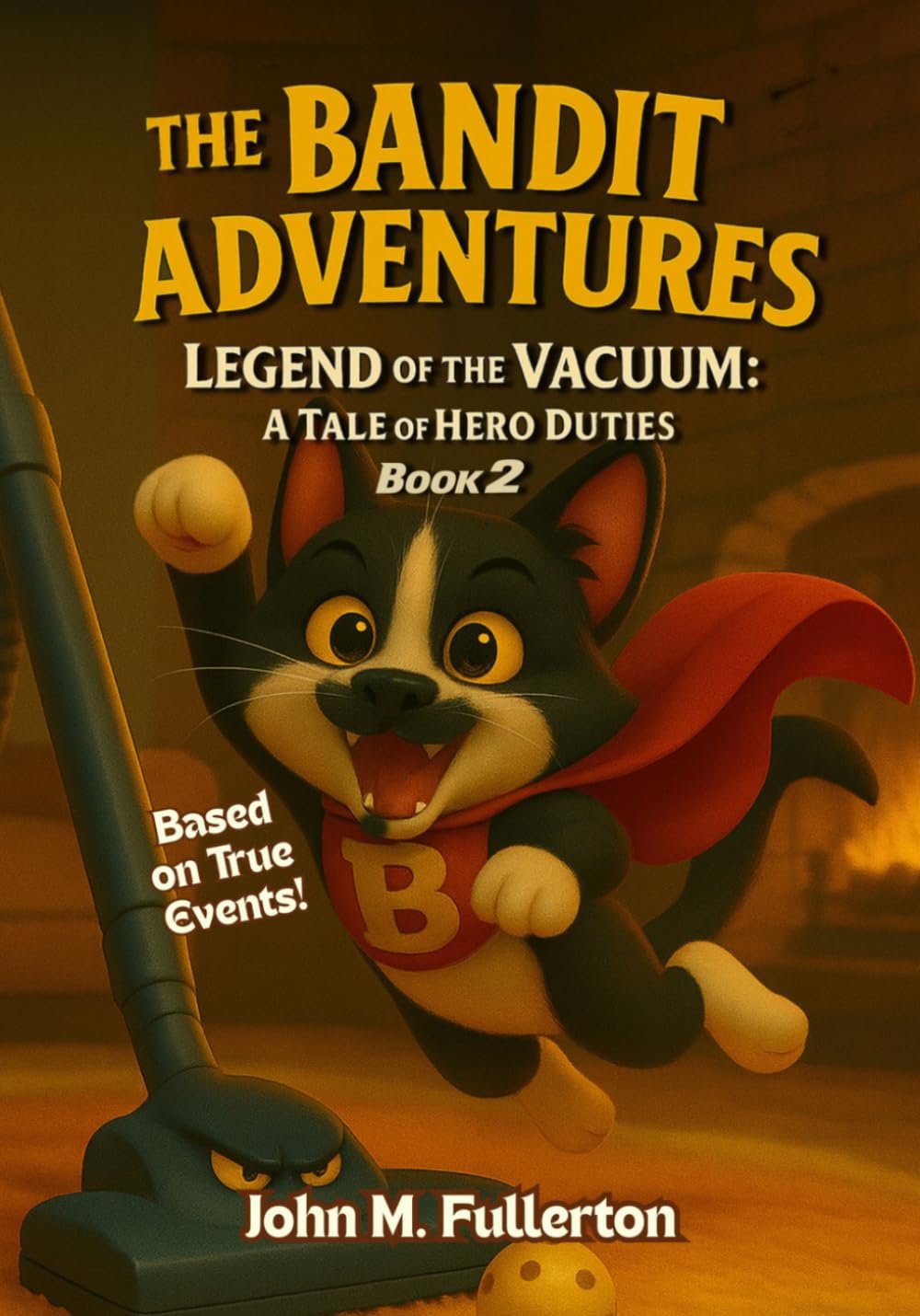
For Bandit, the vacuum cleaner is less an appliance than a rumbling monster that must be faced.
S.
A Monster in the Living Room
For the cat at the center of John M. Fullerton’s The Bandit Adventures: The Legend of Vacuum, the most frightening creature in the house has no claws, teeth or eyes. It growls, moves across the floor and seems to swallow anything that gets in its path. Adult readers know the menace as an ordinary vacuum cleaner. Bandit does not share that perspective. The published synopsis presents his alarm with playful exaggeration, transforming an everyday chore into the kind of confrontation that might demand a hero’s courage.
That difference between a familiar object and a child’s or animal’s interpretation gives the story much of its comic promise. Preschool readers may know how an appliance sounds without knowing why a pet reacts to it. Watching Bandit regard the vacuum as an enemy offers a friendly way to explore fear. The book does not require a dangerous quest or distant kingdom to create adventure. It recognizes that a small house can contain enormous challenges when those challenges are seen from a different height and with different expectations.
The installment is part of Fullerton’s Bandit Adventures and is described for young children, particularly families who enjoy cat stories. Its subtitle, A Tale of Hero Duties, indicates that the mystery is not simply whether the cat can withstand the noisy machine. The story also asks what being useful means. A household task becomes a test of participation, and Bandit discovers that a heroic act may involve helping with something unglamorous rather than winning a spectacular battle.
Why Bandit’s Fear Makes Sense
The vacuum’s sound supplies an obvious source of suspense. To an adult, the motor is evidence that a familiar appliance is working. To a nervous pet, the same sound may be an alarming interruption. Children often understand fear through comparisons with their own experiences: a thunderstorm, a blender, a crowded room or a sudden noise at night. Bandit’s exaggerated response offers a character through whom those feelings can be named without making a child feel personally singled out.
Humor makes this lesson less intimidating. Fullerton’s marketing describes furry chaos, big laughs and the cat’s suspicion that the appliance is a monster. That framing allows children to recognize the distance between what Bandit imagines and what the audience understands. The result is dramatic irony on a preschool scale. Readers can feel knowledgeable and reassuring, noticing something that the fictional hero has not yet worked out. They may even enjoy becoming the calm voice an adult sometimes supplies in a frightening moment.
It would be easy to dismiss an animal’s fear as silly because the actual source seems harmless to us. The more useful response is empathy. An unfamiliar noise can be frightening even when someone else knows it is safe. The story’s premise offers a comfortable way to practice that recognition. Parents and educators can ask what Bandit might be hearing, what he thinks the vacuum intends, and what would help him feel secure. Those questions address emotion without requiring the book to carry a formal psychological program.
Hero Duties Are Usually Small
The subtitle’s phrase Hero Duties gives the book its practical core. Bandit would apparently prefer that somebody else handle the chore that brings him into contact with the vacuum. The reluctance is recognizable to children who find some tasks boring, difficult or uncomfortable. A hero, in this version of an adventure, is not defined by constant bravery. The character’s challenge is to participate despite an inconvenience and to discover that helping has value even when the task does not look exciting.
That is a gentler concept of heroism than the familiar model of defeating villains. Young children rarely have opportunities to rescue whole communities from danger, but they can put away a toy, carry a book, help clean a small space or comfort an anxious friend. A story about a cat facing a household appliance can make those modest contributions feel significant. It connects responsibility with belonging: everyone in a home can do something, even if what they do is small.
The difference between courage and recklessness also deserves attention. Helping with chores does not mean a young child should handle an electrical appliance or approach something dangerous without supervision. Rather, the fictional situation provides a vocabulary for talking about tasks appropriate to a child’s age and ability. Adults can emphasize that Bandit’s lesson concerns facing apprehension with support, not ignoring sensible caution. This keeps an inviting book from turning into a confusing demand that children be brave in every circumstance.
A Cat’s-Eye View of Domestic Comedy
Animal protagonists let picture books shift perspective without requiring long explanations. If the household is seen through Bandit’s eyes, furniture becomes landscape and ordinary routines become mysteries. The public synopsis identifies the vacuum as the central challenge and suggests the character has dealt with previous adventures involving the zoomies. These small domestic observations anchor the series in behavior familiar to cat-loving families. Readers can compare the fictional reaction with pets they have seen hide, stalk or flee when cleaning begins.
The design of a book for ages three to six matters here. A short narrative with a clear problem can support read-aloud pauses, laughter and repetition. The available bibliographic records identify the work as a short, picture-oriented children’s book; the precise artwork and page-by-page presentation were not independently reviewed for this feature. Even without claiming knowledge of every illustration, one can see why the premise is well suited to visual storytelling: a tiny hero and a loud object offer an immediate contrast in scale, sound and confidence.
Courage Without the Pressure of Perfection
The story’s advertised combination of fear and helping suggests a lesson more flexible than simply telling children to stop being afraid. Real courage often begins with acknowledging discomfort. Bandit is interesting precisely because the frightening object remains ordinary to everyone else. The animal’s sense of threat creates an opportunity to practice perspective-taking: something can be manageable for one person and genuinely upsetting for another. A child who sees that difference may become more patient with a frightened sibling, classmate or pet.
Helping around the house can likewise become a shared activity rather than a test of worth. Children participate more readily when their contributions are noticed and when expectations are concrete. The book’s idea of a hero duty gives adults a playful phrase for such moments. Instead of telling a preschooler that sweeping up is tedious, a family might celebrate putting a toy away as a mission accomplished. That adaptation comes from the story’s theme, not from a particular instruction the author promises.
A humorous picture book can carry these conversations without weighing them down. Its first obligation is to entertain and keep a young reader connected to the character. If Bandit’s predicament sparks delight, the additional lesson about doing one’s part may emerge naturally. The comic distance between the fierce imaginary monster and the actual appliance helps keep the moral in proportion. Children can laugh at a ridiculous situation while also recognizing that small acts of cooperation sometimes require their own kind of resolve.
Reading the Adventure Together
The Bandit Adventures: The Legend of Vacuum will be especially appealing to cat owners, preschool classrooms and families whose young listeners enjoy stories built from familiar household events. Its stated age focus is early childhood, so older readers may find its principal pleasure in sharing it aloud rather than reading it for themselves. That is an asset for a picture book whose premise depends on understanding what a frightened animal cannot. Shared laughter is part of the experience the story is designed to invite.
A short conversation after reading could begin with simple observations. What does Bandit believe is happening? What does the grown-up reader know? Which noises at home feel surprising, and how can a family respond safely? These questions build emotional vocabulary while respecting the limits of the source description. The book’s public accounts promise fun, help and courage; they do not provide a fully verified scene-by-scene account, and no imagined ending needs to be supplied here.
Fullerton takes a tiny domestic conflict and gives it the scale of an adventure. The result, as advertised, is a cheerful invitation to treat helping as a kind of heroism and fear as something a character can work through. Bandit’s vacuum may never seem as intimidating to adult readers as it does to him. That is precisely the point. Seen through small eyes, ordinary life contains challenges large enough to make courage meaningful, and a home is full of opportunities to discover it together.
About the book.
A playful picture-book adventure for young children follows cat hero Bandit confronting a loud vacuum and learning why small household contributions matter.
Editorial book feature, not paid sponsorship. Research-based original commentary from public author, publisher, retailer and bibliographic sources; not a first-hand complete-book review. A cover placeholder will be resolved by the owner’s publishing automation.
Found a book worth opening?
Books worth discovering. Authors worth knowing.
Return to the Journal →